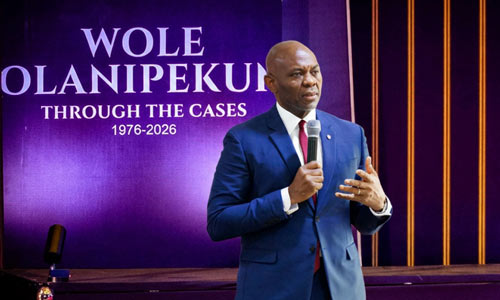
Chairman of Heirs Holdings, Tony Elumelu, has called for urgent reforms in Nigeria’s justice system, warning that investors will continue to withdraw their capital from economies where contracts are not protected, judicial decisions are delayed and the rule of law is not consistently upheld.
Elumelu maintained that a transparent, efficient and impartial judicial system was essential to attracting and retaining investments, stressing that economic transformation could not be achieved without strong institutions capable of protecting businesses and enforcing agreements.
The businessman made the remarks on Thursday, November 19, 2026, while delivering a keynote address at the WOC Justice Summit in Abuja, where he spoke on the theme, “The Rule of Law as a Catalyst for Private Sector Growth and Economic Transformation.”
According to him, investors require more than attractive tax incentives and infrastructure before committing resources to a country, as confidence in the legal system remains a fundamental consideration in investment decisions.
Elumelu explained that, from an entrepreneur’s perspective, the rule of law means that contracts must remain binding, regulations must apply equally to competing businesses, and changes in government must not undermine existing agreements.
He warned that uncertainty in any of these areas could discourage investors and trigger the withdrawal of capital.
“Where any of them is in doubt, capital doesn’t argue. It leaves,” he declared.
Reiterating his position on the relationship between investment and legal certainty, Elumelu said businesses naturally gravitate towards environments where their investments are protected and their rights respected.
“I have said it in New York, London, Paris and I’ll say it in Abuja: capital goes where it’s safe and stays where it’s respected,” he stated.
He maintained that the ability of courts to deliver fair, impartial and timely judgments was an essential condition for economic growth, noting that judicial reliability often influenced investors’ decisions even before considerations such as infrastructure and tax incentives.
Elumelu explained that businesses needed confidence that commercial agreements would be enforced and that disputes would be resolved fairly, regardless of the parties involved.
According to him, weak enforcement of contracts and prolonged legal uncertainty could undermine investor confidence and discourage both domestic and foreign investment.
Drawing from his experience in banking, power, oil and gas, the businessman said his investment decisions in Nigeria had been influenced partly by his confidence that the country’s courts would protect legitimate commercial transactions.
He nevertheless expressed concern over delays in the administration of justice, warning that prolonged litigation could create uncertainty for businesses and weaken confidence in the legal system.
Elumelu consequently urged the Federal Government and members of the legal profession to pursue reforms aimed at making the administration of justice more efficient, predictable and responsive to commercial realities.
He specifically called for the integration of technology into judicial processes to improve case management, reduce delays and strengthen the resolution of disputes.
The Heirs Holdings chairman also advocated the introduction of key performance indicators for case management and settlement, arguing that measurable standards would help assess the efficiency of the justice system.
He maintained that judicial reforms should go beyond policy declarations and produce practical improvements in the speed and effectiveness of dispute resolution.
According to him, a justice system capable of delivering timely and impartial decisions would strengthen investors’ confidence and encourage greater private sector participation in Nigeria’s economy.
Elumelu also addressed the Federal Government’s ongoing economic reforms, commending President Bola Tinubu for removing the petrol subsidy, unifying the foreign exchange market and signing tax reform laws.
He described the decisions as necessary measures aimed at correcting longstanding distortions in the Nigerian economy.
According to him, the Tinubu administration inherited an economy affected by multiple exchange rates, an expensive fuel subsidy arrangement and a tax system that placed disproportionate burdens on compliant taxpayers.
He argued that addressing those structural problems was necessary to establish a more sustainable foundation for economic development.
However, Elumelu acknowledged that the reforms had imposed considerable hardship on ordinary Nigerians.
“I know the cost has been borne by ordinary Nigerians, and I know you know it too. But I also know, as an entrepreneur, that an economy cannot be rebuilt on a foundation of unreality, and you ended that unreality,” he said.
The businessman maintained that despite the difficulties associated with the reforms, addressing the underlying economic distortions was important for Nigeria’s long-term development.
He urged President Tinubu to sustain the reform programme while paying particular attention to the electricity sector, which he identified as critical to private sector growth.
“Keep the focus on power,” Elumelu advised.
According to him, reliable electricity would improve the operating environment for businesses, reduce obstacles to investment and strengthen the capacity of enterprises to expand their activities.
He explained that improvements in power supply would make businesses more attractive to investors and support broader economic transformation.
Elumelu’s comments placed the justice system and electricity supply among the conditions he considered essential for strengthening the investment climate.
He maintained that economic reforms would be more effective where they were supported by reliable institutions, clear regulations and a legal system that treated businesses fairly.
Beyond Nigeria, the businessman also called for a change in Africa’s approach to international trade and economic development.
He argued that African countries should move beyond dependence on the export of raw materials and concentrate on creating value within their economies.
According to him, Africa must strengthen its productive capacity and position itself as an equal participant in global trade rather than remain primarily a supplier of unprocessed resources.
He maintained that greater local value creation would support economic transformation and enable African businesses to play a stronger role in international markets.
Elumelu further emphasised that the private sector could not independently deliver sustainable economic development without the support of strong legal and regulatory institutions.
He argued that businesses depended on the protection provided by the law to invest, expand and contribute meaningfully to economic growth.
“No private sector can do it alone. It can only do it under the law. Justice and prosperity are inseparable,” he declared.
The post “Capital Goes Where It’s Safe And Stays Where It’s Respected” — Tony Elumelu Warns Weak Rule Of Law Drives Investors Away, Demands Judicial Reforms appeared first on TheNigeriaLawyer.