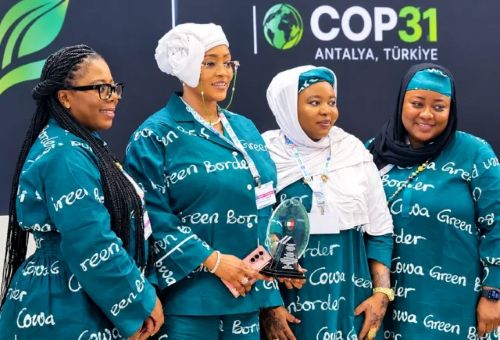
The Customs Officers’ Wives Association (COWA) has planted 14,882 economic trees and empowered more than 8,000 people in communities along Nigeria’s borders in one year, as it seeks ₦402m to expand its climate resilience programme.
The association also announced plans to partner with the Office of the President’s Special Assistant on Climate Change Matters to organise a major gathering of environmental activists and green workers in Abuja on December 5, 2026, in an event expected to attract Guinness World Records recognition.
National President of COWA, Kikelomo Adeniyi, disclosed this on Monday at a side event organised by the association at the ongoing COP31 climate conference in Antalya, Türkiye.
Adeniyi said the association returned to the United Nations climate conference with evidence of its commitments made at COP30 in Belém, Brazil, last year, particularly in tree planting, women’s economic empowerment and climate education for children.
She said: “Last year, when we came to Belém, Brazil, we made so many promises that we were going to plant trees, empower women in green areas and sensitise our children on climate change. We have achieved all of these and more.
“Here in Antalya, Turkey, we have come to show evidence of all these things that we have achieved. So far, we have planted over 14,800 economic trees.
“These are trees that will be beneficial to our women in the near future. They will harvest them, take them to the market and sell them to make money.”
She explained that the initiative focused on economic trees to ensure that environmental conservation also created sustainable income opportunities for women in border communities.
Beyond tree planting, Adeniyi said COWA had trained women in recycling, farming and other green economic activities, while introducing solar energy solutions to help communities maximise available resources.
She disclosed that the association had mobilised 682 Green Ambassadors, reached 6,093 beneficiaries through its community education programme and provided health outreaches to 4,041 people. Another 1,138 people had received skills acquisition support.
According to her, the interventions had reached more than 8,000 people in border communities, including Seme, Idiroko and Illela.
Adeniyi said the empowerment programme was also designed to address economic challenges in border communities, which could push residents, particularly young people, into smuggling and other illegal activities.
She said: “The plan is to empower them because we believe that in the border areas, when people do not have something legal to do, they will go into illicit business, and that is where smuggling comes in.
“The children will begin to go into smuggling, and the mothers will encourage them to do so.
“We are giving them jobs and creating opportunities for the children and their mothers so that they can have something sustainable to do instead of going into illicit businesses.”
The COWA president, however, appealed for additional financial support to expand the initiative, disclosing that the association was seeking about ₦402m to complete its innovation centre in Abuja.
She said COWA had already invested approximately ₦415m in the project, which is expected to serve as a national centre for training, research and the development of green skills, including solar installation.
Adeniyi said: “We have started already. It is already at the finishing level. Now, we are seeking over N400m just to bring it to completion.
“This is a place where people will come for training and research, and women will have a space where they can learn even how to fix solar systems.
“We want to have a place where everybody can come from the North, South, East and West as a hub for COWA.”
She called on development partners and investors to support the project and the association’s proposed expansion across Nigeria’s geopolitical zones.
Speaking at a panel session during the event, Director-General of the National Environmental Standards and Regulations Enforcement Agency (NESREA), Innocent Barikor, commended COWA for extending its environmental interventions to border communities, which he said were frequently overlooked.
Barikor said NESREA was ready to support the association with environmental governance advice, technical guidance and monitoring to ensure that its projects delivered measurable and sustainable results.
He stressed that the success of the tree-planting programme should be determined by the number of trees that survived rather than the number of seedlings planted.
The NESREA director-general also warned against planting unsuitable or invasive tree species, urging COWA to select varieties appropriate for their locations to avoid threatening existing vegetation.
Also speaking, the Special Assistant to the President on Climate Change Matters, Yussuf Kelani, described the association’s intervention as an important contribution to climate prevention and community resilience.
Kelani noted that security agencies, including the military and paramilitary organisations, were traditionally called upon to respond to environmental disasters after they occurred.
He said: “Whenever we have climate crises around the world, we have the paramilitaries and the military coming in whenever there is a bush fire, extreme weather conditions or storms in different communities.
“We call on the military to salvage the situation.
“But now, the fact that we are preaching that there is no way forward without prevention, that we must participate in prevention, and the Customs Officers’ Wives Association has come up with this initiative, where they are actually participating in prevention, is a very good one.”