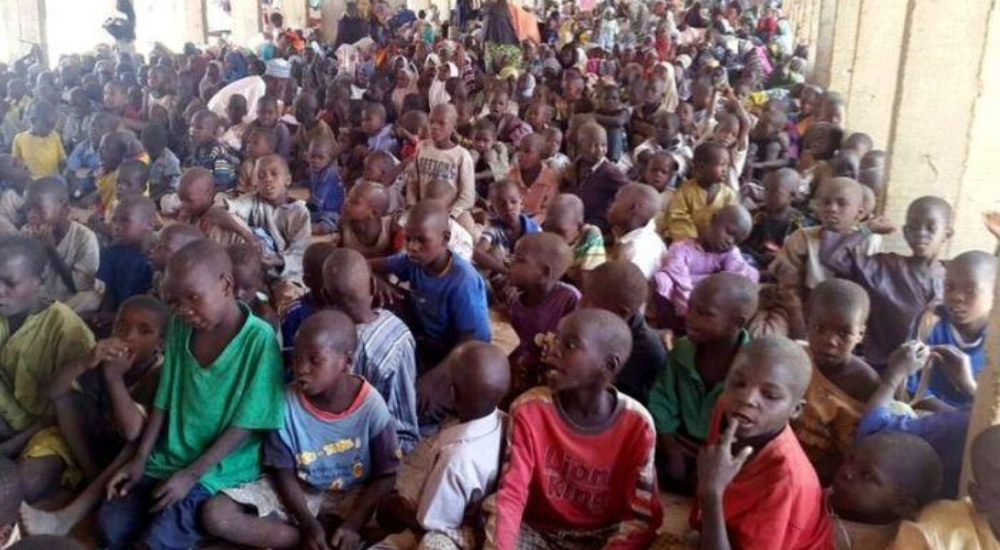
The State Commissioner for Education, Associate Professor Aishatu Umar Maigari, disclosed this on Thursday while responding to questions from a delegation of the Nigerian Guild of Investigative Journalists (NGIJ), currently in the state on a Governance Assessment Visit.
Speaking at her office, Maigari said the administration of Governor Muhammadu Inuwa Yahaya was working closely with local government authorities to identify children roaming the streets and facilitate their return to school.
She disclosed that the government had set a target of enrolling 10,000 out-of-school children in each local government area as part of a broader strategy to address the challenge and expand access to basic education across the state.
According to her, the government has also adopted an inclusive educational approach by integrating the Tsangaya (Almajiri) and non-formal education systems into the broader educational framework.
The university teacher explained that the initiative was designed to accommodate children outside the conventional school system, particularly those undergoing traditional Islamic education, while providing them with opportunities to acquire foundational knowledge and skills.
The Commissioner noted that the out-of-school children challenge in Gombe was also influenced by developments in other North-East states, making coordinated interventions necessary to address the problem.
On funding, Maigari said the state government had consistently allocated an average of 18 per cent of its annual budget to the education sector, demonstrating its commitment to expanding access and improving the quality of education.
She commended Governor Inuwa Yahaya for consistently releasing counterpart funds required to access Universal Basic Education Commission (UBEC) grants, which she said had supported infrastructure development, provision of learning facilities and the introduction of digital technology in schools.
The Commissioner further disclosed that the administration had constructed five mega colleges, each with a capacity of 5,000 students, strategically distributed across the state’s three senatorial districts.
On technical and vocational education, she said the state had established 19 Technical and Vocational Education and Training (TVET) centres to equip young people with practical skills, promote self-reliance and improve their employment opportunities.
Maigari revealed that about 1,500 applicants had so far been selected from the 10,000 applicants seeking admission into the centres, adding that the governor had requested additional admission opportunities from the Federal Ministry of Education to accommodate more candidates.
The NGIJ Governance Assessment Visit is aimed at examining government policies, programmes, institutional performance and service delivery across critical sectors, including education, healthcare, security, infrastructure and economic development.
The education sector assessment will, among other things, provide an opportunity to examine the effectiveness of interventions aimed at reducing the number of out-of-school children, the sustainability of enrolment strategies and the extent to which increased budgetary allocations are translating into improved access to quality education.
