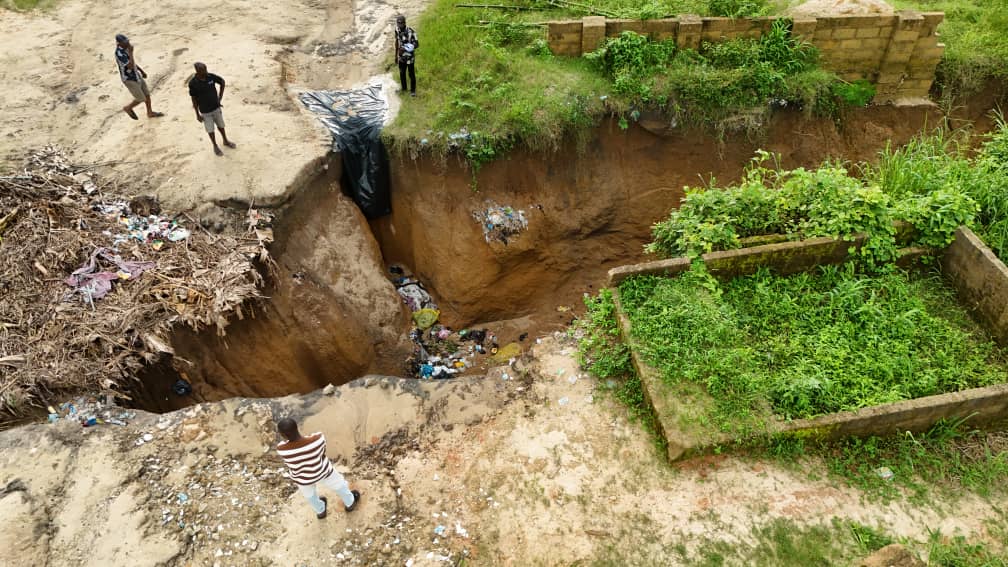
Residents say drainage works of Governor Umo Eno’s flagship agricultural project have worsened flooding, destroyed a community-maintained road and cut families off from their homes, while government records reviewed by PREMIUM TIMES raise questions about procurement, environmental assessment and contract transparency.
When Governor Umo Eno stood before dignitaries on 29 April to commission Akwa Ibom State’s new agricultural equipment leasing facility at Ekpri Nsukara in Uyo, the state capital, the project was presented as a symbol of the administration’s ambition to transform farming.
The facility, built on the grounds of the long-abandoned Akwa Ibom State Agriculture Development Programme (AKADEP) Farm, was intended to put modern agricultural machinery within the reach of farmers and help drive food production under the agricultural component of the administration’s ARISE Agenda.
But a few metres away from the gleaming facility, another story was unfolding.
A community road known as Ekpri Nsukara/ Ikot Okoidio, painstakingly maintained by residents, had become a muddy, waterlogged passage. Sections of the road had been washed away. Some families had become cut off, with no vehicular access to their homes.
When it rains, residents say they wait for hours before floodwater recedes for them to leave their homes. The bad road has caused some residents to abandon their cars. Many trek to the main road to board public transport.
For some parents, rain has become a reason to keep children at home. And for residents who had initially welcomed the government’s arrival, the irony is painful since the project they believed would bring development to their neighbourhood has, according to them, made an existing environmental problem worse.
PREMIUM TIMES visited the area in late July and again on 2 September. The condition of the road had deteriorated further during the period.
The newspaper also found incomplete sections of the drainage system, new drains destroyed by floodwaters, an unconnected existing drain and sections of the outfall drainage that had not been backfilled.
Our investigation also raises questions about how the drainage contractor was selected, whether the work was subjected to the environmental safeguards required by law, and whether the state government adequately disclosed procurement information for a project involving billions of naira in public funds.
Residents said the large expanse of uncultivated farmland also served an environmental function of absorbing some of the water moving through the area.
According to the community, that changed in August 2024 when the state government notified them of its intent to develop the site. Construction began in 2025 leading to the fencing of the facility as work progressed.
The 2025 revised budget provided N160 million jointly for the renovation of the mechanic workshop at the facility and the procurement of safety gear and work outfits.
The 2026 approved budget went much further with a N1.5 billion appropriated for the “Construction of Equipment Leasing Yard at Ekpri Nsukara-Uyo,” under the Ministry of Agriculture. The project was eventually commissioned by Mr Eno on 29 April.
During an earlier inspection of the facility in February, Mr Eno publicly praised the work. “I am so proud of what this young female engineer has done. She has done very well, and I am told by Hensek that this is the best concrete road in this state,” the governor said, according to reports of the inspection.
At the commissioning, reports identified the engineer as Alorye Ewa, managing director of Hansie Building Services Limited, and described her as the project engineer.
Mr Eno said Ms Ewa was selected through the ARISE Procurement Portal based on her perceived competence. That assertion is now one of the questions at the centre of the project.
The flooding problem in the community was not new. Inyang Victor, a public servant who said he had lived in the area for 11 years, told PREMIUM TIMES that residents had spent years managing the water problem themselves.
“We have tried in many ways to make this place habitable,” he said.
According to Mr Victor, residents contributed money to buy laterite, construct makeshift drainage channels and undertake other remedial work.
Earlier this year, he said, residents bought laterite, used cement bags to reinforce vulnerable portions and channelled water away from the road. “The road was manageable although we still needed intervention,” he said.
The Akwa Ibom State Government later initiated a drainage and road project for the community. Residents had expected the new project to solve their problem.
Mr Victor said workers eventually constructed drains from the main road towards the community but stopped before completing the system.
“To encourage the workers, the community was very supportive. Personally, I bought the workers bags of water many times,” he said.
He said many of the labourers were women who carried construction materials manually. But, according to him, the workers disappeared around the time of the commissioning of the equipment leasing facility.
“The day before the Ibom Leasing Company project was commissioned by the governor, all the workers left. We thought perhaps they wanted to attend the event and they would return but they never did.”
Since then, residents say the consequences have become severe, destroying the road they had.
Okon Williams, the caretaker of the street, said he had spent more than N800,000 of his personal funds constructing and maintaining a drainage system before the government project.
He believes the new drainage system has failed to properly channel the volume of water because it was poorly done.
“The flood water no longer pass through the drains, it now moves into the streets and houses. It has destroyed the roads,” Mr Williams said.
He said residents could spend three to four hours waiting for floodwater to recede after heavy rain. He said the problem was particularly troubling because the community is close to the seat of government.