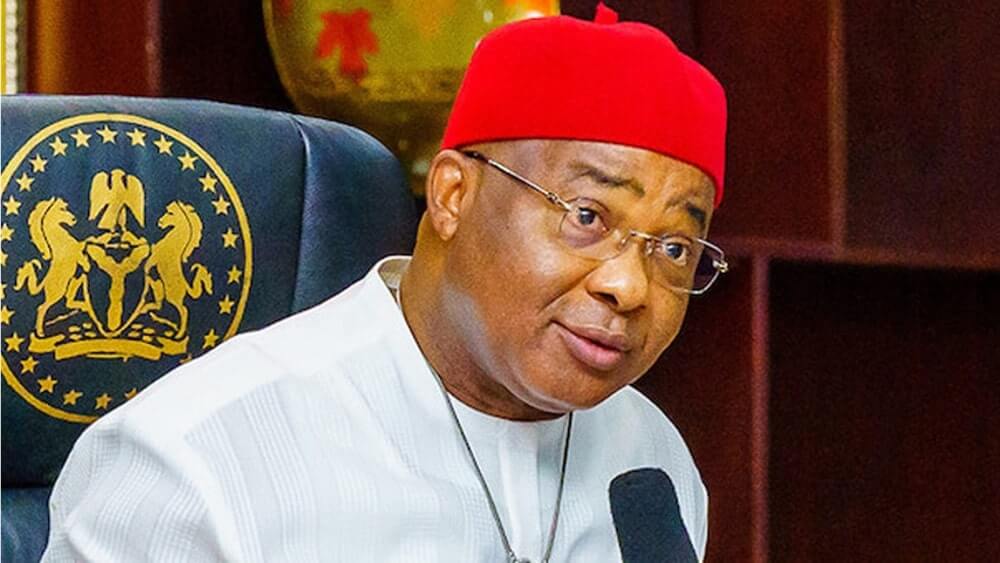
THE WHISTLER reports Uzodimma stated this on Wednesday at the ongoing World Public Relations Forum in Abuja noting that although the removal of the subsidy was necessary in the overall interest of the country, many households experienced difficulties as prices adjusted upwards.
He said, “Admittedly, that many families encountered difficulties when prices adjusted upwards.”
According to him, the removal of the subsidy was justified because much of the benefits of the previous arrangement had gone to intermediaries in the petroleum sector rather than ordinary Nigerians.
“President Bola Ahmed Tinubu, his administration had to put an end to the subsidy regime because it was the right thing to do in the overall interest of our country,” he said.
Uzodimma recalled that Nigerians from different sectors and segments of society had previously demanded the removal of the subsidy, arguing that the decision had become necessary.
He, however, acknowledged that the policy had consequences for households, stressing that governments must recognise the difficulties citizens experience when implementing major economic reforms.
The governor argued that the 36 states and the Federal Capital Territory now had more resources to invest in infrastructure and social and economic development following the removal of the subsidy.
He said the benefits of such reforms could be better appreciated when citizens understood the reasons behind government decisions and trusted that the promised benefits would eventually materialise.
Uzodimma illustrated the challenges of implementing policies with a hypothetical example of the introduction of modern public buses on major routes in Owerri, the Imo State capital.
He explained that while cheaper transport fares would benefit workers, traders and students, commercial drivers operating along the affected routes might initially lose income.
According to him, the government would have a responsibility to communicate the reasons for the intervention and help those affected understand alternative opportunities available to them.
“The same decision that helps many can hurt a few, at least for a while,” he said.
He added that some commercial drivers could adjust by operating shuttle services, offering car hire services or serving routes not covered by the government buses.
The governor maintained that responsible governance required balancing the interests of different groups while ensuring that public policies delivered benefits to the wider population.
“But as a government, our duty is to spread the goods as widely as we can, and to communicate our intentions, our purposes, and goals to those who must bear some pain along the way,” he said.
He stressed that consistent and honest communication was necessary to secure public understanding and cooperation, particularly when government decisions imposed temporary difficulties on citizens.
According to Uzodimma, governments must continue explaining their policies and objectives until the people develop confidence in their intentions.
“This is why I welcome the topic you have given me. You asked me to speak on how responsible governance builds trust through communication,” he said.
The governor also emphasised the importance of stakeholder engagement, citing the new definition of public relations adopted by the Nigerian Institute of Public Relations (NIPR) last December.
He said the definition described public relations as a strategic leadership role that builds trust, reputation and lasting relationships while driving inclusive development through ethical, transparent and culturally respectful communication.
Uzodimma said responsible governance required governments to consider every group affected by their decisions, including those who might initially oppose their policies.
Citing the stakeholder theory developed by American scholar Alfred Edward Freeman, he explained that stakeholders included individuals and groups who could affect or be affected by an organisation’s objectives.
He said the principle applied to governance because both beneficiaries of government policies and those who might lose out from their implementation deserved consideration.
The governor maintained that governors must take responsibility for communicating their administrations’ visions and policies to the people, noting that government projects and fulfilled promises were equally important in building public confidence.
He disclosed that his administration introduced a quarterly stakeholders’ forum in June 2020, less than six months after he assumed office, to enable residents to question the government and express their concerns directly.
According to him, the meetings provided opportunities for citizens to scrutinise government activities, ask difficult questions and openly criticise policies.
“Some of those meetings are uncomfortable, I must confess. But they show us where we have fallen short, and they enable us to see and attend to some problems that may snowball into something bigger,” he said.
Uzodimma said his administration subsequently expanded the engagement through a radio town hall programme, which allows more than 20 radio stations across the South-East to broadcast discussions simultaneously.
He explained that the programme provides opportunities for residents, journalists, diaspora groups and other stakeholders to ask questions, seek clarification and receive responses from government officials.