Muslim Captives Fed Better, Rarely Beaten
RIJANA CHRONICLES
By Luka Binniyat
(KADUNA) – They think the world will never hear their voices. Unknown to the West, unremarked by Nigerian media or official spokesmen, they suffer in silence in dozens of forest gulags in Northcentral Nigeria.
Ester Thaddeus, 30, a Christian wife and mother was among them for 90 days. When she got released on Oct. 10 and met a relief team from Equipping the Persecuted (ETP) she felt “heard” for the first time in eight years.
Thadeus thought the world had forgotten about her and her family until she got rehabilitation and bills paid by Equipping The Persecuted (ETP), founded by Judd Saul.
Thaddeus, was kidnapped by the same Fulani Ethnic Militia (FEM) from whom other villagers had been hiding in the bushes in Unguwan Aku, Kufana Ward, Kajuru County, Southern Kaduna.
Thaddeus had survived several horrific attacks on her village, including an attack in July 2019 in which FEM reportedly killed 21 Christians and looted Unguwan Aku before razing most of the village’s approximately 120 homes, as reported by The Punch.
Betrayed by an Informant
“My village has been attacked several times and each time, people were killed, crops and livestock stolen,” she said.
“They have now stopped the killings since 2024. They are now kidnapping and asking for ransom,” she added.
A report by TruthNigeria has suggested that terrorist kidnap kingpins could earn an average of $1.4 million annually from kidnapping.
Thaddeus explained that when villagers get warned of approaching band-terrorists, they routinely abandon their homes by 6 p.m. and seek refuge in surrounding bushes and hills, fearing attacks by kidnappers they identify as Fulani militia. They return home the following morning.
But on July 10, 2026, apparently acting on information from an informant within the community, five armed terrorists surprised them at about 11 p.m. and abducted several women and four children aged between two and seven. Thaddeus was among them.
Her husband was elsewhere with other men, as men and women slept in separate hiding locations.
“I had been married for just a month,” she recalled.
Arrival at the Terrorists’ Camp
After several exhausting hours on foot, the abductees arrived at a forest camp.
“The camp was not far from a river, and there were many trees and huts there,” she said.
“I saw men and women chained to trees, and there were little children lying on leaves spread on the wet grounds.”
A tall, lanky man emerged from a hut. The kidnappers informed him in Hausa that they had brought only women and children.
“He said that our cowardly men could not be found,” she recalled.
The man, who introduced himself as “Sanda,” ordered the captives to sit down and welcomed them to his camp.
No Christian Prayers Allowed
Sanda assured the women that none of them would be raped, irrespective of whether they were Muslims or Christians.
He then asked if any of them were Muslims. They replied that they were all Christians.
“Ok, no Christian is allowed to pray here. There shall be no Christian songs or preaching of any kind,” he warned.
By sunrise, about six armed men arrived. The original kidnappers departed, leaving the captives under the supervision of the new guards.
Thaddeus said the hostages were chained in separate sections, with Muslim men and women on one side and Christian captives on another.
She estimated that about 100 people were held in the camp, with considerably more Christians than Muslims.
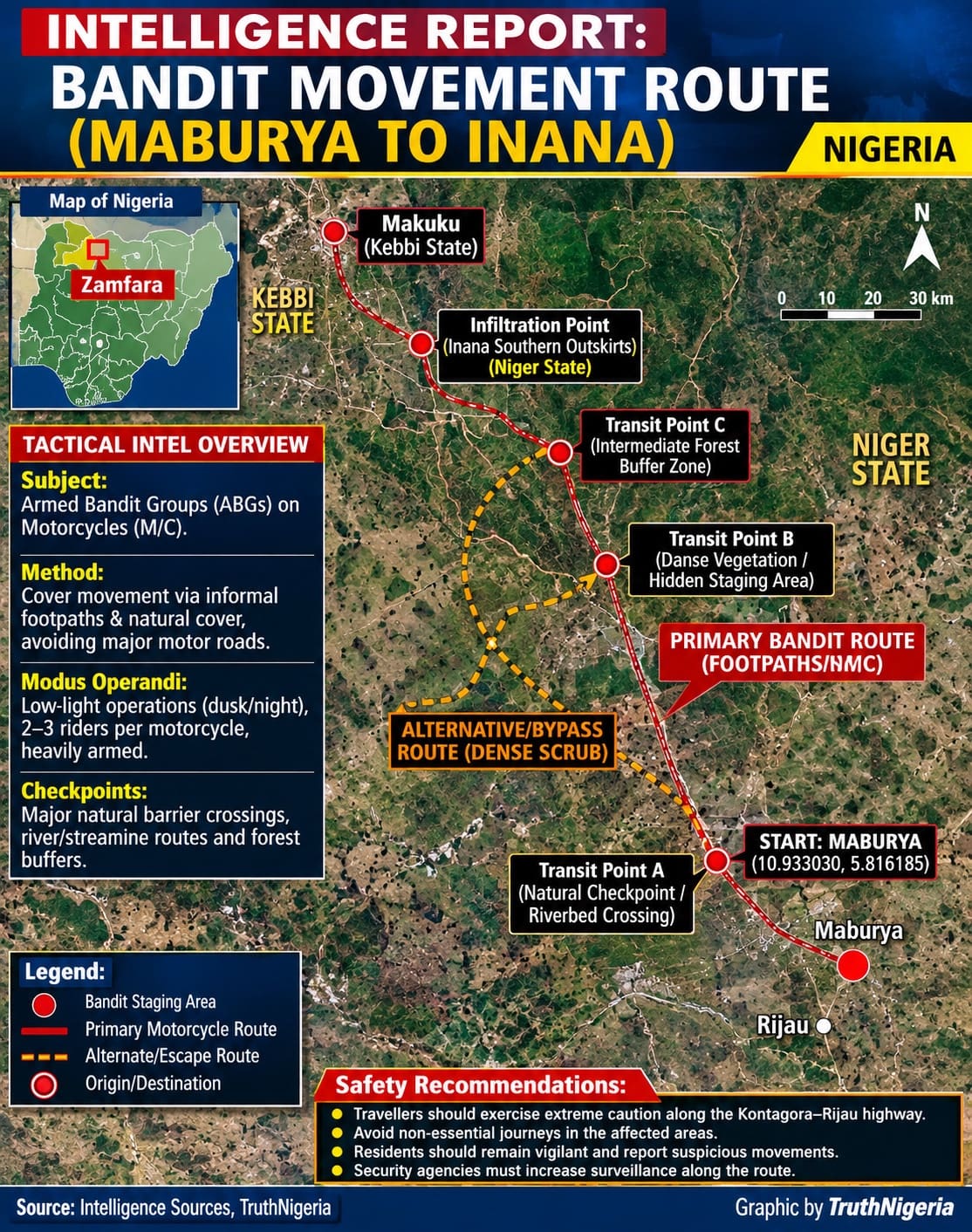
Thaddeus said the camp was somewhere around Rijana, explaining that the terrorists frequently travelled to Rijana and returned shortly afterwards with provisions.
Unequal Treatment of Muslims and Christians
Nigerian government spokesmen routinely deny that criminals treat Muslims and Christian victims with equal ferocity. “We do have sporadic attacks on some villages by bandits and terrorists and the attacks are religiously insensitive. Christians, Muslims, churches and mosques are attacked randomly,” Tinubu’s aide, Bayo Onanuga, posted on X in 2025.
That’s a big lie, according to Thaddeus. The distinction between Muslim and Christian captives was unmistakable, particularly in feeding, religious freedom and punishment.
“They fed us Christians small portions of food that could barely fill my palm, we were fed only every three days. But the Muslims got bigger rations,” she said.
The terrorists prepared sumptuous meals for themselves and occasionally gave children of captives small portions.
Muslim hostages were allowed to come out of their shackles to perform ablution and observe their five daily prayers. Christian captives, however, were forbidden from praying, singing Christian songs or engaging in any form of Christian worship. The disparity extended to physical punishment.
Thaddeus alleged that Christian hostages were routinely beaten when ransom negotiations with their families failed to satisfy the terrorists.
After telephone conversations with relatives, she said, the guards sometimes beat Christian captives savagely if they were dissatisfied with the discussions.
Conversely, Muslim captives were rarely beaten.
Thaddeus said the kidnappers sometimes stayed away for a week, returning with fresh captives. Ransoms arrived daily in sacks and bags, sometimes accompanied by motorcycles, drugs and sachets of alcohol.
The money was counted in Sanda’s presence before being paid out to the guards and kidnappers.
Sanda answered to a superior authority, she said, citing armed men who arrived every two days on three motorcycles, collected money in cleaner bags and departing after brief, seemingly formal exchanges with him.
The hostages were released on October 10, 2026 after the community raised ₦24 million ($18,000) as ransom.
Hundreds others remain unrescued, according to TruthNigeria sources.
Luka Binniyat writes for TruthNigeria on conflict and politics from Kaduna.