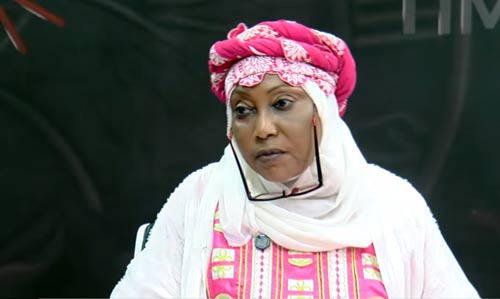
A chieftain of the African Democratic Congress (ADC), Hajia Naja’atu Muhammad, has strongly criticised the Federal High Court judgment affecting the party’s leadership and former Vice President Atiku Abubakar’s presidential ambition, accusing the ruling All Progressives Congress (APC) of attempting to weaken opposition parties through the judiciary ahead of the 2027 general elections.
Muhammad, a member of the party’s presidential campaign council, maintained that the judgment contradicted an earlier court decision recognising the leadership of Senator David Mark and questioned the circumstances surrounding the ruling delivered on November 5, 2026.
Speaking during a television interview, she also warned that attempts to prevent Atiku from participating in the 2027 presidential election could provoke serious public resistance, drawing comparisons with the political crisis that followed the annulment of the June 12, 1993 presidential election.
The former APC campaign figure, who left the ruling party in 2023, alleged that the government was uncomfortable with the growing popularity of the ADC and was attempting to undermine its political prospects.
She maintained that the opposition party would continue its political activities despite the legal challenges confronting its leadership.
Asked whether the Federal High Court judgment could derail Atiku’s presidential ambition, Muhammad argued that the party’s position remained supported by earlier judicial decisions, including a Supreme Court judgment concerning judicial intervention in the internal affairs of political parties.
According to her, the Supreme Court had established that courts should generally not interfere in internal party disputes except where the issues concerned primary elections.
She recalled that Justice M. S. Liman had earlier delivered a judgment favourable to the ADC leadership recognised by her faction.
Muhammad questioned how another court of coordinate jurisdiction could subsequently deliver a decision that appeared to contradict the earlier ruling.
She maintained that courts exercising the same level of jurisdiction should not issue conflicting judgments on the same leadership dispute.
The ADC chieftain also questioned the November 5 judgment concerning Nafiu Bala Gombe, who has been involved in the dispute over the party’s leadership.
Asked whether the ADC had made sufficient efforts to resolve the disagreement politically before it became the subject of litigation, particularly following Gombe’s claim that Atiku had not reached out to him, Muhammad rejected the suggestion that the responsibility rested with her faction.
She argued that, by Gombe’s own account, his tenure had expired on October 24, 2026, before the November 5 judgment was delivered.
“That is what I’m telling you about, like one of the judges would refer to as judicial rascality,” she said.
“You have somebody whose term, on his own terms, has expired, but you are still giving him judgment.”
When the interviewer suggested that Gombe’s claim of being unlawfully displaced could mean his tenure had not validly expired, Muhammad maintained that he had already resigned and that the party’s former executive had been dissolved at a national executive meeting.
“It wasn’t as if they resigned individually,” she said, arguing that the dissolution of the executive went beyond the issue of individual resignations.
Muhammad insisted that the party remained confident in its legal position despite the judgment, which it had appealed.
Asked whether the ADC was giving supporters false confidence by encouraging continued mobilisation and insisting that Atiku and other candidates remained on the Independent National Electoral Commission’s (INEC) portal, she rejected the suggestion.
“There’s nothing like false confidence, because as far as we are concerned we are still relying on the Supreme Court judgment if we are going all the way back to the Supreme Court,” she stated.
“No matter what, I don’t expect the Supreme Court to vomit and eat its vomit.”
The ADC chieftain alleged that the APC was increasingly concerned about the opposition party’s political activities and growing public support.
According to her, the ruling party was attempting to frustrate the ADC through court proceedings and political interference.
“They are so scared, they are rattled,” she said, accusing the APC of attempting to “buy up the courts” and sponsoring individuals to pursue political interests through litigation.
Her allegations of judicial compromise and political sponsorship were not accompanied by independently established findings in the interview.
Nevertheless, Muhammad maintained that the ADC would not abandon its political activities because of the leadership dispute.
“We will keep moving,” she declared, adding: “Nigeria is not Cameroon.”
The former APC campaign figure also addressed her earlier warning that excluding Atiku from the 2027 presidential election could provoke what she described as a revolution.
Asked whether she was referring to mass protests, civil disobedience or a more serious development, Muhammad replied that she envisaged “something much more serious”.
She drew parallels between the current political situation and the events surrounding the annulled June 12, 1993 presidential election, which was widely associated with the late Chief M. K. O. Abiola.
According to Muhammad, the crisis demonstrated the dangers of judicial interference, political intolerance and an electoral system lacking sufficient independence.
She recalled that Abiola enjoyed widespread support across Nigeria, including northern states.
She cited her ward in Kano, where she said Abiola defeated Bashir Tofa, the presidential candidate who opposed him in the 1993 election.
Muhammad argued that the support Abiola received in the North demonstrated that political choices were not always determined by ethnic or regional considerations.
She maintained that northern voters could support candidates from other regions when convinced of their suitability for leadership.
However, she warned against political arrangements that could be perceived as marginalising or suppressing the political choices of northern Nigerians.
She recalled that a court injunction was obtained on June 10, 1993, by a group seeking to prevent the presidential election.
According to her, the electoral commission proceeded with the June 12 election because an existing decree restricted judicial interference with the electoral process.
She said another judicial intervention subsequently affected the counting of election results, contributing to widespread unrest.
Muhammad recalled that protests followed the annulment, particularly in parts of the North and South-West, including Kano, and that public pressure eventually contributed to the decision of the then military president, General Ibrahim Babangida, to step aside.
She argued that the circumstances demonstrated how interference with democratic processes could produce consequences extending beyond the immediate political dispute.
Describing what she considered the recurring threats to Nigeria’s democracy, Muhammad identified the judiciary, political elites and the electoral commission as three institutions or groups whose conduct could undermine the electoral system.
“It’s a Bermuda triangle that will always truncate democracy in Nigeria,” she stated.
She accused some judicial officers of compromising their independence, alleging that they had placed themselves “on the shelves for the highest bidder”.
Muhammad also criticised political elites who treated electoral competition as a do-or-die affair and accused them of losing sight of their responsibilities to the electorate.
The third element, according to her, was an electoral commission whose independence could not always be guaranteed.
“That is what happened on June 12, and that is exactly what is happening today,” she alleged.
Asked whether her criticism of irresponsible politicians also applied to members of the ADC, Muhammad said she did not presently consider politicians in her party to fall into that category, although she acknowledged that their conduct could change if they attained power.
She maintained that the ruling political class had become disconnected from the hardship and insecurity facing ordinary Nigerians.
The ADC chieftain rejected concerns that her warnings could heighten political tension, arguing that widespread insecurity and economic difficulties had already created serious frustration among citizens.
According to her, public dissatisfaction was sufficiently widespread that unrest could occur without political leaders encouraging it.
“You don’t have to say anything for them to revolt. They fight back,” she stated.
Muhammad also addressed her criticism of former Labour Party presidential candidate Peter Obi and former Kano State Governor Rabiu Musa Kwankwaso, whom she had previously accused of acting as political moles for the government.
Asked to provide evidence supporting the allegation, she argued that opposition politicians should not indirectly support the government they were expected to challenge.
She particularly criticised comments she attributed to Kwankwaso, suggesting that Tinubu was a better administrator than Atiku.
According to her, such remarks were inconsistent with the political objective of removing the incumbent administration from office.
When the interviewer pointed out that expressing a favourable opinion about Tinubu did not necessarily establish that Kwankwaso was a government mole, Muhammad disagreed.
“Oh, yes it does,” she responded, maintaining that opposition politicians should be seeking to “uproot the Tinubu government, not supporting it”.
She also referred to allegations concerning the deliberate spoiling of votes by some supporters during the 2023 elections in Kano.
Muhammad alleged that some voters had been encouraged to thumbprint ballot papers in ways that would invalidate their votes.
However, the interviewer challenged the allegation, observing that sufficient evidence had not been provided to substantiate it.
Muhammad did not establish the allegation during the exchange and subsequently redirected the discussion to the ADC’s political activities.
On the party’s mobilisation efforts, she expressed confidence in the support the ADC was receiving, particularly across northern Nigeria.
According to her, the turnout at recent political gatherings had exceeded her expectations despite the leadership crisis and other challenges confronting the party.
She attributed the response to public frustration with insecurity, economic hardship and what she described as a growing desire for political change.
“I didn’t realise that we had so much followership in spite of the detractions that the party has been getting over a couple of months,” she said.
Muhammad cited political activities in Sokoto, Bauchi and Yobe as evidence of the party’s growing appeal.
She recalled that a journey from the airport to a political venue in Sokoto, which ordinarily took about 15 minutes, lasted approximately four hours because of the number of supporters who gathered along the route.
According to her, many of those who participated travelled on foot, with some walking barefoot.
She rejected suggestions that the crowds had been hired or financially induced to attend the event.
“That was genuine,” she declared.
Muhammad maintained that the turnout in Bauchi was even larger than what she witnessed in Sokoto.
She also described the reception in Yobe as exceptional and emotionally moving.
According to her, thousands of supporters gathered in Azare, which she described as being around the border between Yobe and Bauchi states.
She said the crowd was so large that the campaign team could not stop at one of the palaces it intended to visit.
Muhammad described the turnout as a demonstration of the resilience of Nigerians and their determination to express dissatisfaction with the prevailing political and economic situation.
“I don’t know about the south, but for the north we have been consistent. When you push us to the wall, we take a position,” she stated.
The ADC chieftain also spoke extensively about insecurity in northern Nigeria, describing the conditions in several communities as unbearable.
She alleged that millions of people had been displaced by banditry and other forms of armed violence, with women and girls particularly vulnerable to abuse.
Muhammad made sweeping claims about the extent of bandit control in Zamfara and Katsina states, alleging that only a small number of local government areas in Zamfara remained free from bandit activity.
She maintained that similar security challenges were affecting Katsina and other neighbouring states.
The politician also recounted her experience travelling from Sokoto to Kebbi between approximately 11 p.m. and 1 a.m.
According to her, she became emotional after witnessing the conditions in communities along the route.
She said several villages appeared to have been displaced towards the main road because of insecurity.
Muhammad recalled passing through Shagari Local Government Area, where she said she observed little evidence of electricity or security presence despite seeing large numbers of people.
Asked whether travelling through the area at night indicated an improvement in security, she disagreed.
She argued that the large number of vehicles and people accompanying the political convoy made an attack less likely, and that the journey could not be taken as proof that ordinary travellers were safe.
Muhammad also narrated an account she said was given to her by a man she interviewed in Zamfara.
According to the account, residents of some communities climbed trees in the evening to avoid attacks by bandits who entered their villages after sunset.
She further alleged that armed groups subjected women and girls to sexual violence and demanded payments from vulnerable families.
The politician recounted an alleged incident in which a man resisted attackers by setting fire to his house while they were inside, after which the armed group reportedly returned and killed residents of the community.
She also claimed that some families sent adolescents to cities to beg or work as labourers to raise money demanded by bandits.
Muhammad maintained that such experiences reflected the severity of insecurity affecting parts of Zamfara, Katsina, Sokoto and Kebbi states.
The accounts were presented as her allegations and personal recollections, rather than independently verified findings.
Beyond insecurity, Muhammad blamed economic hardship on government policies, particularly the removal of fuel subsidies and the rising cost of agricultural inputs.
She maintained that the combined effects of insecurity and economic pressure had made life increasingly difficult for northern communities.
According to her, millions of farmers had been displaced from their communities and could no longer access their farmlands safely.
She also complained that the cost of fertiliser had increased substantially, making agricultural production less economically viable.
Muhammad, who said she was involved in farming, disclosed that she did not cultivate her farm during the current season because of the high cost of production.
She compared the price of fertiliser under former President Goodluck Jonathan’s administration with current prices.
According to her, a bag of fertiliser that previously sold for approximately ₦3,000 now cost more than ₦60,000.
She argued that farmers consequently faced a situation in which they might have to sell several bags of rice or maize merely to purchase one bag of fertiliser.
The politician also criticised the government’s importation of food products, alleging that large quantities of imported rice and maize had affected domestic agricultural production.
She maintained that although imported food could be relatively cheaper, it remained unaffordable to many Nigerians because their purchasing power had declined considerably.
According to Muhammad, the growing support for opposition political activities should therefore be understood as a reflection of economic frustration rather than mere loyalty to a political party.
“It’s not about the ADC. It’s about Nigerians trying to fight to retrieve their lives and their country,” she declared.
She added that Atiku “just happens to be at the helm and the platform happens to be ADC”.
The former APC campaign figure also addressed questions about her previous association with the ruling party and her involvement in its political activities ahead of the 2023 presidential election.
Asked whether she accepted responsibility for having been associated with the party that eventually brought Tinubu to power, Muhammad maintained that she had never personally supported his presidential ambition.
According to her, her preferred candidate during the APC presidential nomination process was former Vice President Yemi Osinbajo.
She said she considered Osinbajo better suited to the country’s leadership because of his approach to governance.
Muhammad criticised political leaders whom she described as lacking empathy and being excessively concerned with money and personal interests.
She also praised Osinbajo’s performance during periods when he served as Acting President under former President Muhammadu Buhari.
According to her, Osinbajo helped improve the security situation and stabilise the naira during Buhari’s absence, although she maintained that conditions deteriorated after the former President resumed office.
Muhammad disclosed that she had been approached to participate in Tinubu’s campaign but initially declined because she wanted to understand his plans for northern Nigeria.
She claimed that she subsequently travelled to London at Tinubu’s invitation and asked him what he intended to do for the North.
According to her account, Tinubu allegedly replied: “Nothing.”
Muhammad further claimed that when she asked about his broader plans for Nigeria, he said he could not disclose them because doing so might offend influential interests and place his life at risk.
She alleged that Tinubu told her he could not explain the plans because he would be “stepping on too many toes” and “they might kill me”.
These statements were presented by Muhammad as her account of a private conversation and were not independently established in the interview.
She maintained that she subsequently informed Tinubu that she needed concrete commitments to communicate to the people she represented, even if those commitments were campaign promises.
According to her, she presented proposals addressing girl-child education, insecurity and economic empowerment.
She said her group prepared a policy template within three days and attempted to arrange another meeting through Ibrahim Masari.
However, Muhammad claimed that she was subsequently informed that the campaign had already consulted another person who maintained that the North primarily needed state police.
She alleged that her proposed policy template was never accepted by Tinubu’s campaign organisation.
Asked whether her opposition to Tinubu was motivated by a personal grievance arising from those events, Muhammad rejected the suggestion.
“No, it’s a moral thing,” she declared.
She maintained that her present criticism of the administration was based on its performance and the conditions facing northern Nigerians.
According to her, Tinubu had lived up to the expectations she formed during their earlier conversations.
She also questioned the benefits northern voters had received from supporting the President during the 2023 election.
“The north gave him 63 per cent of the so-called votes that he had. How is the north faring today?” she asked.
The post “Judges Have Put Themselves On The Shelves For Sale” — Naja’atu Accuses Judiciary Of Undermining Democracy, Faults ADC Judgment appeared first on TheNigeriaLawyer.