*As Judge Dismisses SSS Complaint Against Former Governor’s Family Over Social Media Campaigns
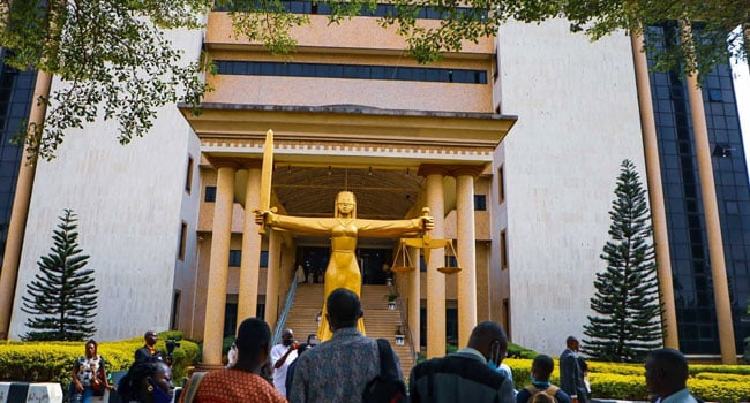
The trial of former Kaduna State Governor, Nasir El-Rufai, over allegations of treason and breach of national security entered its second day at the Federal High Court in Abuja on Tuesday, with the prosecution playing the full video recording of the Arise News Television interview at the centre of the case, while Justice Joyce Abdulmalik dismissed a complaint by the State Security Service (SSS) accusing the former governor’s family of using social media and press engagements to incite public opinion against the judiciary and the prosecution.
El-Rufai, dressed in a blue agbada and seated in the dock, watched the video of his own interview with rapt attention, occasionally raising his head, adjusting his agbada, and at certain points shaking his head as the recording played in open court.
Before the substantive proceedings resumed, the SSS lawyer, Oluwole Aladedoye, SAN, raised a complaint alleging that El-Rufai’s relatives had repeatedly used social media and press engagements to portray the prosecution and security agencies as persecuting the defendant.
Aladedoye cited a specific incident on May 15 where one of El-Rufai’s wives allegedly arrived at the ICPC’s facility with cameramen and began livestreaming, claiming her husband was being denied food and access to family members.
The senior lawyer further alleged that a popular politician published claims suggesting El-Rufai could be harmed in custody, which forced security operatives to move him to SSS custody to avoid further controversy.
According to the prosecution, the situation escalated when members of the defendant’s family including two wives and a son reportedly went to the SSS headquarters with journalists and publicly criticised the court’s bail conditions. Aladedoye argued that instead of pursuing their grievances through legal channels, the family resorted to media campaigns capable of undermining public confidence in the judiciary.
He urged the court to caution the defendant and his family against further public attacks, insisting that the matter was a criminal prosecution, not political persecution.
Responding, defence counsel E.E. Ekere said he was unaware of the allegations and submitted that El-Rufai should not be held responsible for comments made outside the courtroom. He however said the defence team would advise the former governor’s family members and sympathisers to exercise restraint.
Justice Abdulmalik swiftly disposed of the complaint, stating that she paid no attention to social media narratives. The judge directed that issues circulating online should remain outside courtroom proceedings and ordered the trial to continue.
The judge’s response effectively shut down the SSS’s attempt to bring the family’s public protests into the courtroom proceedings, treating the matter as irrelevant to the substantive trial.
With the preliminary issue resolved, the prosecution called its first witness codenamed “APC” for security reasons and shielded from public view during proceedings to continue testimony from where he stopped on Monday. The prosecution tendered a silver flash drive and a certificate of compliance through the witness, which were admitted as Exhibits B and B1 respectively.
Justice Abdulmalik then directed that the video recording of the interview granted by El-Rufai, saved on the flash drive, be played in open court.
The video showed El-Rufai speaking with Arise TV anchor Charles Aniagolu in a wide-ranging interview that touched on his confrontation with security agents at an airport, his relationship with President Tinubu, and most critically his claim that someone had intercepted a phone conversation involving the National Security Adviser.
In the video played before the court, El-Rufai narrated an encounter with DSS operatives at an airport, describing how a young officer approached him and asked him to accompany them to their office.
“I came out of the plane and a young man came to me and said, ‘I am DSS and they would want to meet with me in our office.’ I asked him for a letter of invitation, and he said their boss had it in the office. I said okay,” El-Rufai recounted in the video.
He described the situation escalating, with more officers surrounding him and insisting he follow them. “I told them that even the president cannot tell me what to do,” El-Rufai stated in the recording.
El-Rufai said approximately 50 DSS operatives attempted to arrest him, but supporters who had come to receive him at the airport refused to allow them to take him. The operatives later demanded to see his passport, but one of his aides collected it from him and the officers snatched it from the aide.
On the critical wiretapping allegation, El-Rufai said he knew NSA Ribadu had instructed the SSS to arrest him because someone had tapped Ribadu’s phone conversation and informed him.
When Aniagolu told him that phone tapping was wrong, El-Rufai responded directly: “We listened to their call, someone tapped the phone conversation and told us that he gave the order.”
El-Rufai further stated: “The National Security Adviser told the SSS that I must be abducted today. When you try to take a person without a valid order, it is not an arrest, it is an abduction.”
When Aniagolu suggested that the officers may have been trying to compel him to honour an invitation, El-Rufai replied that there was no law requiring an invitation to be honoured on the same day.
In the interview, El-Rufai also alleged that his prosecution was politically motivated and orchestrated by the federal government through his successor as Kaduna governor. He claimed investigators had interrogated several persons without finding evidence against him and accused the administration of becoming “desperate.”
El-Rufai stated that he had 16 years of public service and had never taken a bribe, challenging Nigerians to come forward and prove him wrong. He said the case against him was linked to pressure on him to support President Bola Ahmed Tinubu’s second-term bid.
“You do not investigate people by abducting them in a civilised country,” El-Rufai said in the video, adding that he was not afraid of scrutiny because he had documentation of his activities in office.
As the video continued to play, it stopped due to technical issues. Following the interruption, the prosecution applied for an adjournment to produce a clearer version of the recording. The judge subsequently adjourned the matter.
The Tuesday proceedings built on Monday’s session, where the prosecution witness had provided detailed testimony about the investigation that followed the broadcast of the interview.
The witness testified on Monday that investigators interviewed NSA Nuhu Ribadu, who verbally confirmed that the conversation referenced by El-Rufai had indeed taken place between him and the ICPC Chairman. The ICPC Chairman also confirmed having such a discussion with the NSA.
The Arise TV anchor, Charles Aniagolu, activist-lawyer Deji Adeyanju, and cameraman Ugochukwu Agalayana were all questioned. Their statements were tendered and admitted as Exhibits C, C1, D, and E without defence objection. A preliminary investigation report was admitted as Exhibit F.
The prosecution concluded that El-Rufai made an “open confession” during the interview, and the investigation team considered the act capable of undermining national security.
However, under cross-examination by Chief Paul Erokoro, SAN, significant weaknesses emerged. The witness acknowledged that investigators did not examine any communication devices belonging to the NSA, did not obtain IP addresses, and did not conduct forensic analysis of the alleged wiretapping.
The witness maintained these steps became unnecessary after the NSA confirmed the conversation’s authenticity. He also agreed that El-Rufai never specifically stated he personally carried out the interception, but insisted the former governor repeatedly stood by the claim that the conversation had been tapped and forwarded to him.
When asked whether El-Rufai could merely have been boasting during a politically charged broadcast, the witness responded that he considered El-Rufai “a person of integrity” and believed he meant what he said.
El-Rufai’s trial is complicated by his ongoing detention. He was arraigned on April 23, 2026, and pleaded not guilty to a five-count further amended charge. He is facing multiple cases the treason charge at the Federal High Court in Abuja and separate cases in Kaduna stemming from his activities as governor.
A judge overseeing one of his trials in Kaduna denied him bail last month and ordered him to remain in the custody of the ICPC. Until that ruling is reversed or set aside by a higher court, El-Rufai will remain in detention even if other judges overseeing his other trials grant him bail.
His family has publicly protested his detention conditions. Members of the family, led by his eldest wife, Asiya El-Rufai, protested at the SSS headquarters in Abuja over his continued detention and alleged breach of court orders. They were joined by Senator Lawal Adamu, representing Kaduna Central, and other supporters who demanded the immediate return of El-Rufai to ICPC custody.
El-Rufai is an ally-turned-critic of President Tinubu. He backed Tinubu during the 2023 presidential campaign, with the then-candidate publicly persuading El-Rufai to forgo retirement and take up government roles. However, the relationship collapsed after a botched attempt by President Tinubu to appoint El-Rufai as minister, with the Senate refusing to clear him citing security concerns.
Since then, El-Rufai has become one of the administration’s most prominent critics, while the government has pursued multiple legal actions against him. His supporters view the prosecutions as politically motivated retaliation for his criticism of the Tinubu administration, while the prosecution maintains the charges are based on genuine evidence of criminal conduct.
The trial continues before Justice Joyce Abdulmalik at the Federal High Court, Abuja. The next adjourned dates are June 22 and 23, 2026.
The post “43-Minute Arise TV Interview Played In Court” — Prosecution Says El-Rufai Made ‘Open Confession’ In Treason Trial As Defence Cites Lack Of Forensic Evidence appeared first on TheNigeriaLawyer.