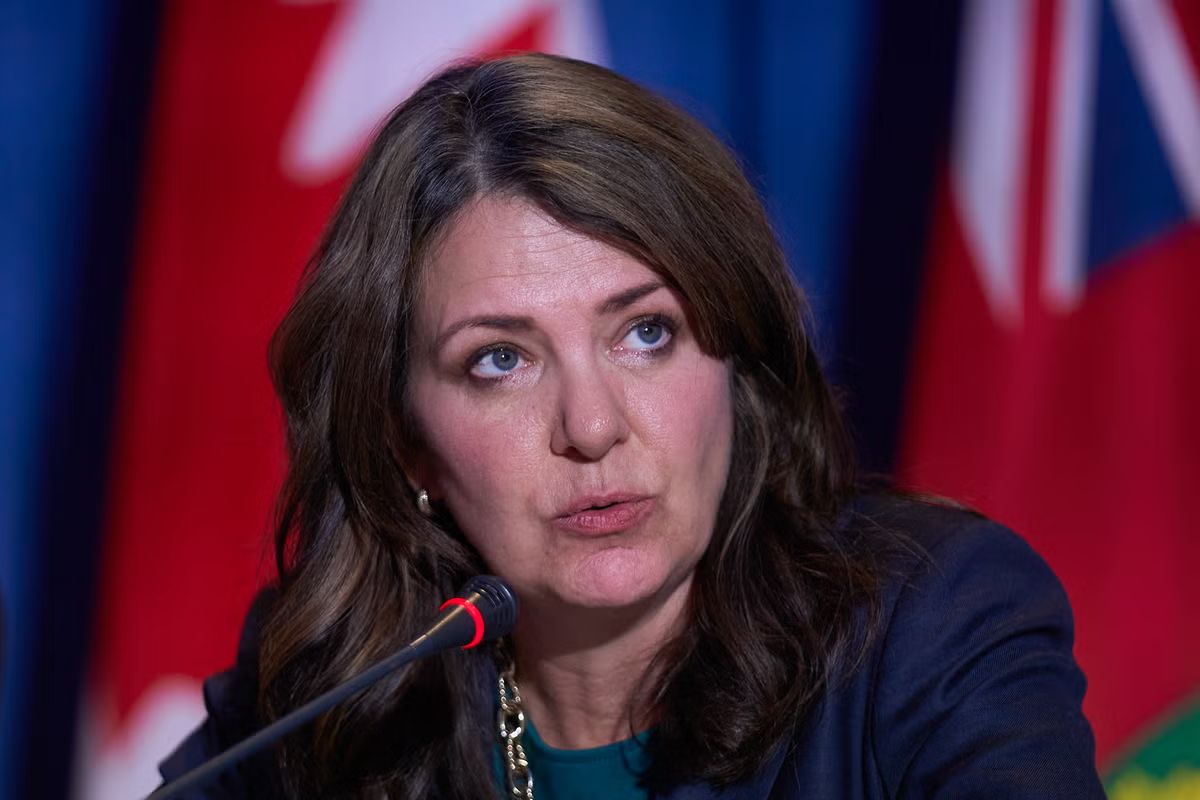
Alberta, Canada’s oil-rich province, is set to hold a referendum this October, though its premier, Danielle Smith, clarified on Thursday that the vote will not directly address secession from the Canadian federation. Instead, voters will be asked to decide whether the province should hold a binding referendum on leaving Canada.
Smith, in televised remarks, unequivocally affirmed her personal and governmental commitment to Alberta remaining within Canada.
“I want to be clear. I support Alberta remaining in Canada, and this is how I would vote in a provincial referendum on separation. It is also the position of my government,” she stated. The specific ballot question will ask whether Alberta should stay in Canada or take legal steps under the Constitution to hold a binding referendum on departure.
Ian Brodie, a political science professor at the University of Calgary and former chief of staff to Prime Minister Stephen Harper, observed that Smith appears to be navigating this politically sensitive issue with extreme caution.
“A vote to see if people even want a vote. It’s a good way to let the swing voters swing against separation,” Brodie commented, suggesting a strategic move to temper separatist sentiment.
Even a “yes” vote in a future binding referendum would not automatically trigger independence. Such a significant move would necessitate complex negotiations with the federal government, as a landmark 1998 Supreme Court ruling established that provinces cannot unilaterally secede from Canada.
Daniel Béland, a political science professor at McGill University in Montreal, drew parallels between Smith’s nuanced approach and that of former British Prime Minister David Cameron before the Brexit referendum. Béland noted that Smith, despite publicly opposing independence, might be using the referendum as a strategic tool to manage a vocal faction within her United Conservative Party (UCP).
“Politically Smith seems committed to do so to appease supporters of her own party who want a referendum. If she doesn’t follow suit, she might face a potentially perilous mutiny within her partisan ranks,” Béland explained.
The premier’s announcement followed a motion passed by three UCP caucus members earlier on Thursday, urging her and her cabinet to schedule a referendum for October 19.
Concurrently, Prime Minister Mark Carney’s federal Liberal government has been collaborating with Smith on an oil pipeline project to the Pacific coast, an effort aimed at addressing economic concerns among many Albertans.
Dominic LeBlanc, the federal minister of Intergovernmental Affairs, reiterated the federal stance on social media: “Canada’s government strongly believes that the interests of Albertans and all Canadians are best served when we work together.”
Béland further suggested that the carefully worded question allows some voters to express dissatisfaction with the federal government without directly endorsing independence. “It might lower the apparent stakes, making it perhaps easier for some voters to think they can send a political message to the rest of the country without taking the risk of leading the province to the point of no return,” he elaborated.
While current support for separation in Alberta stands at slightly less than 30 percent, Béland cautioned that political campaigns can significantly influence public opinion and outcomes. Federal Conservative Leader Pierre Poilievre has previously stated that he and all Conservative Members of Parliament would actively advocate for Alberta to remain part of Canada during any potential referendum campaign.
Smith also addressed a recent court ruling, stating that a judge erred last week in deeming a citizen-led petition designed to force a referendum unconstitutional. Béland clarified the premier’s position, explaining, “In her address, Smith explained that a recent court ruling makes such a binding reference impossible for now, which justifies the new question.”