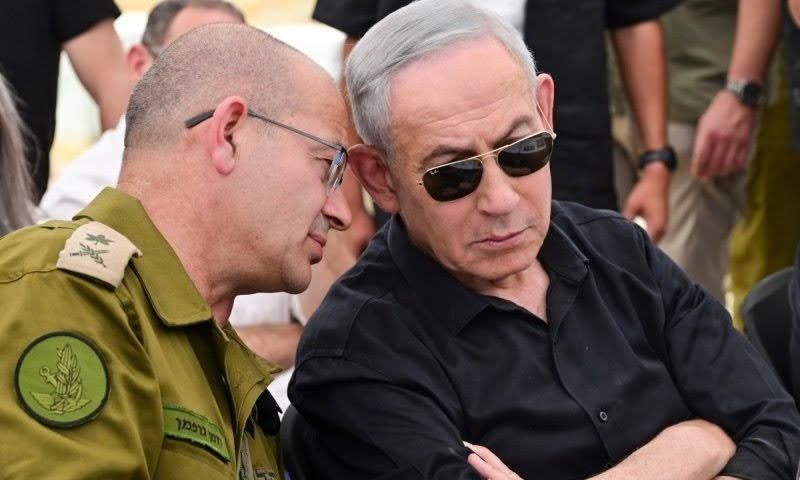
A majority of the members of the Advisory Committee for Senior Appointments on Tuesday submitted a supplementary opinion to the Prime Minister, clearing Maj.-Gen. Roman Gofman of any wrongdoing or integrity issues.
Prime Minister Binyamin Netanyahu said that a majority of the committee members found no issue with Gofman’s integrity and that reviewing the additional materials only “substantially” reinforced their support for his appointment. He added that Gofman had suffered “unnecessary legal torment” and that “the mountain did not even produce a mouse,” and he expects the High Court to immediately reject the petitions and not delay Gofman’s entry into the position.
The Prime Minister’s Office stressed that the appointment is especially necessary given the extraordinary security reality, with Israel, in its words, “in the midst of a war on seven fronts.”
The committee examined all the evidence in depth regarding the case of the petitioner Ori Elmakayes, the former underage blogger at the center of the case, including 511 pages of WhatsApp messages exchanged between Major Ratzon Tzur — the officer in contact with Elmakayes — and Elmakayes himself. The conclusion: Roman Gofman’s name was never mentioned even once. Elmakayes himself confirmed to the committee that he never had any direct contact with Gofman and that his name never came up.
The committee further determined that the accusations Elmakayes made against Major Tzur, and indirectly against Gofman, “were baseless.”
In his remarks to the committee, Major General Gofman described the personal harm caused to him by the affair. “What is at stake for me is my integrity,” he said, “which is the foundation of my ability and of how I view my mission.” He called the claim that he abandoned Elmakayes “a severe blow” that creates an intolerable gap between the accusations and his actual conduct at the time.
Gofman explained that when asked — before Elmakayes’s arrest — whether there had been an intelligence leak of classified material from the division, he categorically denied it. He even sought to verify his answer with his subordinates, but was prevented from doing so due to an ongoing investigation. He added that he learned the blogger’s identity only about two years after the arrest, when a journalist contacted him with a query.
Gofman also criticized the letter submitted by current Mossad chief Dedi Barnea opposing his appointment. He said the letter — based, in his view, on “facts that are not facts” — harmed him internationally and even affected his relationships with people in Israel.
The supplementary opinion also includes sharp criticism of how Attorney General Gali Baharav-Miara’s opinion was transmitted. According to the three committee members, they discovered “to their complete surprise” during a Supreme Court hearing that the opinion had been sent directly to the committee chair, former Supreme Court President Asher Grunis, marked “personal, for addressee only” — and was never shared with the other committee members. They also noted that the opinion was written without reviewing materials that disproved the allegations against Gofman.
Separately, the majority noted that the committee chair admitted during a May 24 hearing that he had not read the WhatsApp messages — evidence the committee itself had requested and which the majority considers “the best and only evidence” for examining the matter. “This is regrettable,” the opinion states.
The committee majority concluded: “Our clear conclusion, beyond any reasonable doubt, is that no flaw exists in Major General Gofman’s integrity, and this conclusion is well supported by the material before us.” They rejected the chair’s proposal to refer the matter to an additional external body, noting that it had already been thoroughly examined both in real time by Northern Command chief Major General Amir Baram and again by the committee itself.
The High Court ordered all parties to the case to respond to the committee’s supplementary opinion by Tuesday evening.
(YWN Israel Desk—Jerusalem)