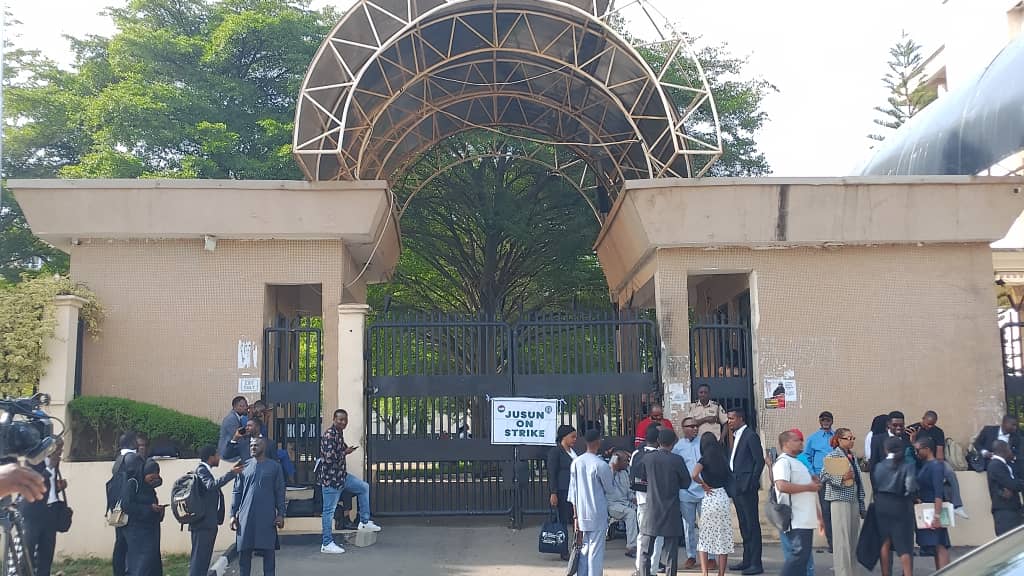
A Federal High Court in Abuja has granted Malabu Oil & Gas Limited permission to seek a judicial review against the Federal Government over the alleged division and reallocation of OPL 245 to major oil firms and the NNPC.
The Federal High Court in Abuja on Thursday granted leave to Malabu Oil & Gas Limited to apply for a judicial review against the Federal Government over the alleged splitting of Oil Prospecting Licence (OPL) 245.
Delivering the ruling, Justice Mohammed Umar held that the ex-parte motion filed by the company through its lawyer, Reuben Atabo, a Senior Advocate of Nigeria, was meritorious.
The judge said the court was satisfied with the depositions contained in the affidavit attached to the application, particularly some of the paragraphs relied upon by the applicant.
Mr Umar subsequently adjourned the matter until 11 June to enable Malabu to file and serve the originating summons in respect of the reliefs being sought.
In the suit marked FHC/ABJ/CS/871/2026, Malabu Oil & Gas Limited listed the president, the Attorney-General of the Federation (AGF), and the Minister of Petroleum Resources as first to third respondents respectively.
The suit comes less than two months after President Bola Tinubu on 5 March announced the government had resolved a decades-long dispute over Oil Prospecting Licence (OPL) 245, one of Nigeria’s most commercially significant deepwater oil blocks.
At the time, the presidency said the agreement paves the way for development that could add approximately 150,000 barrels per day to Nigeria’s production capacity.
Although details of the agreement are still sketchy and were not made public, the president’s office described it as a “historic settlement” that would unlock the development of one of Nigeria’s most strategically important deepwater resources.
On Thursday, Malabu in its suit alleged that the Federal Government split OPL 245 into four separate assets and reassigned them to Shell Nigeria Ultra-Deep Limited, Shell Nigeria Exploration Production Company Limited, Nigerian Agip Exploration Company Limited, and Nigerian National Petroleum Company (NNPC) Limited.
According to Malabu, the reallocation was carried out through the OPL 245 Resolution Agreement executed on or about 5 March.
The firm further alleged that the action was taken without the consent or approval of its directors.
The matter is expected to return to court on 11 June for further proceedings.
OPL 245 was originally awarded to Malabu Oil and Gas by the regime of General Sani Abacha in 1998.
Under the terms of the award, Malabu — a briefcase company set up by Mr Abacha’s son and the then petroleum minister, Dan Etete, in controversial circumstances — was required to develop the block in partnership with an international technical partner and pay a signature bonus of $20 million.
The company paid only $2 million before entering into a joint operation agreement with Shell Nigeria Ultra Deep Limited (SNUD). Malabu received its operating licence in April 2001, but it was revoked three months later, in July 2001.
The administration of former President Olusegun Obasanjo subsequently invited ExxonMobil and Shell — Malabu’s technical partner — to bid for OPL 245 in partnership with the Nigerian National Petroleum Corporation (NNPC). Shell won the bid and began work on the block.
Malabu accused Shell of conniving with the government to seize the block and petitioned the House of Representatives, which directed the federal government to re-award Block 245 to the company.
Malabu also approached the Federal High Court in Abuja, but the suit was struck out. While an appeal was pending, the then Minister of State for Petroleum, Edmund Daukoru, sought an out-of-court settlement on behalf of the federal government.
The block’s association with Mr Etete — whom the federal government alleged had awarded the block to himself while in office — inflamed opinion in the Niger Delta, where communities demanded a full audit of oil block allocations and disclosure of the ethnic identities of their owners.
The Obasanjo government eventually reversed course, reclaimed OPL 245 from Shell, and re-awarded it to Malabu on the condition that the company pay a new signature bonus of $210 million, in addition to the $2 million earlier paid in 1998.
Malabu paid the sum and withdrew its court cases, but the settlement created another dispute.
Shell filed for arbitration at the International Centre for Settlement of Investment Disputes (ICSID) in Washington, D.C., and also instituted proceedings at the Federal High Court in Abuja. SNUD, which had entered into a Production Sharing Contract with the NNPC in 2002, had paid $1 million of the $210 million signature bonus and held the remaining $209 million in an escrow account with JP Morgan pending resolution of the dispute.
Shell sought compensation and damages exceeding $2 billion, citing costs incurred in de-risking the block.
Several settlement efforts followed, though none produced a definitive outcome. However, a Terms of Settlement Framework was adopted in 2006.
In April 2011, under the Goodluck Jonathan administration, then Attorney-General Mohammed Adoke brokered a Resolution Agreement.
Under the agreement signed on 29 April 2011, Malabu agreed to waive all claims to OPL 245 in exchange for compensation from the federal government. Shell, in turn, agreed to withdraw all suits against the government and to pay, through the federal government, the sum of $1.092 billion as full and final settlement of Malabu’s claims. The block would then revert to Shell and its new partner, Italian oil company Eni.
In June 2013, the matter was formally concluded on those terms, and presidential approval was granted for the payment of $1.092 billion to Malabu — now controlled by Mr Etete after scheming out the Abachas — from the federal government’s escrow account at JP Morgan in London.
The deal later attracted international scrutiny. Italian prosecutors alleged that most of the $1.3 billion purchase price for OPL 245 had been siphoned off to politicians and intermediaries.
PREMIUM TIMES reported that about half of the funds were transferred to the accounts of controversial businessman Abubakar Aliyu, believed to be a front for senior government officials.
Shell and Eni, along with several of their former and current executives — including Eni CEO Claudio Descalzi — were tried in Italy. All were acquitted in 2021 after denying any wrongdoing.