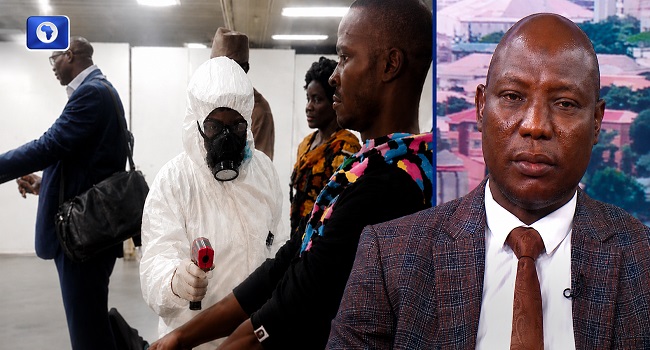
A Consultant and Clinical Microbiologist at the Federal Medical Centre, Abuja, Dr Abdullahi Nasiru, has urged the government and relevant agencies to intensify public awareness campaigns to educate Nigerians on precautionary measures following the recent Ebola virus outbreak in the Democratic Republic of Congo (DRC).
Nasiru made the call during an interview on Channels Television’s The Morning Brief on Monday.
“I think there is also a need for government and relevant agencies to heighten public awareness, public health education, creation of awareness and so on.
“It’s very important because, in 2014, community engagement really helped. Public health education via radio, one-on-one engagement, community leaders and religious leaders really helped to contain it.
“I think we need to begin to look at those things that gave us that success story in 2014 and bring them back because we have to leverage the existing infrastructure and everything that was done then that was able to help us minimise the fatality rate associated with the disease,” Nasiru added.
His remarks come in the wake of the recent Ebola outbreak in the Democratic Republic of Congo, where 88 deaths have been recorded, alongside a reported imported case in Uganda.
READ ALSO: Nigeria Tightens Surveillance, WHO Declares Emergency As Ebola Kills 88 In Congo
The Nigeria Centre for Disease Control and Prevention (NCDC) has said there is no need for panic in Nigeria, as no case has been confirmed in the country.
However, Dr Nasiru said precautionary measures should still be taken.
“There is no need for panic, as has been said by the NCDC. However, that is not to say that we must not take precautionary or proactive measures to ensure that people are not infected.
“So, those basic things that border on prevention, precaution and control must be implemented.
“At this point in time, either in the hospital or in the community, particularly hand hygiene and hand washing, this has been one of the most effective infection prevention and control practices found to prevent transmission of infection in about 90 percent of cases.”
Still speaking on the breakfast show, the medical practitioner stressed the importance of handwashing.
“Nigerians should do more in terms of washing their hands regularly because Ebola is a disease that is transmitted through contact with secretions from either infected individuals or individuals who might have died from the disease.
“Secretions including blood, faeces, vomitus and other body secretions, even organs, as well as surfaces that these secretions have come in contact with, can transmit the virus. So, it’s important that we strengthen our hand hygiene practices and also ensure that cough etiquette is observed,” he stated.