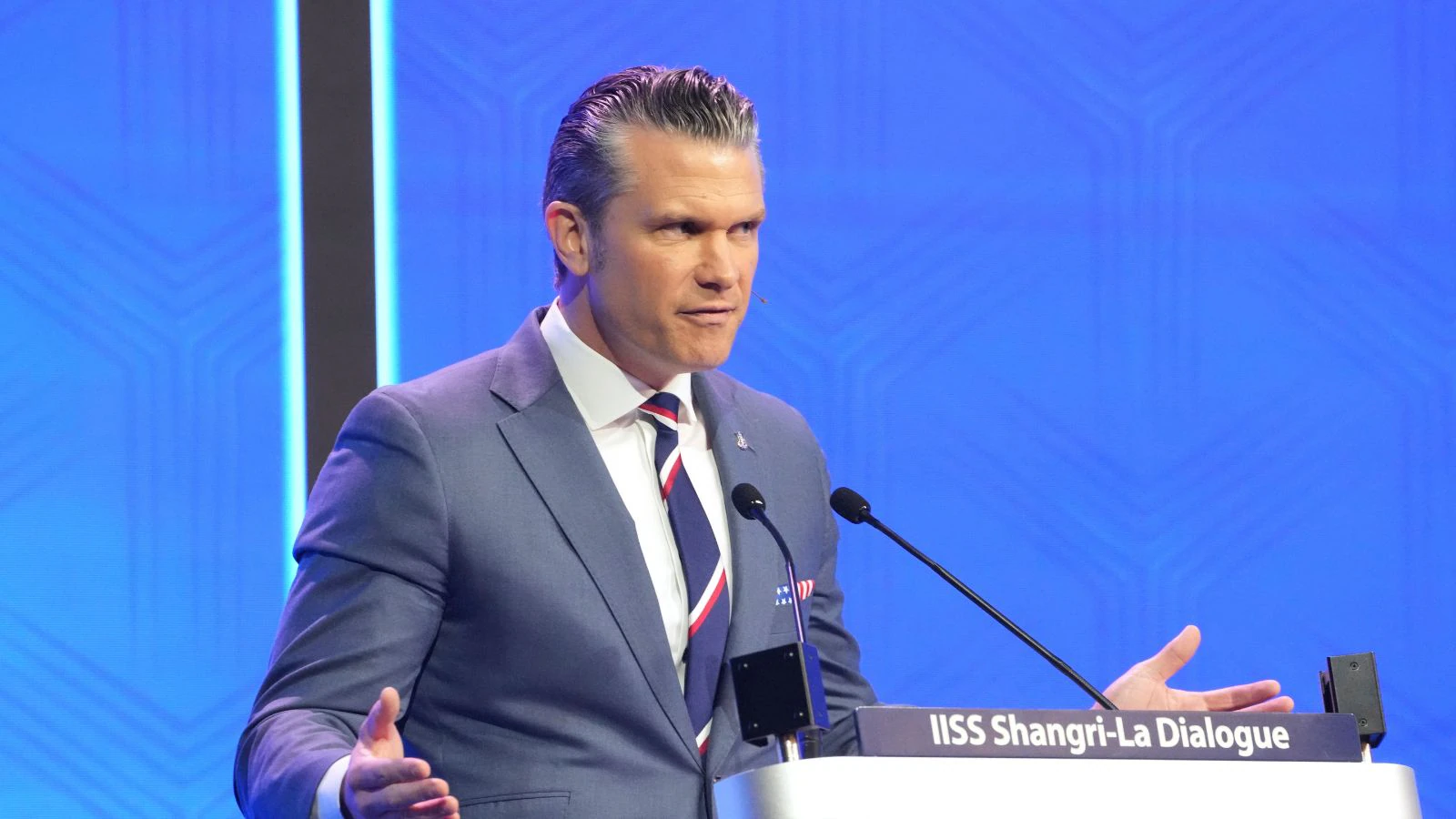
The United States is “more than capable” of restarting attacks on Iran if a deal cannot be reached, US Secretary of War Pete Hegseth said Saturday at the Shangri-La Dialogue in Singapore, even as US President Donald Trump weighed a tentative 60-day extension of the fragile ceasefire negotiated at the working level by US and Iranian officials.
Speaking at Asia’s premier annual defence and security forum, Hegseth said Washington remained ready to resume military operations if the diplomatic track collapsed, but stressed that Trump was “patient” in pursuit of an agreement that ensures Iran does not acquire a nuclear weapon.
“Our ability to recommence if necessary… we are more than capable,” Hegseth said. “Our stockpiles are more than suited for that, both there and around the globe, so we’re in a very good place.”
He added that the United States had not turned its back on the Asia-Pacific despite remaining engaged in the conflict with Iran. “We can do two things at one time. We’re super-charging our defence industrial base so that we’re building 2X, 3X, 4X the munitions very soon to ensure that all of our (operations) plans are properly funded throughout the world,” Hegseth said, according to a Reuters dispatch from Singapore.
Trump holds two-hour Situation Room meeting
Hegseth’s remarks came hours after Trump emerged from a roughly two-hour White House Situation Room meeting with his national security advisers on Friday, called to make what he described as a “final determination” on whether to accept the proposed framework. A senior administration official, speaking on condition of anonymity, would not confirm whether Trump had signed off on the tentative agreement after the meeting concluded.
The deal under consideration would extend the early-April ceasefire that has held in fragile form for nearly seven weeks, while opening fresh talks on Iran’s nuclear programme. US and Iranian negotiating teams reached an agreement in principle on a memorandum of understanding earlier in the week, but the framework still requires political-level approval from both Trump and Iran’s top leadership, according to multiple reports.
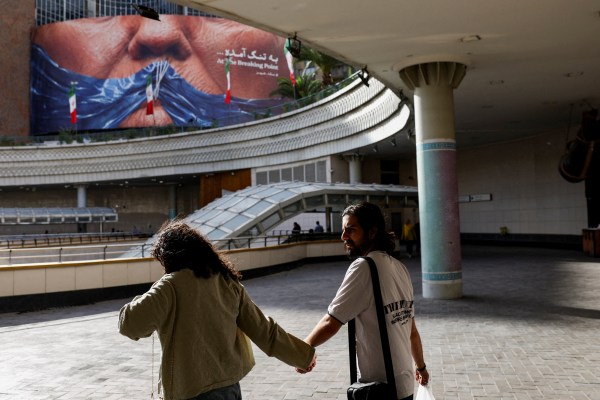 People walk past an anti-US billboard depicting US President Donald Trump and the Strait of Hormuz, in Tehran. (Reuters)
A senior administration official said Trump would only accept a deal “that is good for America and satisfies his redlines. Iran can never possess a nuclear weapon,” the Associated Press reported.
Story continues below this ad
Iran says deal ‘has not yet been finalised’
Iran’s Foreign Ministry spokesman Esmail Baghaei said Friday the agreement to extend the ceasefire and reopen the Strait of Hormuz “has not yet been finalised,” in remarks to a state broadcaster.
Baghaei said Iranian officials were “focused on the end of war and are not discussing the details of the nuclear plan at this point”, apparent pushback against US Vice President JD Vance’s suggestion on Thursday that negotiators were trying to strike general terms on the nuclear question with the specifics to be hammered out in ensuing talks. Baghaei also reiterated Iran’s longstanding position that the management of the Strait of Hormuz, which lies in Iranian and Omani territorial waters, with the main shipping lane running through Omani waters near Musandam, was a matter to be decided by Iran and Oman.
Iran’s semi-official Fars news agency, considered close to the Islamic Revolutionary Guard Corps, separately rejected key elements of Trump’s public framing of the deal.
Disagreements on nuclear, Hormuz remain
Based on public statements from both sides, the principal areas of disagreement between Washington and Tehran centre on Iran’s nuclear programme and control of the Strait of Hormuz.
Story continues below this ad
Trump has insisted that any agreement must include Iranian guarantees that Tehran will never develop nuclear weapons and that the Strait of Hormuz will be reopened to unrestricted shipping. Iran, in turn, has insisted that decisions on Hormuz fall under its sovereign rights, and has signalled deep scepticism about the durability of US commitments.
In a Truth Social post on Friday, Trump said only the United States and China possessed “the mechanical capability” of removing Iran’s highly enriched uranium stockpile, which he said was buried under sites damaged in last year’s US bombardment.
“The enriched material, sometimes referred to as ‘Nuclear Dust,’ which is buried deep underground with virtually collapsed mountains, caused by our powerful B2 Bomber attack 11 months ago, sitting on top of it, will be unearthed by the United States… in close coordination and conjunction with the Islamic Republic of Iran, plus the International Atomic Energy Agency, and DESTROYED,” Trump wrote.
Pakistan mediator role: Rubio meets Dar
US Secretary of State Marco Rubio Friday met Pakistan’s Deputy Prime Minister and Foreign Minister Ishaq Dar at the State Department, as Islamabad’s role as a key mediator in the US-Iran diplomatic track continued to draw attention. Neither Rubio nor Dar took questions from reporters at the photo opportunity.
Story continues below this ad
Pakistan has emerged as the principal regional intermediary in the negotiations since Prime Minister Shehbaz Sharif and Field Marshal Asim Munir helped broker the original early-April ceasefire.
Meetings at Shangri-La
Hegseth was speaking at the Shangri-La Dialogue, convened annually by the International Institute for Strategic Studies and regarded as the Indo-Pacific’s premier defence and security summit. He held separate sidelines meetings with leaders from Vietnam and Singapore, the Pentagon said, with discussions including expanding rotational deployments of US Navy and Air Force assets in Singapore and deepening unmanned naval cooperation with Vietnam.
The war launched by the United States and Israel on February 28 has killed thousands of people, mainly in Iran and Lebanon, and has caused global economic pain by pushing up energy prices on account of Iran’s effective closure of the Strait of Hormuz, a waterway through which roughly one-fifth of global oil consumption transits, according to the US Energy Information Administration. India, which imports an estimated 65-70 per cent of its crude oil through the strait, is among the largest economies exposed to the outcome of the talks.
(With inputs from Reuters and AP)