
While the economic impact of the Strait and its de facto and effective closure has been enumerated in myriad ways, the impending food crisis that it could spin in the short term has now been underscored by the UN food body, the Food and Agriculture Organisation of the United Nations, or FAO.
FAO Warns Of Crisis
In a statement issued on May 20, the Food and Agriculture Organisation said that the shutdown of the Strait of Hormuz is not a temporary shipping disruption. The body said this is the beginning of a systemic agrifood shock.
FAO even suggested a timeline within which this crisis could unfold.
According to the Food and Agriculture Organisation, the persistent Strait closure could trigger a severe global food price crisis within six to 12 months.
The Food and Agriculture Organisation’s Chief Economist, Maximo Torero said, “The time has come to start seriously thinking about how to increase the absorption capacity of countries, how to increase their resilience to this choke, so that we start to minimise the potential impacts.”
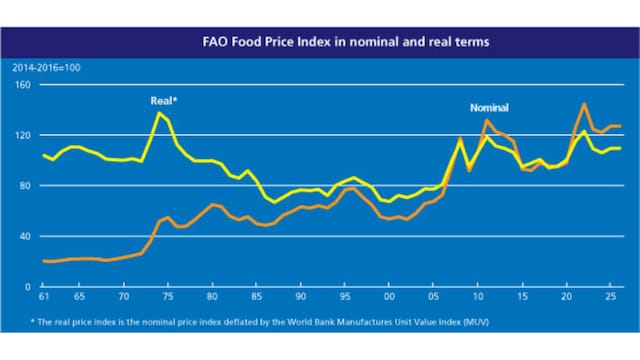
According to the FAO, the impact is already visible. The FAO Food Price Index, which tracks monthly changes in the international prices of a basket of globally traded food commodities, rose for a third consecutive month in April, driven by high energy costs and disruptions linked to the conflict in the Middle East.
 The Fertiliser Fault
The crisis is unfolding in stages: energy, fertiliser, seeds, lower yields, commodity price increases, and then food inflation. And here, West Asia and the Strait of Hormuz, by extension, play a major role in the fertiliser market. According to the International Food Policy Research Institute, in 2024, around 30% of global fertiliser trade passed through the Strait of Hormuz from the Persian Gulf countries.
In this, the peninsula of Qatar alone provides about 10% of the world’s traded natural gas, which would have a big impact on the global output of nitrogen fertiliser. The main energy source and essential feedstock for the production of ammonia, the building block of all nitrogen fertilisers, is natural gas.
Weather Worry
In addition to that, another factor looms as a dark plume of uncertainty. After a gap, El Niño, a climatic phenomenon that leads to warming of the surface temperature of the oceans, could further tighten the already dire situation. An El-Nino-like condition naturally leads to an increase in temperature, potential disruption in usual weather patterns, a decline in rainfall, and even increased chances of calamities like cyclones.
What makes it worse is the US National Oceanic and Atmospheric Administration (NOAA ENSO Forecast) projection of a ‘Super El-Nino’. There is a 82% chance of an El Niño event developing between May and July.
Where Does India Stand?
In India, the Indian Meteorological Department and privately owned Skymet have both predicted a below-normal monsoon. Monsoon, more specifically the South-west monsoon, is critical for Indian agriculture and its Kharif crops, as they depend heavily on the monsoon that starts in June and ends in September-October for their agricultural production.
When it comes to India’s existing reserve, recently, C. Shikha, the Joint Secretary in the Department of Food and Public Distribution, Ministry of Consumer Affairs, Food and Public Distribution, said that India currently has about 222 lakh metric tonnes (LMT) of wheat and approximately 380 LMT of rice, taking the total food stock to about 602 LMT.
New Delhi-based Agriwatch claimed that India’s monthly wheat consumption is estimated at 90–95 lakh metric tonnes. When it comes to rice, multiple reports hint at a range of 80-100 lakh metric tonnes.
The FAO also added that to avert the crisis, a solution to the conflict will have to be established, and in the short term, mitigating these impacts will require shifting to alternative land and sea routes, including via the eastern Arabian Peninsula, western Saudi Arabia and the Red Sea. The FAO, however, cautions that these alternative routes have limited capacity, making it critical to avoid export restrictions by major producers.
Also Read: Bharti AXA Life declares ₹205 crore bonus for participating policyholders in FY26