Communities warn that treating gas flare penalties as government revenue rewards polluters, undermines environmental justice and worsens conditions in oil-producing areas.
Host communities in oil-producing areas of Akwa Ibom and Bayelsa states have asked President Bola Tinubu to rescind part of Executive Order 9, which directs that gas-flare penalties be paid into the federation account as government revenue.
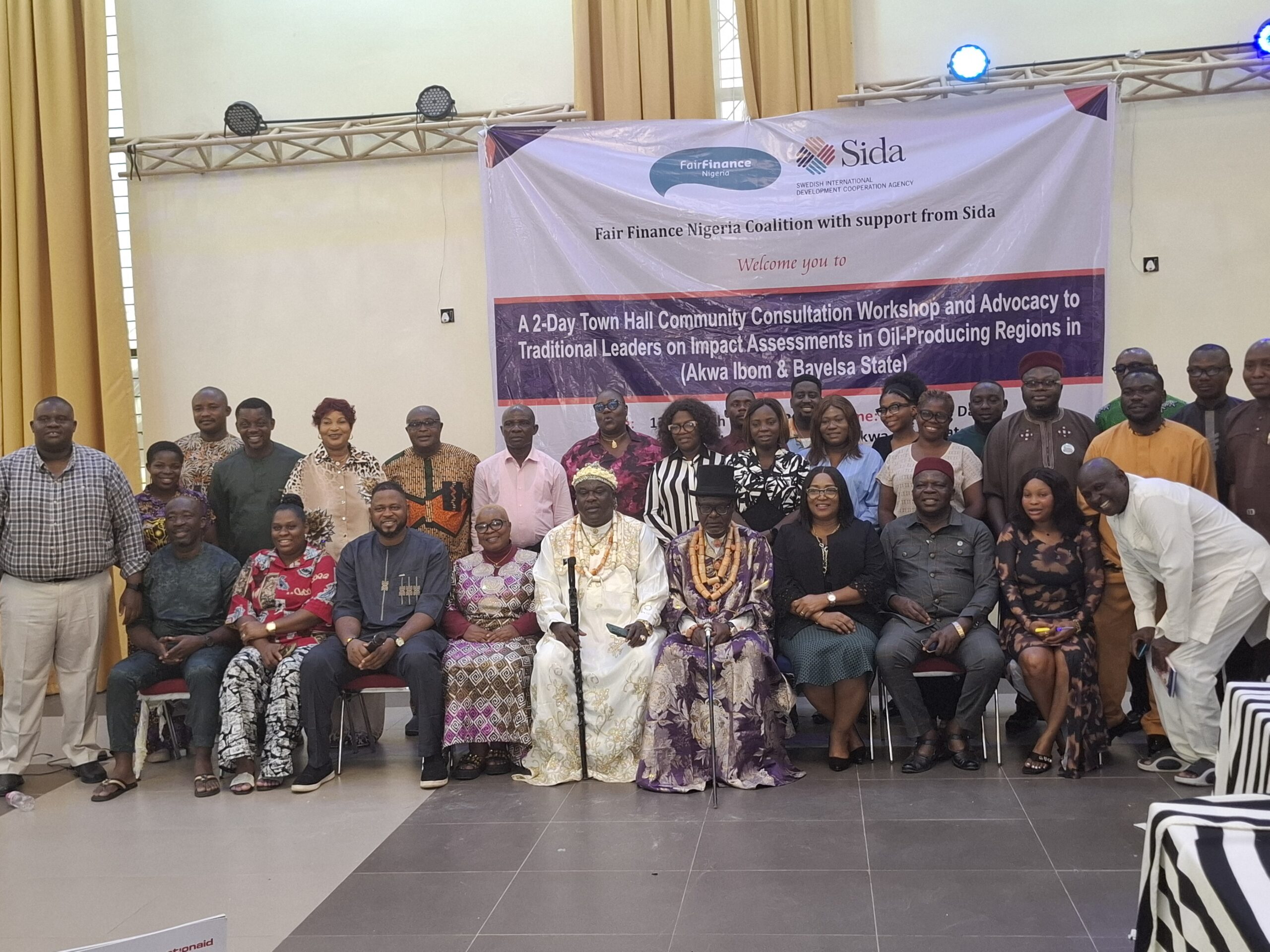
The demand is contained in a communiqué issued at the end of a two-day town hall consultation workshop and advocacy meeting on impact assessments in oil-producing regions held in Eket, Akwa Ibom State.
The workshop, organised by the Fair Finance Nigeria Coalition and attended by traditional rulers, host community representatives, civil society groups and the media, focused on the environmental and economic impact of oil exploration activities in the Niger Delta.
Participants argued that the failure of the Nigerian Upstream Petroleum Regulatory Commission to use penalties paid since 2021 for environmental remediation and relief of the host communities where gas is flared as provided under the Petroleum Industry Act (PIA) and the recent presidential order allows gas flare penalties to be treated as part of the federation’s general revenue, instead of being dedicated to environmental remediation and compensation for affected communities.
PREMIUM TIMES analysis of Nigerian Upstream Petroleum Regulatory Commission (NUPRC) annual reports shows that between 2021 and 2024, NUPRC received N700.77 billion in gas flared penalties.
Participants urged the National Assembly to defend section 104(4) of the PIA and “ring fence” gas flare penalties strictly for environmental remediation and relief programmes in impacted host communities.
“The President should rescind his Executive Order 9, to pay the gas flare penalty as revenue to the federation account, which is a general pool for expenditure of the federation, at the expense of the people who bear the brunt of this gas flare,” the communiqué stated.
The participants said the federal government should not treat gas flare penalties as a revenue source, as doing so violates the “polluter-pay principle,” which requires polluters to bear the costs of environmental damage.
PREMIUM TIMES recently reported how gas flaring is turning oil communities into a furnace.
The communiqué was signed by several organisations and stakeholders, including Oxfam in Nigeria, the Civil Society Legislative Advocacy Centre, BudgIT Foundation, Connected Development, Policy Alert, and the Youth and Environmental Advocacy Centre.
Participants at the meeting accused oil companies and regulators of poor transparency in managing the Host Community Development Trust (HCDT) funds established under the PIA.
The stakeholders alleged that corruption, political interference and regulatory capture were weakening trust in the HCDT structures and limiting community participation.
“Few women are awarded contracts or benefits from the HCDT funds and projects,” the communiqué noted, adding that women, youths and persons with disabilities were poorly represented in decision-making processes.
The participants also criticised what they described as weak enforcement of court judgements in favour of oil communities and poor response from government agencies to environmental complaints.
The workshop recommended stronger legislation and political will to enforce transparency and accountability provisions in the PIA.
Participants also called for the unbundling of the Nigerian Upstream Petroleum Regulatory Commission to improve efficiency in handling host community affairs.
Other recommendations included regular town hall meetings with host communities, independent monitoring groups for oil projects, improved disclosure of financial reports by oil companies, and the enforcement of gas flare penalties.
The stakeholders further urged the government to amend the PIA to ensure 40 per cent representation of women, youths, and persons with disabilities on HCDT boards.
They also called on civil society groups to harmonise advocacy efforts to improve environmental justice and accountability in the oil and gas sector.
Among traditional rulers at the meeting were Wapaebiama David Amakiri of Ogbia Local Government Area in Bayelsa State.