Florida scientists and volunteers are expanding coral restoration efforts as ocean temperatures rise ahead of what experts predict could be another record-breaking hot summer.
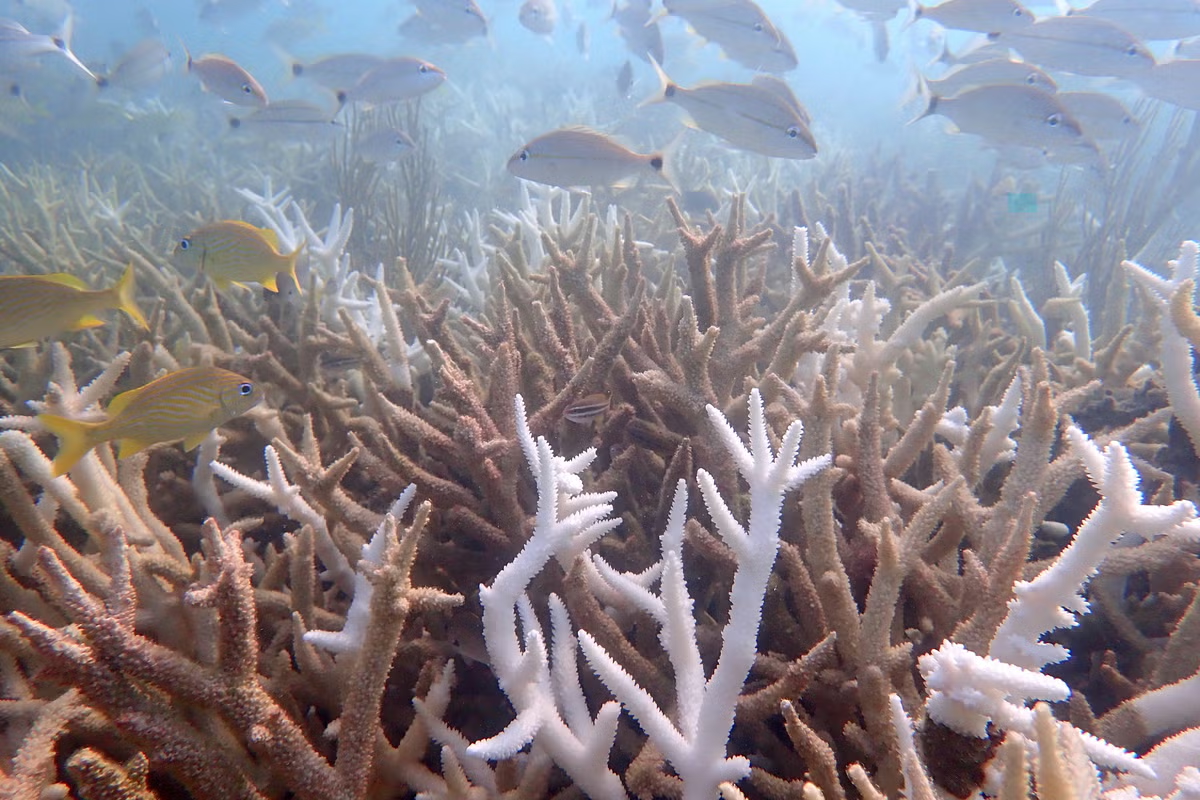
Recent data showing sea surface temperatures in parts of Florida Bay reached 97 degrees Fahrenheit has heightened fears of a mass bleaching event, WPLG reported. The process occurs when heat-stressed corals turn white and begin to starve after expelling the algae that feed them.
The spike follows the summer of 2023, which NOAA scientists recorded as the worst coral bleaching event in South Florida history.
Though federal officials have not yet reported widespread bleaching in the Florida Keys this season, early warning signs are emerging near Miami. Colin Foord of Coral Morphologic, who operates the Coral City Camera at Government Cut, recently reported bleaching in roughly 25 percent of the corals near PortMiami.
“Miami has been feeling that heat stress for actually three years straight,” Dalton Hesley, a coral restoration ecologist at the University of Miami’s Rosenstiel School, told the outlet. “We’re ground zero for the coral crisis.”
Florida’s reef systems have faced severe decline over the last several decades. Since the 1970s, warming oceans, disease outbreaks, hurricanes and pollution have destroyed more than 90 percent of the state’s coral cover.
“There’s been a suite of stressors that have really decimated our reefs to the point that they’re on the brink,” Hesley said.
To combat the loss, researchers are using selective breeding to develop heat-tolerant strains capable of surviving rising ocean temperatures. Weeks before the latest mission, scientists launched a pilot project to revive Florida’s endangered elkhorn coral by introducing resilient strains from Honduras.
Last year, University of Miami scientists traveled to Tela Bay, Honduras, to collect fragments from elkhorn corals, the Associated Press reported. In partnership with the Florida Aquarium, those fragments were crossbred with Florida elkhorn coral. The resulting juvenile corals have now been planted on a Miami reef.
“It’s the first time ever that it’s been permitted and we’ve gone ahead and outplanted,” Andrew Baker, a marine biologist at the University of Miami Rosenstiel School, said of the project. “We’re going to see how well these do over the next few months, particularly over the course of a warm summer, to see if they are more thermally tolerant, as we hope, and better able to deal with the changing conditions in Florida’s coral reef.”
Scientists hope these crossbred varieties, combined with Miami’s native urban corals, will help establish highly resilient reef systems.
“They are tough, so they are special,” Hesley said. “We’re trying to better understand why, so we can integrate that into gardening and restoration. So we’re building that super coral reef.”
Work is also taking place three miles offshore at Paradise Reef, where a program called Rescue a Reef grows threatened staghorn corals on underwater metal structures before transplanting them onto damaged wild reefs. During a recent maintenance trip, volunteers helped clean algae from the nursery and planted more than 150 coral fragments back onto the reef.
“If we’re not there to actually clean them, they’re going to get overgrown,” Hesley said. “We want these to be healthy habitats for the corals themselves.”
Over the last decade, the Rescue a Reef program has restored approximately 2,000 corals at this local site.
The scale of the threat remains severe. During the 2023 heatwave, federal researchers documented near-total bleaching across multiple reef systems.
Biologists emphasize that localized restoration and selective breeding cannot fully reverse decades of decline without broader action.
More details here...