Three years after a law upgraded Nigeria’s Maritime Academy Oron into a university, the institution remains in limbo while unaccounted billions of naira flow through an institution that no longer exists in the eyes of the law.
On 16 February 2023, then President Muhammadu Buhari signed a law intended to upgrade one of Nigeria’s most strategic training institutions.
In legal terms, the academy ceased to exist on 16 February 2023.
Three years later, that legal stamp has not translated into practice as the university exists only on paper, while the academy, which the law abolished, continues to operate.
Students still apply to the academy for admission. Budgets are still prepared in its name. Federal allocations continue to flow to the academy. Billions of naira move through a structure that no longer has legal backing.
An investigation by PREMIUM TIMES reveals that this delay is not due to routine bureaucracy. It is driven by the convergence of individuals’ financial interests and weak accountability. Insiders say powerful government officials benefit from keeping the institution in its current state: neither fully upgraded nor legally compliant.
The law that created the University of Maritime Studies, Oron, set out a mandate for degree-awarding programmes in marine engineering, nautical science and related fields. It also mandates postgraduate research in shipping, maritime technology and marine environmental protection.
The university is to operate under the National Universities Commission and align with global standards set by the International Maritime Organisation. It is designed to serve as a national hub for maritime research, innovation and international collaboration.
Its location in Oron, close to Nigeria’s maritime boundary with Cameroon, positions it as a strategic asset for the country’s blue economy. However, none of these provisions has been implemented.
Faced with growing concerns, government officials have repeatedly said the transition is underway.
In a 29 November 2024 letter to the Senate Committee on Legislative Compliance, the Federal Ministry of Marine and Blue Economy said it had directed the academy to begin transitioning. It also said it initiated a joint process involving the Ministry of Education and the National Universities Commission.
A follow-up meeting was scheduled for December 2024.
On 7 April 2025, the Joint Admissions and Matriculation Board (JAMB) invited the institution to an orientation for newly approved universities, a step meant to integrate it into the national admission system.
At first glance, these steps suggested movement.
However, the reality on the ground told a different story. The academy continued to admit students under its old structure.
Even at the 2025 graduation ceremony in Oron, the Minister of Marine and Blue Economy, Adegboyega Oyetola, stated the government’s commitment to transition.
“We hope that this upgrade will unlock new opportunities for advanced learning, cutting-edge research and innovation,” he said.
Despite the assurances, “hope” has yet to materialise.
As the delay continued, frustration grew within the host communities.
In December 2025, leaders from the Oron ethnic nationality travelled to Abuja to press for the implementation of the law.
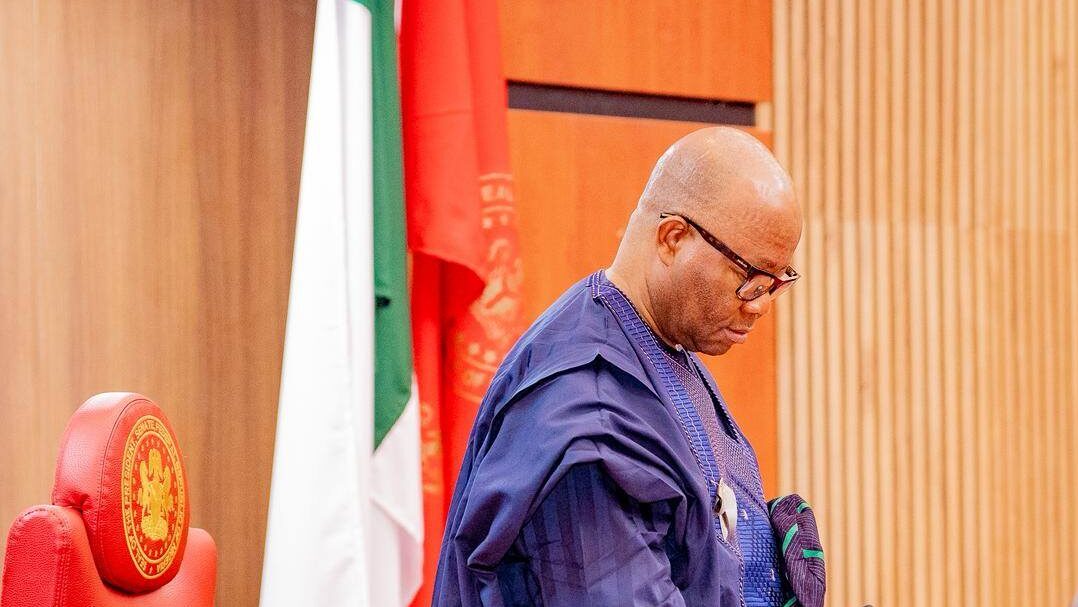
They met with the President of the Senate, Godswill Akpabio, and asked him to facilitate the appointment of a governing council, a vice-chancellor, and other principal officers for the university.
Their meeting with Mr Akpabio revealed a deeper layer of the problem.
According to Mr Akpabio, there is a split within the government over the institution’s future. Some officials favour retaining the academy structure while granting it degree-awarding powers, similar to the Nigerian Defence Academy. He explained that the reason is funding.
According to Mr Akpabio, as an academy, the institution receives funds from agencies such as the Nigerian Maritime Administration and Safety Agency (NIMASA) and international bodies. He argued that a full transition to a university would place it under the Federal Ministry of Education, where funding and oversight differ.
“You have spoken tonight about your preference for a Maritime University. I will convey your decision,” Mr Akpabio told the delegation after deliberations.
The exchange exposed a central tension in the institution’s transition: the choice between legal compliance and financial convenience.
In January 2026, a group within the host communities, the Oro Youth Movement, reinforced pressure by writing to the minister of Marine and Blue Economy, describing the delay as “undue” and calling for immediate implementation of the law.
Financial records reviewed by PREMIUM TIMES show why the status quo has remained attractive.
Under Section 16 (2) of the NIMASA Act, the agency must remit at least five per cent of its annual revenue to the Maritime Academy of Nigeria. This provision has generated billions of naira for the academy.
Between 2021 and 2024, NIMASA remitted N12.21 billion to the institution. Records from NIMASA financial statements show that in three years alone, the agency remitted N12.21 billion to the academy: