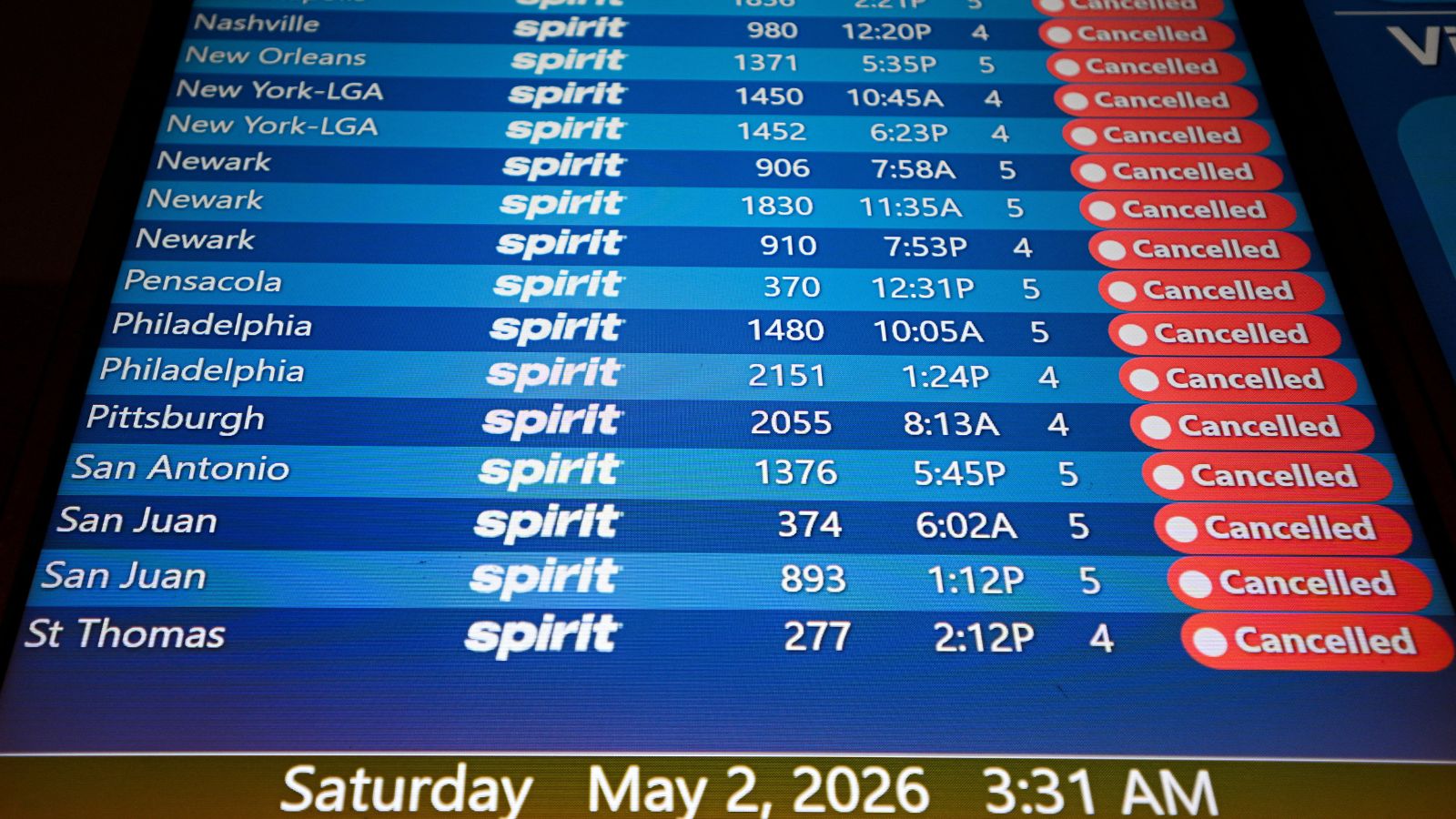
Bankrupt budget carrier Spirit Airlines has ceased operations, becoming the first major aviation casualty linked to the ongoing Iran war, after failing to secure creditor support for a US government-backed rescue plan, news agency Reuters reported.
The airline said it had “started an orderly wind-down of our operations, effective immediately,” with all flights cancelled and passengers advised not to go to airports, another news agency Associated Press reported. The shutdown ends a 34-year run for the ultra-low-cost carrier that once accounted for about 5% of US flights and employed roughly 17,000 people.
The collapse is also a political setback for US President Donald Trump, whose administration had proposed a $500 million bailout in exchange for warrants equivalent to 90% equity, Reuters said. Talks, however, ended without agreement.
Fuel price shock from Iran war triggers collapse
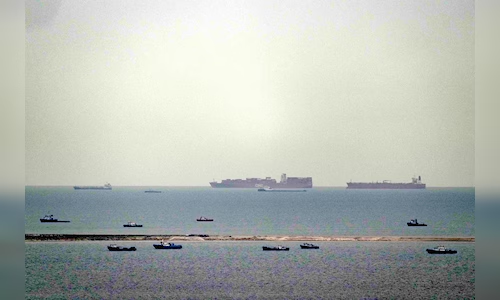
The immediate trigger was a sharp spike in jet fuel prices following a disruption in the Strait of Hormuz during the Iran conflict, Reuters reported.
Spirit said “the recent material increase in oil prices and other pressures on the business have significantly impacted [its] financial outlook,” according to Reuters.
Its restructuring plan had assumed jet fuel prices of around $2.24 per gallon in 2026, but costs surged to about $4.51 by late April, effectively derailing its bankruptcy exit strategy, Reuters said.
Jet fuel typically accounts for about a quarter of airline operating expenses, making low-cost carriers especially vulnerable to price shocks.
Story continues below this ad
Industry faces worst crisis since Covid-19
The Iran war has pushed the global aviation sector into its deepest crisis since the Covid-19 pandemic, with airlines struggling to absorb soaring costs and operational disruptions, Reuters reported.
Spirit’s failure highlights how weaker carriers are being hit first.
Economist Mohamed El-Erian warned that the war’s spillover effects “risk pushing other fragile businesses over the edge and severely burdening vulnerable households and economies alike,” Reuters reported.
Spirit had already been under pressure post-pandemic, as travellers shifted from bare-bones fares to more comfort-focused flying, undermining the ultra-low-cost model.
Story continues below this ad
Rivals move quickly to fill the gap
Competitors, including JetBlue and Frontier, are already moving to capture Spirit’s market share, Reuters reported.
JetBlue announced expanded services from Fort Lauderdale, one of Spirit’s key hubs, adding 11 new cities and increasing frequencies on existing routes.
Airlines also rolled out rescue fares for stranded passengers:
- Frontier: Systemwide discounts and new summer routes
- JetBlue: $99 fares through midweek
- Southwest, United, American: Capped or discounted tickets
Jobs, passengers, and competition take a hit
The shutdown is expected to put thousands of jobs at risk and reduce competition, likely pushing fares higher, especially for budget travellers, AP reported.
Spirit carried around 1.7 million domestic passengers in February, though its market share had already fallen to 3.9% from 5.1% a year earlier, Reuters reported.
Story continues below this ad
Budget-conscious travellers and leisure flyers are expected to be hit hardest, particularly in markets like Florida and Las Vegas where Spirit had a strong presence.
Bailout effort collapses amid internal divisions
Despite last-minute efforts, the bailout failed amid disagreements within the Trump administration and resistance from creditors, Reuters reported.
Trump said, “If we can help them, we will… but only if it’s a good deal,” according to the report.
Transportation Secretary Sean Duffy also indicated there was little private-sector appetite to rescue the airline, telling Reuters: “If no one else wants to buy them, why would we buy them?”
Story continues below this ad
A creditor close to the deal added, “You can’t breathe life into a corpse.”
A warning sign for global aviation
Spirit’s collapse underscores how geopolitical conflicts are directly destabilising industries far beyond the battlefield. With fuel volatility, disrupted trade routes, and weak balance sheets across airlines, this may not be an isolated failure, Reuters reported.
Stay updated with the latest – Click here to follow us on Instagram
© IE Online Media Services Pvt Ltd