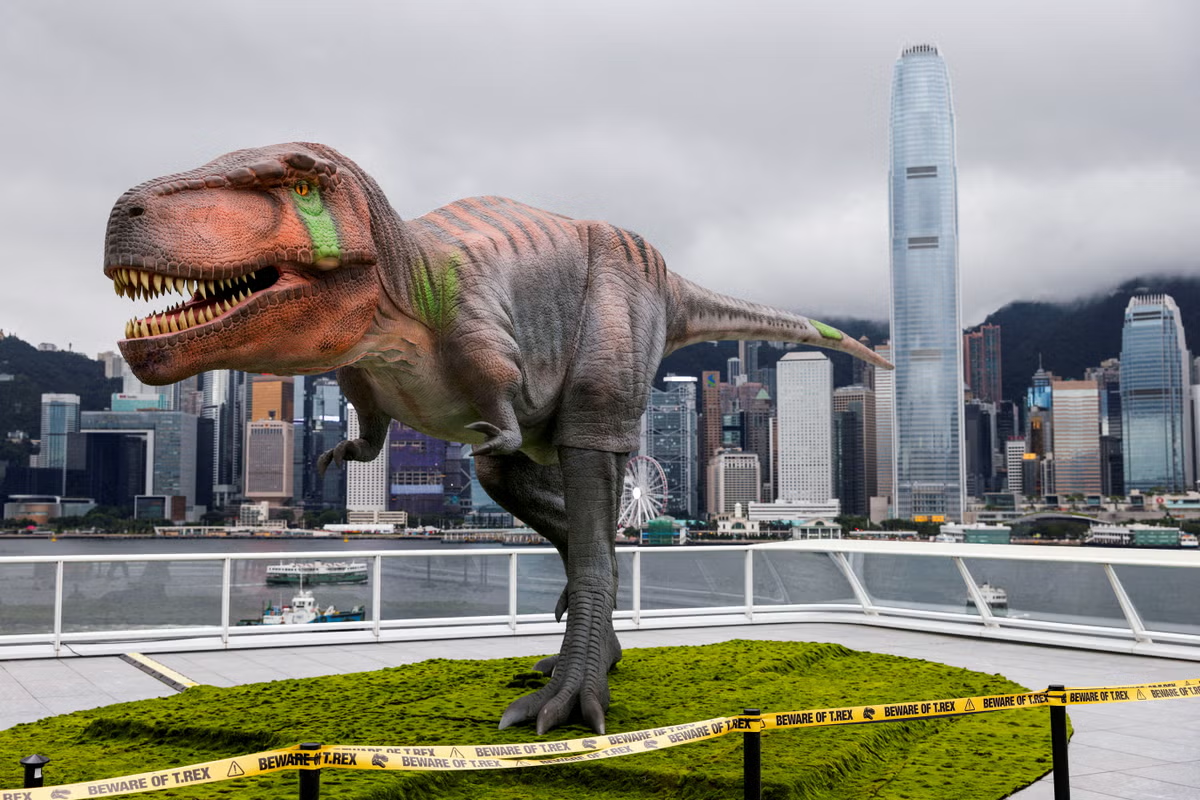
Tyrannosaurus rex, an apex predator of the Cretaceous period, famously sported a massive, 5-foot-long skull designed for bone-crushing bites, yet possessed remarkably diminutive arms.
This peculiar combination of traits was not unique to T. rex; many other meat-eating dinosaurs exhibited a similar anatomical mismatch. Now, researchers have shed light on how this evolutionary paradox came to be.
A new study documents that the robustness of skulls in carnivorous dinosaurs began to evolve first, a direct response to the increasing size of the plant-eating dinosaurs they hunted, shortly after dinosaurs became Earth’s dominant land animals.
This development subsequently led to a reduction in forelimb size. Scientists identified five distinct lineages of theropods – the two-legged group encompassing all meat-eating dinosaurs – where this phenomenon emerged independently, highlighting the significant evolutionary advantages driving these changes.
The tiny arms of T. rex have long been a source of fascination and even humor, inspiring online memes that mock the fearsome predator’s inability to perform simple actions like clapping or scratching its nose. However, the evolutionary journey behind these limbs is far more complex.
Dinosaurs first appeared approximately 230 million years ago during the Triassic Period, subsequently dominating the landscape throughout the Jurassic and Cretaceous Periods before their demise by an asteroid strike 66 million years ago.
Early theropods initially had well-developed arms useful for subduing prey. This began to change with the emergence of increasingly larger plant-eaters, including the colossal long-necked sauropods.
“Body size in dinosaurs increased massively from the Triassic to the end-Cretaceous, so it’s likely that the increase in body size drove some theropods to shift towards using their heads more than their limbs in hunting. Effectively, the forelimbs became redundant in hunting,” explained Charlie Scherer, a University College London doctoral student in paleontology and lead author of the study published in the journal Proceedings of the Royal Society B.
Scherer further elaborated on the selective pressures at play: “Natural selection will act on the traits which allow an animal to survive and thrive in its ecosystem.
If that means sacrificing the size of the arms for a stronger head, which is the primary weapon for the animal, then that’s likely what will happen.” The researchers developed a new methodology to quantify skull robustness, considering factors such as skull dimensions, bite force, tooth shape, and cranial bone-fusion patterns.
Tyrannosaurus, which roamed North America during the Cretaceous, scored highest in this metric, followed by Tyrannotitan from Cretaceous South America.
The study revealed a close association between increased skull robustness and forelimb reduction.
The theropod lineages exhibiting this phenomenon included tyrannosaurs (such as Tyrannosaurus), carcharodontosaurs (such as Carcharodontosaurus of Cretaceous Africa), megalosaurs (including Megalosaurus of Jurassic England), ceratosaurs (such as Ceratosaurus of Jurassic North America and Europe), and abelisaurs (including Abelisaurus of Cretaceous South America).
These groups comprised apex predators that relied on their large body size and powerful jaws to tackle various types of large plant-eating dinosaurs, from sauropods to horned, armored, and duck-billed dinosaurs. Eoabelisaurus, which lived in Jurassic South America about 170 million years ago, was one of the earliest theropods to display this trait.
Interestingly, some lineages of large theropods retained long, strong arms, such as Spinosaurus from Cretaceous Africa and Megaraptor from Cretaceous South America.
These dinosaurs “have incredibly large and mobile arms for their body size, which suggest a more prominent role for them in hunting compared to something like T. rex,” Scherer noted. Smaller theropods, including the lineage that eventually led to birds, also maintained useful arms.
For theropods like Tyrannosaurus, the precise function of their small arms remains a puzzle. Not only were their length and strength diminished, but T. rex also retained only two fingers on each hand.
“Potentially, they did nothing with them – they were just useless. This raises the question: why did they have tiny arms, rather than no arms? If the tiny arms are still there, then it is possible that they still retain some kind of function that we are not aware of,” pondered Paul Upchurch, a University College London paleontologist and study co-author.
However, Upchurch finds this unlikely, suggesting “something else is going on.” He explained that when an anatomical structure loses its utility, genetic changes can lead to its reduction, preventing the animal from expending energy and resources on something unnecessary. Yet, genetics are complex, and often, genes have multiple roles.
“For example, a gene might be involved in building something that the animal no longer needs, but the same gene might also be doing something in another part of the body that the animal does still need. This means that the gene is maintained because it is still doing something useful, so the useless structure persists in a reduced form rather than disappearing completely,” Upchurch concluded, offering a nuanced perspective on the persistence of T. rex’s famously tiny arms.
More details here...