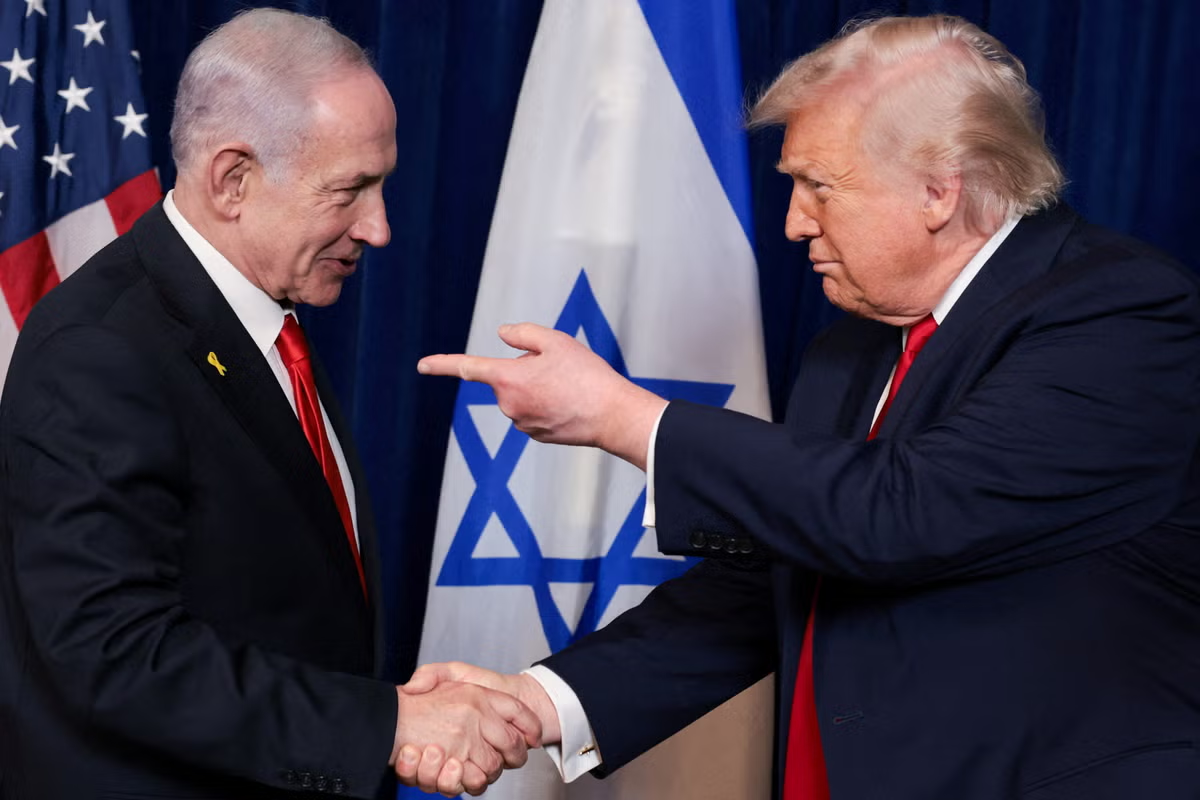
President Donald Trump is demanding multiple Middle Eastern countries join the Abraham Accords as part of an effort to reach a deal with Iran.
Trump said he spoke to leaders in the region about the possibility of them joining the accords, a set of diplomatic agreements aimed at normalizing relations with Israel.
But while some commentators believe the president’s “mandatory request” is aimed at making the mooted peace agreement with Iran more tolerable to its skeptics, critics have accused Trump of “trading one fantasy for another”.
In a lengthy post on Truth Social Monday, Trump said: “After all the work done by the United States to try and pull this very complex puzzle together, it should be mandatory that all of these countries, at a minimum, simultaneously, sign onto the Abraham Accords.
“Those countries discussed are Saudi Arabia, The United Arab Emirates (already a Member!), Qatar, Pakistan, Türkiye, Egypt, Jordan, and Bahrain (already a Member!).
“If they don’t, they should not be part of this Deal in that it shows bad intention.”
The United Arab Emirates and Bahrain signed during Trump’s first term in 2020, breaking a longstanding taboo to become the first Arab states to recognise Israel in a quarter century.
Morocco and Sudan followed suit. Trump claimed in his Truth Social post a number of these countries had experienced a “Financial, Economic, and Social BOOM” as a result.
“The reason for this is that the Abraham Accords have been great for them, and will be even better for everybody, and bring true Power, Strength, and Peace to the Middle East for the first time in 5,000 years,” he added.
The Abraham Accords were first signed between Bahrain, Israel, and the United Arab Emirates in 2020 with the aim of establishing diplomatic normalization between the countries.
But Trump faces potential resistance from some of the nations on his list, even acknowledging in his post that “it may be possible that one or two have a reason” not to sign up.
Pakistan has already rejected the idea, having previously said it will not recognise Israel until the establishment of an independent Palestinian state.
None of the other countries has so far publicly reacted to Trump’s demand and a positive response was unlikely when the public mistrust of Israel in Muslim nations remains high over the scale of its military offensive in Gaza. Israel also has yet to comment.
Saudi Arabia’s Crown Prince Mohammed bin Salman told Trump in November 2025 that the kingdom was open to joining the Abraham Accords, so long as there was “a clear path” toward a two-state solution for Palestine.
Egypt, Jordan and Turkey already have diplomatic relations with Israel, even as those ties have been strained since the start of the Gaza war.
“Trump is trying to sell an Iran deal as an Abraham Accords sequel: good for Israel, good for the region, tough enough for Washington,” said Ali Vaez, Iran project director at the International Crisis Group.
“But he is trading one fantasy for another — from forcing Iran to surrender to pretending a fragile deal can anchor a new Middle East order.”
After claiming two days ago that the peace deal with Iran was “largely negotiated”, Trump has since dialled back expectations by claiming the US was “in no rush”.
The president made the Accords announcement on Memorial Day, when the U.S. commemorates fallen military personal, and as he faced fierce criticism from members of his own party who believe the peace deal will only embolden Iran further.
It remains to be seen whether Trump’s Accords push will alleviate that domestic backlash, as he looks to extricate the US from a war that has proven to be very unpopular among American voters feeling its economic consequences.
South Carolina senator Lindsey Graham, who has long pushed for military action against Tehran, had said allowing Iran to “terrorize” the Strait of Hormuz and damage regional oil infrastructure would be a “major shift of the balance of power in the region and over time will be a nightmare for Israel.”
However, in a second statement on Sunday, Graham hailed Trump’s suggestion that these countries join the Abraham Accords as a “brilliant proposal”.