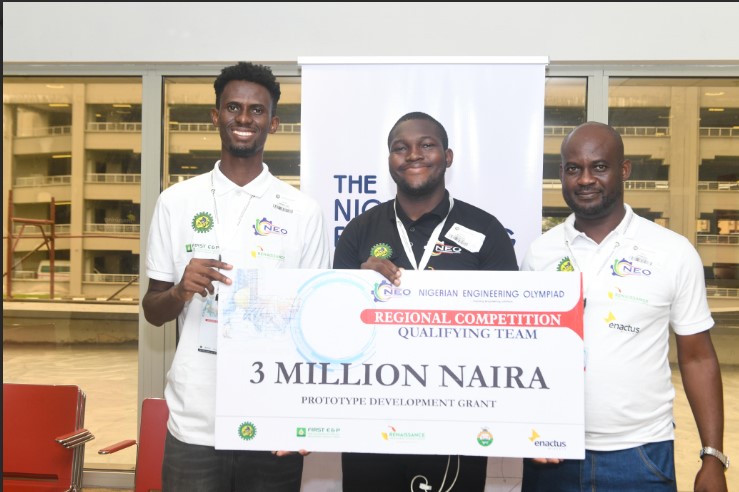
The competition is a nationwide engineering, innovation and entrepreneurship competition launched in 2025 by a non-profit Organisation, Enactus Nigeria, in partnership with the Nigerian Content Development and Monitoring Board (NCDMB) and three others
The University of Port Harcourt, represented by innovation Team PROTRONICS, and the University of Benin, by Team VHORDE, on Monday at the Nigerian Content Tower (NCT), Yenagoa, emerged winners from the South-South region in the Nigerian Engineering Olympiad (NEO).
The competition is a nationwide engineering, innovation and entrepreneurship competition launched in 2025 by a non-profit Organisation, Enactus Nigeria, in partnership with the Nigerian Content Development and Monitoring Board (NCDMB), Renaissance Africa Energy Company Limited, First Exploration & Petroleum Development Company and the Nigerian Society of Engineers (NSE).
The two teams eclipsed their counterparts from the Igbinedion University, Okada, Edo State, Federal University of Petroleum Resources (FUPRE), Effurun, Delta State, and University of Uyo, Uyo, Akwa Ibom State, in the competition, where they showcased hardware and software prototypes developed to serve as innovative solutions to real-world challenges, with specific reference to Nigeria and Africa.
From Team PROTRONICS was KEYTRIC, which the group presented as “SMART POWER CONTROL Made Effortless” and “Automating electricity usage using intelligent locking systems.” For Problem Statement, the Team highlighted high electricity bills, electricity fire risk and expensive smart home, and proceeded to list gaps in existing solutions. They include costly installation, as change in wiring is required; lack of integration between security and energy, and dependence on the Internet.
The Team’s solution is “A smart energy door lock that switches off a user’s electricity supply when they lock to leave the house.” According to the students, their solution saves money on electricity bill, reduces the risk of electric fire accident, and is affordable to everyone.
Team VHORDE of the University of Benin made a presentation on what it terms IRIS, Intelligent Real-time Interface for Sight, pointing out that there are 4.5 million visually impaired Nigerians who are in some way incapacitated and unable to live life to the fullest. The students displayed an IRIS pack, which consisted of TOF sensors, wearable glasses, microphone, camera and Haptic feedback.
On how the IRIS works, the smart glasses, which consist of camera, depth sensor, and edge AI (Artificial Intelligence) processor, enable a visually impaired person to see and understand the world in real time. There is also an AI Compute Unit, to be worn at the waist, which “runs CNN (convolutional neutral network) object detection, face recognition, and voice processing on-device.”
In a section on Business Model and Revenue Streams, the team indicated production-scale pricing for IRIS Standard as N699,000 (one-time purchase. IRIS Standard has the following functions: real-time object and scene identification, familiar face recognition, obstacle and hazard detection (haptic wristbands), natural voice interaction, Edge AI – fully offline core functions, and OTA software updates via Wi-Fi.
In an assessment of the prototypes and demonstrations made, one of the key judges of the competition, Dokubo Obongo, an engineer and Manager, Institutional Strengthening, at the NCDMB, described all the presentations as “top-notch,” noting that “There are solutions that are viable – marketwise – relevant to our society and the challenges we face.”
He explained that the Engineering Olympiad is “a competition targeted at developing home-grown solutions from research and development from Nigerian universities.” According to him, “the idea is to see how we can proffer solutions to our own problems,” which means creating business opportunities.
Speaking for Enactus Nigeria, the group’s Country Director, Mr Michael Ajayi, said the two top finalists from the six geopolitical zones would move to a boot camp for further preparation towards the main national championship, and that the best three teams would share N100 million. He also disclosed that each of the 30 teams that displayed prototype technology in the regional competition would receive N3 million.
Team PROTRONICS of the University of Port Harcourt had as Team Lead Dr Victor Jinn (Faculty Adviser), while the contestants were Chukwuma Sunday-Odu, Fubara David Otokini, and Ekemini Godwin Akpan. Team VHORDE of University of Benin had Anoint Oritsetimeyin Igorki, Oghosa Derick Osarobo, Uti Henry Eworitsewarami, Jada O Godfrey-Ariavie, Richard O.Enegbuna, Momodu O Olayemi, and Asemota G Ayevbosa.