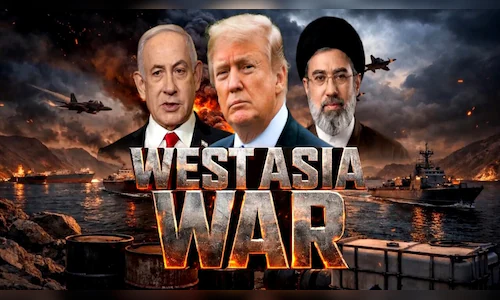
Meanwhile, the global economy has borne the brunt of the conflict, largely due to disruptions around the Strait of Hormuz, a critical passage for about one-fifth of global oil shipments. The result has been an immediate domino effect, pushing up the costs of transport, food, and other essentials.
Now, the Trump administration is signalling an important announcement on West Asia and “good news” on the Strait of Hormuz within hours. Here are the key developments from the last 24 hours:
- Saturday, May 23: Indian Prime Minister Narendra Modi met US State Secretary Marco Rubio and discussed the war in West Asia, among other things.According to spokesperson Tommy Pigott, Rubio assured the US will not let Iran “hold the global energy market hostage” and ensured US energy supply to India. This would trigger a lengthy statement from Iran.
Rubio, on behalf of Trump, also invited Modi to the White House.
- Saturday, May 23: A delegation of Pakistani leaders returned from Iran after a round of negotiations with Iranian officials in Tehran. Reza Amiri Moghadam, Iranian ambassador to Pakistan, said, “a positive stride is taking shape”. The delegation included Prime Minister Shahbaz Sharif and Field Marshal Seyed Asim Munir, Deputy Prime Minister and Foreign Minister Ishaq Dar, and Interior Minister Mohsin Naqvi.
- Saturday, May 23: Iran’s Foreign Ministry said the Memorandum of Understanding is in the “finalisation stage” but expressed doubt over US commitment.
“We may say that we are very far and (at the same time) very close to an agreement,” the ministry’s spokesperson Esmaeil Baqaei told Tasnim News Agency.
“On the one hand, we have the experience of the American side contradicting itself and changing their views. They have expressed contradictory positions many times. We cannot be completely sure that this approach will not change,” he said. - Saturday, May 23: US President Donald Trump said an agreement to end the war is “largely negotiated”. He said it was yet to be finalised with Iran.
Trump said he held a joint call from the Oval Office with Saudi Crown Prince Mohammed bin Salman, UAE President Mohammed bin Zayed Al Nahyan, Qatar Emir Tamim bin Hamad Al Thani, Pakistani Army Chief Asim Munir, Turkish President Recep Tayyip Erdogan, Egyptian President Abdel Fattah El-Sisi, Jordan’s King Abdullah II, and Bahrain’s King Hamad bin Isa Al Khalifa.
He also said he separately spoke with Israeli Prime Minister Benjamin Netanyahu.
- Sunday, May 24: Rubio said “good news” with regard to the Strait of Hormuz would be announced soon. He reiterated that the Strait of Hormuz is an international waterway that Iran can’t own.
- Sunday, May 24: Iran’s semi-official news agency Tasnim News Agency reported Iran’s conditions before agreeing to a deal:
- Release of at least part of Iran’s frozen assets in the first phase
- Mechanism for releasing remaining frozen funds to be defined during negotiations
- Lifting of the naval blockade within 30 days under the understanding of gradual normalisation of shipping through the Strait of Hormuz over a 30-day period, not an immediate return to pre-war levels
- Iran to retain and exercise sovereignty over the Strait of Hormuz, with implementation details to be announced
- Sunday, May 24: As optimism builds over the possibility of the war coming to an end, Iran’s Armed Forces are reportedly ready, whatever the outcome from the negotiations.
“If the Americans once again make a miscalculation and resort to aggression or criminal actions against Iran, they will face ‘Iran’s third version of confrontation’,” Tasnim News Agency reported, citing a military source.