Washington:
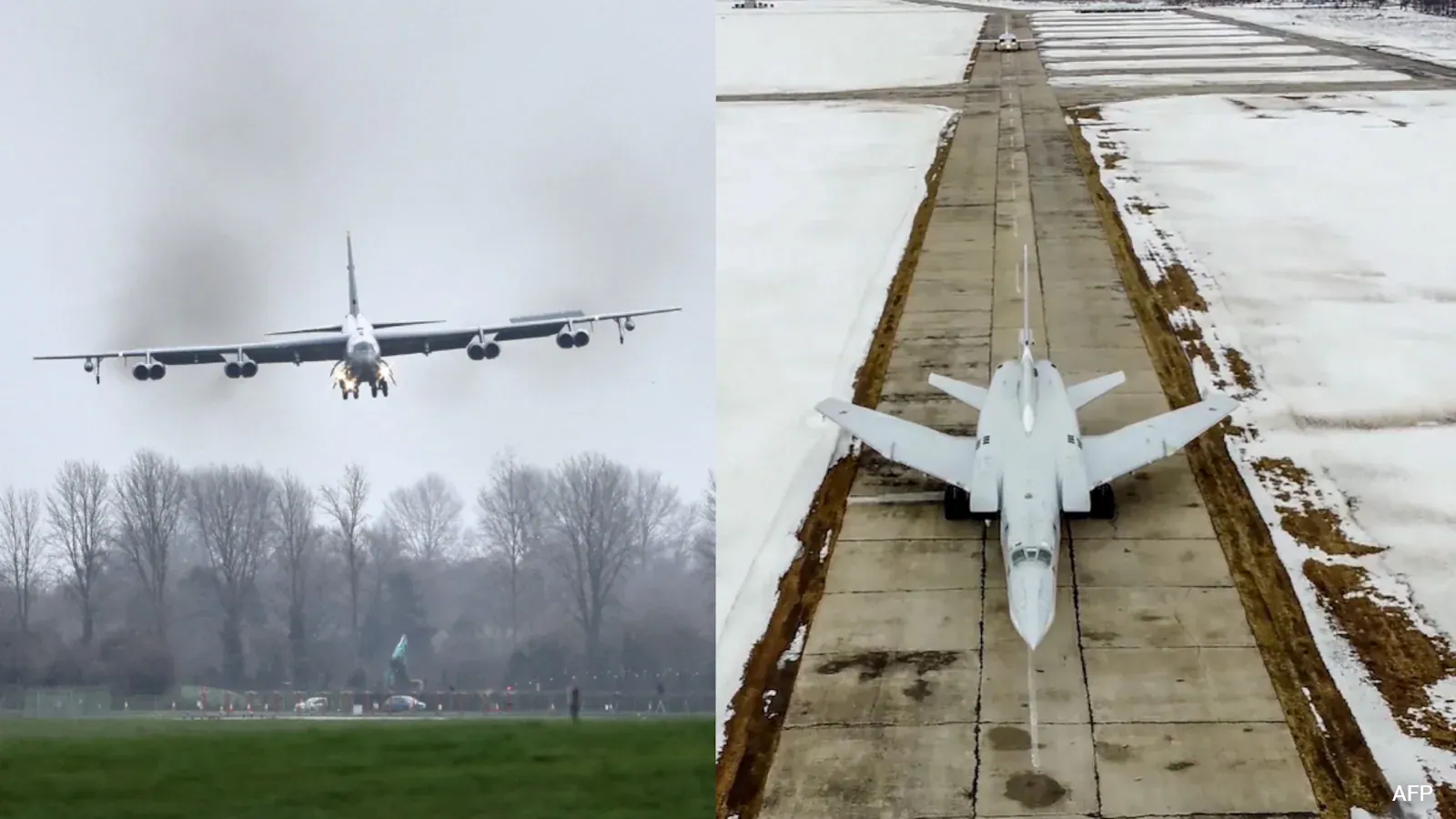
A US Air Force B-52 bomber crashed shortly after takeoff from Edwards Air Force Base in Southern California’s Mojave Desert on Monday, killing all eight people aboard. Miles apart, on the same day, a Russian Tu-22M3 strategic bomber plane crashed in Siberia’s Irkutsk region during a training flight.
The military combat aircraft of the two biggest Cold War enemies were designed to attack the enemy’s ground and naval targets by dropping bombs, even nuclear ones, deploying torpedoes, or launching air-launched cruise missiles.
B-52 Bomber Crash
The US Air Force B-52 Stratofortress bomber crashed on takeoff, bursting into flames and killing all eight crew members aboard, Air Force officials said. The eight-engine, jet-powered aircraft, built to carry a wide array of nuclear and conventional bombs, was on a routine test mission when it went down on the runway at Edwards just after leaving the ground, Air Force Colonel James Hayes told reporters later.
A post-crash video showed a towering pall of black smoke billowing from the crash site, which was visible for miles immediately after the accident. Aerial video footage of the crash scene, about 100 miles (161 km) north of Los Angeles, showed a charred, smouldering patch of the desert floor larger than a football field as an emergency vehicle was seen driving along the site’s perimeter. From a distance, there were no large pieces of debris readily visible in the footage.
All 8 crew DEAD in B-52 bomber crash in routine test flight — CNN
‘Indications are crash was not survivable’ — officialshttps://t.co/Llhou3fYku pic.twitter.com/DwEmKbAhTb
— RT (@RT_com) June 16, 2026
Colonel Hayes said the “mixed crew” of eight aboard the aircraft consisted of government civilians, government contractors and uniformed military personnel. Aerospace giant Boeing, which designed and built the plane, said two of its employees were among the dead.
The flight was intended to support a radar modernisation programme, Hayes told reporters. The cause of the crash was unknown and under investigation, he added.
Air Force officials did not name the victims, saying they were still in the process of notifying their families.
Hayes said the crash was quickly “deemed to be unsurvivable.” Because of damage to the runway, he said, “we’re grounding all operations at Edwards Air Force Base” through at least Tuesday, adding that no operations beyond the base would be suspended.
Monday’s incident marked the first crash of a B-52 Stratofortress since the same type of bomber crashed on the island of Guam in May 2016, according to the Bureau of Aircraft Accidents Archives.
Tu-22M3 Crash
The Russian Tu-22M3 strategic bomber crashed during a training flight, the Russian Defence Ministry said, and the aircraft’s crew had managed to safely eject.
Unverified footage of the crash on social media showed a plane nose-diving into a thickly wooded area not far from the banks of the Angara River, producing a huge column of smoke.
SHOCKING COINCIDENCE: On June 15, 2026, TWO strategic bombers crashed on the SAME DAY — first Russia’s Tu-22M3 in Siberia (4 pilots survived), then US B-52 in California (8 crew died) ❄️🇺🇸
Both Cold War-era aircraft. Both gone in one day. pic.twitter.com/rxZ01MztPX
— RB. (@KailashVashi) June 16, 2026
“The crew ejected. There is no threat to the pilots’ lives or health,” the Interfax news agency cited the Defence Ministry as saying. “There is no damage on the ground. The aircraft was flying without a combat load.”
Irkutsk’s governor, Igor Kobzev, said in a statement that the plane had crashed near the village of Kamenka and that emergency services and medical personnel were on the scene providing necessary assistance.
B-52 Bomber Vs Tu-22M3 Capabilities
The B-52 and Tu-22M3 bombers have remained in service for the US and Russian militaries, respectively, for decades, primarily because no direct successors have been developed that fully replicate their combinations of payload, range, flexibility, and cost-effectiveness.
The B-52 Stratofortress, a long-range, subsonic aircraft built to carry up to 70,000 pounds (31,750 kg) of weapons and supplies, has served as the backbone of the US-crewed strategic bomber force since the Cold War, according to the military.
The swept-wing aircraft has seen several upgradations over the years and is capable of unleashing the widest range of weapons in the US inventory, from cluster bombs and gravity bombs to precision-guided missiles and nuclear warheads, at altitudes of up to 50,000 feet (15,166 m), according to an Air Force fact sheet. Its combat range extends more than 8,000 miles without refuelling.
Only H models of the B-52 remain in the Air Force inventory. The aircraft involved in Monday’s crash was assigned to the 412th Test Wing, which is based at Edwards. Most B-52s are stationed in North Dakota and Louisiana.
The Tu-22, on the other hand, is code-named “Backfire” by NATO. It is a Soviet-era supersonic bomber that Russia has since used for combat missions in Syria and Ukraine. It is a modernised version of the original Tu-22 plane, which can deliver Kh-22 (AS-4 Kitchen) air-launched cruise missiles as well as the air-launched hypersonic Kinzhal “Dagger” missiles, according to the Bulletin of the Atomic Scientists.
Also, much like the B-52, the Tu-22 has also been the focus of upgrades, sustainment, and modernisation efforts since entering the Russian fleet in the 1960s. The most modern variant, the Tu-22M3s, emerged in 2018 and is reportedly capable of high-altitude, stand-off-range bombing with
Both the US and Russia have made very conservative investments in developing new designs of large bombers like the B-52 and Tu-22 after the end of the Cold War. Washington and Moscow are currently developing new generations of intercontinental-range strategic bombers under the respective B-21 and PAK DP programmes, but both nations are facing significant delays.