Some 50 million Africans have been connected to electricity in the space of just two years through what has been described as an “unprecedented” partnership between development agencies including the World Bank, the African Development Bank (AfDB), and the Global Energy Alliance for People and Planet.
Energy access in Sub-Saharan Africa is a perennial problem, with the number of people on the continent without electricity remaining stuck at 600 million for some time, due to the rate of connection broadly keeping pace with the rate of population growth.
With countries including the US, UK and France cutting their foreign aid budgets, there have been concerns that electrification efforts would stall due to diminishing grant-based finance being available for energy projects in African markets that often struggle to attract commercial investment.
But a pioneering partnership set up in 2024 that is aiming to connect 300 million people to electricity by 2030 – called Mission 300 – has made serious progress in global electrification efforts. The connection of 50m people represents around four per cent of the continent’s entire population. Much of Mission 300’s work has been around developing financial solutions to support small startups that are developing renewable power projects.
“This kind of donor collaboration is unprecedented at this scale, and we are a template for others to follow,” says Wale Shonibare, director for energy financial solutions and policy at AfDB. “I did not use to have meetings with the World Bank every week, it was almost like we were in competition trying to do this. But now we are in complete collaboration… [And] we are saying: If you’re a donor in the energy sector, then this is the best game in town.”
William Madara from the Global Energy Alliance, a Mission 300 partner that is a philanthropic body backed by the Rockefeller Foundation, the UN-backed group Sustainable Energy for All and the Bezos Earth Fund, adds that the 50 million achievement is a “huge milestone”, driven by major progress in both grid connections and off-grid solar power connections.
“Mission 300 is not your usual big ambition that is announced at a fancy event somewhere and then forgotten about. This is a real program, with real people, real money behind, and real commitment from countries,” says Erik Fernstrom, regional director for infrastructure in East and Southern Africa at the World Bank Group.
“In the past we would be very proud to bring the press to one little mini grid somewhere and say this is fantastic… But now [under Mission 300] we are inaugurating a mini grid every week,” he continues. “[50m] is not just a number: this is 50m people whose lives have been completely transformed and who now have been given a chance for a modern life.”
Top power connection performers under the initiative so far include Tanzania (with 7.5m people connected), Ethiopia (4.6m), Nigeria (4.5m), Uganda and Mozambique, with several others also achieving notable success, according to Fernstrom.
The model that Mission 300 has adopted has seen 30 countries across the continent submit energy access plans known as “National Energy Compacts”, which detail policy reforms – as well as the pipeline of projects – that countries intend to carry out to complete their share of the 300 million people connected by 2030.
The plans factor in several development priorities, including generating the lowest-cost renewable energy for a given country, expanding off-grid power for remote communities, improving transparency in state utilities, and developing systems to support cross-border electricity trade. “The proposed Grand Inga dam in the Democratic Republic of the Congo is supposed to generate 40,000 megawatts (MW), enough to power much of the continent, so this cannot be developed on the basis of a single national utility signing the off-take agreement to buy the power,” explains AfDB’s Shonibare about the last of those priorities.
Once submitted, the plans enable Mission 300 partners to provide technical assistance that help countries develop policies and financial packages that are tailored to their different realities. This is important given how some countries, like Kenya and Ghana, already have more than 70 per cent of people connected to power, while others, such as Chad or South Sudan, have less than 15 per cent connected.
Much of Mission 300’s work has been around developing financial solutions to support small startups that are developing innovative renewable power solutions, instead of the “100-year-old, General Electrics of the world,” says the World Bank’s Fernstrom. “We are not just helping them invest, we are actually helping them build [as companies], because these are not companies with multi-billion dollar balance sheets,” he adds.
The launch of Mission 300 in 2024, months before the effective shutdown of the US Agency for International Development (USAID) the following year by Donald Trump, has helped shield Africa’s electricity access efforts from the worst effects of sweeping aid cuts. “I think that without Mission 300, we would be having a much harder time attracting the kind of financing we see in the energy space in Africa right now,” says Fernstrom.
The partnership has been assisted by the fact that private investors are now much more open to backing renewable power technologies like solar and wind whose costs have plummeted in recent years. But Mission 300 is still fighting for every bit of grant funding that it can get from foreign aid agencies, philanthropies, or the sovereign wealth funds that have recently been created in countries including Nigeria and Gabon.
“Whether it was the electrification of the rural US in the 1930s, or energy for rural Africa today, it’s very hard to go deep into remote areas and electrify without some type of subsidy,” says Fernstrom. “But we have a platform that fits very well with a much scarcer funding environment, and we are able to show partners the entry points where they can get results with limited resources, and they can be part of a bigger movement.”
Grants put towards Mission 300 are used strategically to attract commercial lenders, rather than serving as the primary source of finance. A key success of Mission 300’s work has also been the increased engagement of Africa-based financial institutions, which are sitting on an estimated $4 trillion (£3 trillion) in assets. That is instead of waiting for the mega-wealthy asset managers of Europe and the US to turn their focus to Africa.
“I’ve always been skeptical when you hear things like: there is $100 trillion of international capital waiting to come into Africa [from the Global North],” says AfDB’s Shonibare. “Not all capital is equal, and the capital that comes has to understand the risks, and it has to be the right capital for countries.”
Mission 300 has developed new ways to tap domestic capital markets for infrastructure investment, including the first listings of infrastructure funds on local stock exchanges in Nigeria and Kenya.
Too much capital from foreign investors that lend in US dollars also risks worsening the debt crises that many African countries are currently struggling to emerge from. There are currently 21 African countries dealing with, or at risk of, debt distress, with low-income countries currently spending an average of 18 per cent of government revenue servicing foreign debts each year, up from 5 per cent in 2014.
“20 years after the last round of debt forgiveness, countries are once again hitting their debt sustainability limits again,” says AfDB’s Shonibare. “One of the key reasons for default is currency devaluation. If you take a long-term dollar loan to invest in a sector where you’re receiving local currency, you struggle when the value of your currency declines against the dollar.”
If debt sustainability declines to such a point that countries fall under an International Monetary Fund (IMF) programme for help – as recently happened in both Zambia and Ghana – then they will not be able to attract any significant commercial investment. Mission 300 is therefore working hard to structure smart financing solutions in local currencies that will avoid pushing countries into “debt traps,” Shonibare says.
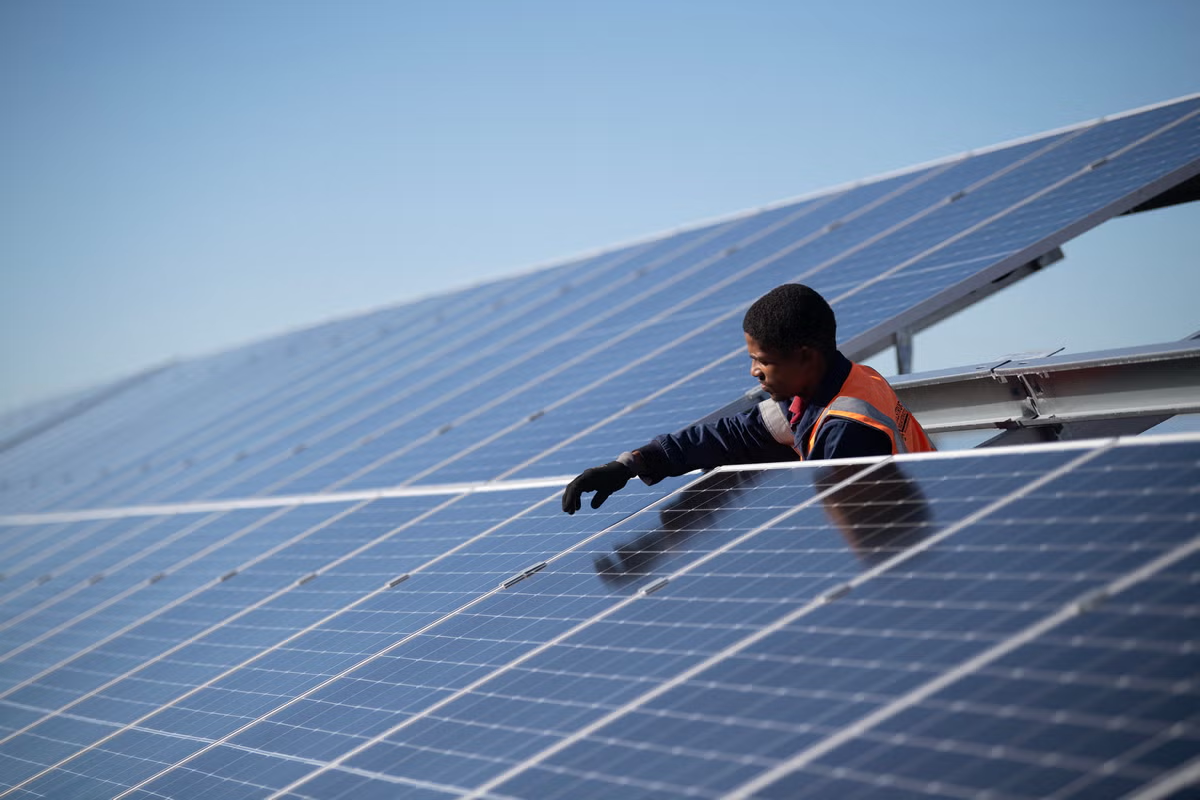
While 50m people connected is a huge achievement, achieving 250m in less than five years will be an even bigger challenge. A new report from the Global Energy Alliance highlights a host of challenges that point to the difficulty of maintaining energy access gains, including the fact that 75 per cent of the 375,000,000 solar kits sold across Africa since the early 2000s are now believed to be in disrepair. Meanwhile in South Africa, the growing use of cheap, off-grid solar has led the country’s national utility to start losing money.
According to Edward Borgstein, a technical advisor at the Global Energy Alliance, Mission 300 needs to now be doing more to develop investable power solutions that reach the most remote communities on the continent. More still needs to be done, too, to attract private capital to investment proposals.
“Reaching the next 50 million will be even harder as we need to get to people who are poorer and further away… It’s much easier to connect areas that are on the edge of the existing grid” he says. “When we really look at industry data, we see that private investment is not increasing, or certainly not at anything like the rate that is needed.”
More details here...