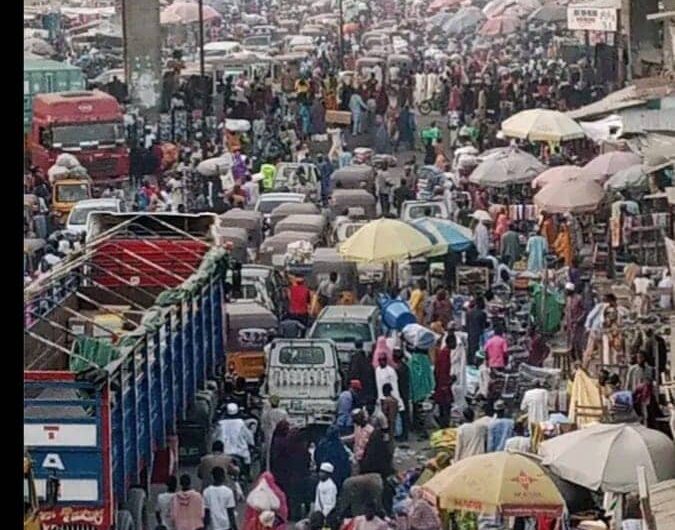
Kwari Market is kept alive by the resilience, adaptation, and determination of thousands of traders and workers who depend on it daily.
As the early-morning sun illuminates the skies, Kwari Market comes alive in the heart of Kano with the rustle of fabrics, the movement of bales, and the rising voices of bargaining.
Inside its dense network of shops and plazas, colourful textiles—laces, shadda, Ankara, chiffon, veils, caps, and imported fabrics – fill every space. Traders call out to customers in Hausa, reflecting a marketplace shaped by decades of cross-border commerce.
Kano State has long stood as one of West Africa’s most important commercial hubs, historically positioned at the centre of trans-Saharan trade routes and today serving as Northern Nigeria’s economic engine for manufacturing, trade, and distribution. Its markets connect producers, importers, and consumers across Nigeria and neighbouring countries in the Sahel and West Africa, reinforcing the state’s identity as a regional commercial gateway.
At the heart of this ecosystem is Kwari Market, the largest textile trading hub in Africa.
But beneath the colour and movement lies a quieter reality.
Prices have climbed sharply. Customers are buying less. Import and customs costs have doubled. Currency instability and insecurity across parts of Northern Nigeria have also reduced the flow of long-distance and foreign buyers into Kano.
Yet, every morning, the market opens.
For over four decades, Kwari Market has stood as one of Africa’s most important textile trading centres. Today, it mirrors Nigeria’s wider economic strain, surviving not because conditions are favourable, but because traders refuse to let it collapse.
According to Ishaq Alkassam, widely known as Balarabe Tatari, Chairman of the Kwari Market Houses, Plazas and Shops Association and former chairman of the market association, the history of Kantin Kwari predates its commercial identity.
He explained that Kantin Kwari was originally a highbrow residential area in Kano, comparable to modern GRA districts such as Nassarawa and Dala.
“It was a residential area where people lived like any other developed part of the ancient city,” he said.
Because Kano has long been a commercial centre, foreign settlers, including Lebanese, Pakistani, Indian, and other West African traders, settled in the area and engaged in trade.
At first, they traded cotton and groundnuts sourced from villages across Northern Nigeria. But as that trade declined, they shifted into importing textiles from their home countries.
“They turned their garages into shops and used their rooftops as sleeping spaces while their cars were moved to the backyard,” he narrates.
Over time, Hausa traders gradually entered the business, first as shop assistants, then as independent traders, expanding the market into what it is today.
Today, the market has about 275 plazas and over 13,000 shops, though the numbers continue to change as more residential buildings are converted into commercial spaces.
“It is not owned by the government; it is owned by individuals. It is an association-driven market, for over 43 years now,” he said.
Despite recent government involvement three years ago, he noted that the market remains largely community-controlled, with about 19 leadership transitions under the association system since its evolution into a major market.
“This market deals in billions of naira. It contributes heavily to government revenue through multiple taxes,” he added.
From loaders and cart pushers to transporters, security guards, and traders, thousands of livelihoods depend on the market daily.
“We even employ over 500 security guards ourselves. The government does not pay them,” he said.
Inside Kwari Market’s tightly packed corridors, traders describe a system stretched by inflation, exchange rate volatility, rising customs charges, and weakening purchasing power. Yet beneath the pressure lies a quieter reality, one of constant adjustment, shrinking margins, and survival strategies that now define daily trade.
A trader, Muhammadu Auwalu, who sells Atampa fabrics imported from Cotonou, said rising costs have significantly reduced profit margins.
“What I used to buy for one million naira is now over two million,” he said.
He noted that despite importing higher-quality fabrics from Cotonou rather than China, low patronage has made profit-making difficult. Some sales now recover only capital, with no real gain.
To stay afloat, he breaks bulk goods into smaller pieces, allowing customers to buy what they can afford while keeping the business running.
Umar Faruk, a lace trader in Gidan Garage (Plaza), said declining sales have forced him into multiple means of survival.
“Some days we don’t make any sales,” he said. “After closing, I do tricycle business.”
He explained that lace purchases that cost ₦300,000–₦350,000 five years ago now go for ₦550,000–₦700,000. Retail prices have also risen from about ₦17,000–₦18,000 to over ₦30,000.
To cope with demand fluctuations, he said he now sells in smaller quantities and relies on seasonal peaks such as Ramadan and festive periods. He also supplies neighbouring shops in bulk, which are then broken into smaller units for affordability, to maintain the business.