When PREMIUM contacted him on the telephone on Saturday, the Executive Secretary of the Borno State Guidance and Counselling Board, Mohammed Jimmeh, dismissed the claim.
The Borno State Government has denied sponsoring former Boko Haram members for enlistment in the Nigerian Army.
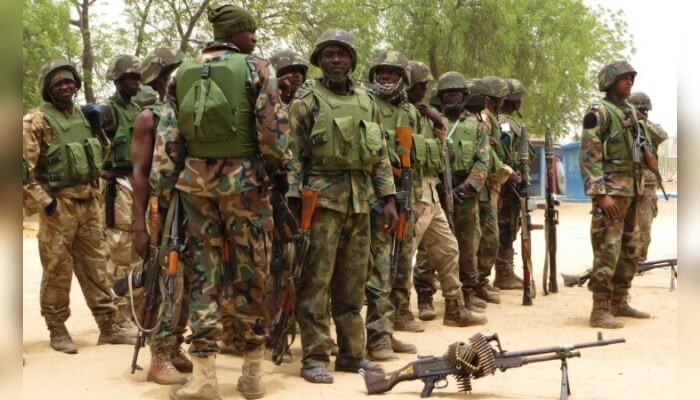
A report by Sahara Reporters on 25 June had claimed that 40 former Boko Haram members shortlisted for the Nigerian Army’s 91 Regular Recruit Intake (RRI) were undergoing medical screening in Borno State.
When contacted by PREMIUM TIMES to confirm the report, the Borno State Commissioner for Information and Internal Security, Usman Tar, referred our reporter to the Borno State Guidance and Counselling Board.
He said the agency is responsible for recruitment support and attestation during military and paramilitary recruitment exercises.
When PREMIUM contacted him on the telephone on Saturday, the Executive Secretary of the Borno State Guidance and Counselling Board, Mohammed Jimmeh, dismissed the claim.
Mr Jimmeh said that neither the state government nor his agency sponsored or recommended any former insurgents for enlistment.
“No, no, that is not true. I am surprised myself when I saw this because I’ve been there throughout the screening,” he said.
Mr Jimmeh said only 732 candidates have so far been enlisted from 3,036 applicants from the state in the ongoing Nigerian Army recruitment exercise.
Those shortlisted were within the last four or five months. They are genuine indigenes, and I don’t think they are associated with what was claimed. As far as I’m concerned, that is not true.”
He stressed that candidates apply independently through the Nigerian Army portal and that the board does not recruit or nominate applicants.
According to him, the board’s role begins after the Army releases its shortlist and includes verifying indigene status and coordinating logistics and support during the movement of successful candidates.
“Candidates apply through the Nigerian Army portal. When the list is published, they come with their credentials, which are checked. Their indigeneship is equally verified before they proceed to other stages of screening,” he said
According to Mr Jimmeh, 3,036 applicants from the state were initially shortlisted through the Nigerian Army recruitment portal.
Of that number, 2,100 candidates presented in person for the screening exercise.
He said only 732 eventually cleared the various stages of screening after undergoing identity verification, medical examinations, physical assessments and other checks conducted during the exercise.
“We have, all in all, 732 now that were successfully screened, which we can confirm by face and by name,” Mr Jimmeh said.
He added that some of the successful candidates had already been transported to the military training depots in Zaria, while others would proceed to Jaji and Osogbo.
Mr Jimmeh said the board deploys two representatives from each of Borno State’s 27 local government areas during the exercise, making a total of 54 officials responsible for verifying applicants’ indigene status.
According to him, the representatives are selected for their familiarity with families and communities in their respective local government areas.
Applicants whose identities cannot be verified are rejected before proceeding to the physical and medical screening stages, he said.
Mr Jimmeh said candidates who fail requirements relating to height, health conditions, physical fitness and other assessments are also disqualified.
He added that the board conducts a final cross-check before successful candidates are transported to military depots.
“We escort them to the depots, cross-check the names with the Army and ensure that only those successfully screened are accepted before we return,” he said.
Asked whether the board had seen or authenticated the alleged list of 40 former insurgents, Mr Jimmeh said it had not.
“No, not at all,” he said.
“Not to my knowledge.”
The official also cited a recent case involving an applicant who presented himself as a Borno indigene but was later found during verification to be from Plateau State.
According to him, the matter was subsequently handed over to military authorities.
“Even the least issue, we detect it and flush it out,” he said.
Mr Jimmeh said the board does not maintain records of rehabilitated or deradicalised former insurgents and plays no role in rehabilitation or reintegration programmes.
“That is not our responsibility,” he said.
“Our responsibility is to ensure that indigenes of Borno access opportunities in the military and paramilitary services and that the recruitment process is transparent.”