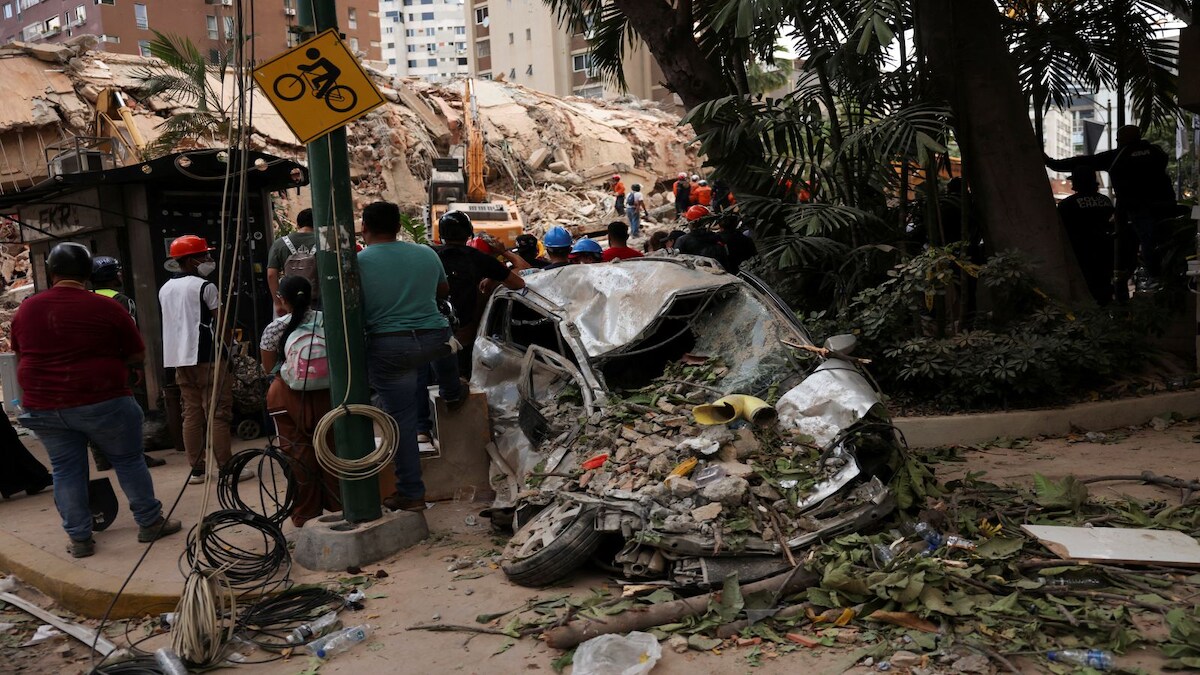
According to the US Geological Survey (USGS), the first earthquake measured 7.2 in magnitude, while the second, a 7.5-magnitude quake, struck just 39 seconds later.
What Is an Earthquake Doublet?
An earthquake doublet occurs when two powerful earthquakes of nearly the same magnitude strike close to each other in both time and location.
In contrast to typical earthquakes, in which a stronger quake is followed by lesser aftershocks, a doublet involves two large earthquakes that are separate seismic events. Although they are linked, each earthquake originates from distinct sources and produces its own seismic waves.
According to the USGS, the first quake hit near San Felipe, the capital of the state of Yaracuy, while the second and stronger earthquake occurred near Yumare just 39 seconds later.
Are Doublets More Dangerous?
Doublets are more dangerous than standard earthquakes as they feature two similarly strong quakes hitting in close succession. It can cause greater destruction because people have little or no time to recover after the first earthquake. In Venezuela, the second earthquake began rumbling before the first had even concluded.
“Double earthquakes are very destructive. The main difference is that double earthquakes have similar energy, whereas (a) single earthquake and (smaller) aftershocks are lesser in energy,” Raul Perez-Lopez, an earthquake scientist at Madrid’s Geological and Mining Institute of Spain, was quoted as saying by CNN.
Why Are Doublet Earthquakes So Rare?
Earthquake doublets are relatively rare, but they do occur. One of the best-known recent examples occurred in Turkey and Syria in 2023, when two major earthquakes measuring 7.8 and 7.7 struck about nine hours apart. Another example is the 1988 Tennant Creek earthquake series in Australia, where a triplet of strong earthquakes occurred just half an hour apart.
Why Is Venezuela Prone To Earthquakes?
Venezuela lies along the boundary between the Caribbean Plate and the South American Plate. These plates constantly slide past each other in the northern parts of the country. The plates move at a rate of about 20 millimetres a year.
The movement of these tectonic plates produces large strike-slip faults, making the region vulnerable to frequent shallow earthquakes, and a few of them can be damaging. The country has experienced several major earthquakes in the past, including the 1900 7.7 Caracas earthquake and another strong earthquake in 1967 with a magnitude of 6.5.
(Edited by : Priyanka Deshpande)