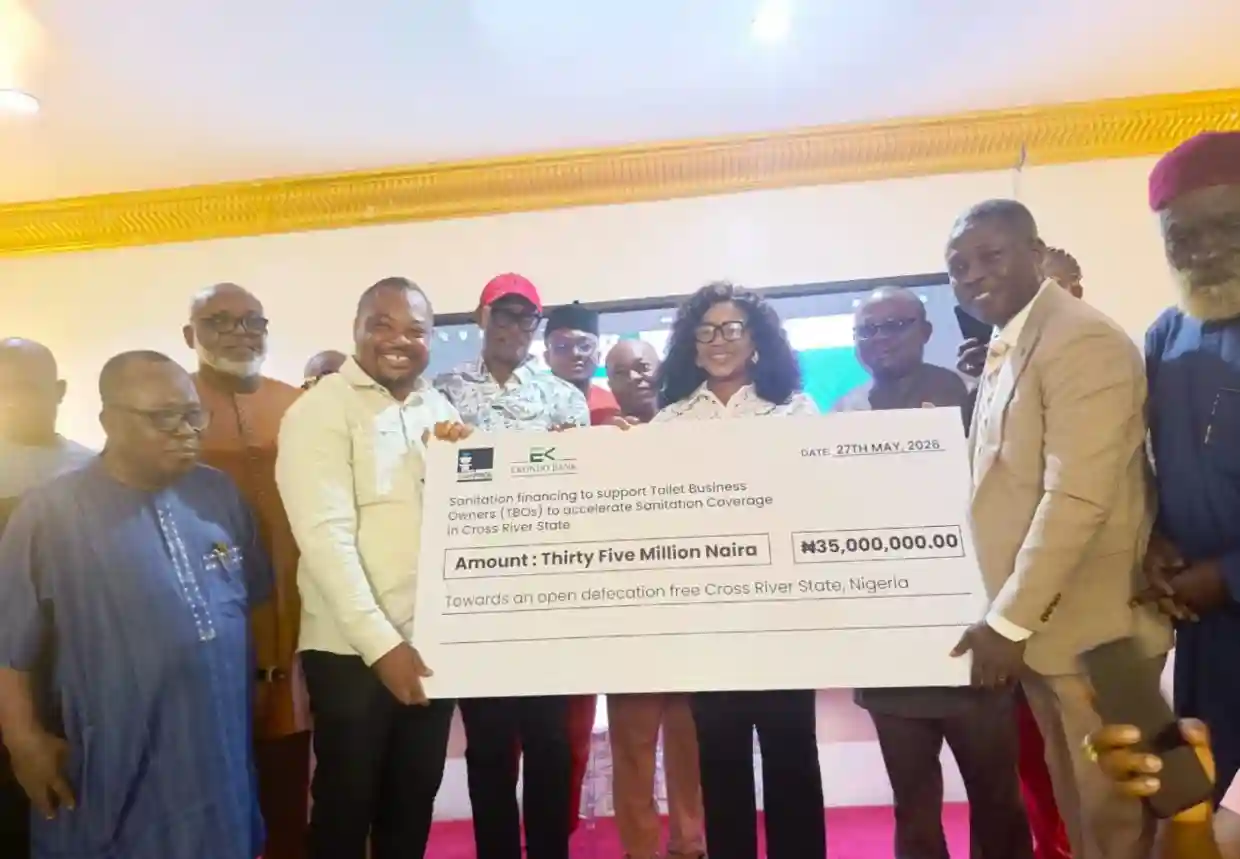
Cross River State has launched a N35 million sanitation financing scheme aimed at supporting small businesses operating within the sanitation value chain, as part of efforts to tackle open defecation and improve public health across the state.
The initiative is being driven through a partnership involving Ekondo Microfinance Bank, ToiletPride, the Cross River State Government, and Self Help Africa (SHA) under the WASH Systems for Health Programme.
The agreement was formally signed during a cheque presentation ceremony held in Calabar, where stakeholders described the move as a major step toward expanding market-based sanitation solutions in the state.
Under the pilot phase of the programme, 50 Toilet Business Owners (TBOs) will receive loans ranging from ₦300,000 to ₦500,000 to support sanitation-related businesses and improve access to toilet facilities in underserved communities.
The first phase of the rollout will focus on Yala, Obubra, and Odukpani local government areas, which were identified as locations with significant sanitation challenges.
Speaking during the event, Executive Director of ToiletPride, Mr Chukwuma Nnanna, said sanitation should no longer be treated as a social intervention alone, but as a viable business sector capable of creating jobs and improving livelihoods.
“Our assessments indicate that the sanitation economy in Cross River State is worth over N150 billion. That represents tremendous potential for small businesses to improve livelihoods,” he said.
According to him, the financing arrangement reflects a deliberate transition toward Market-Based Sanitation, where sanitation services are developed through sustainable business models rather than dependency on grants and donations.
Nnanna explained that beneficiaries were selected from an existing network of Toilet Business Owners who had already undergone enterprise training organised by ToiletPride and development partners under the WASH Systems for Health Programme.
He noted that only trained operators within the established TBO structure qualified for the loan support, adding that the goal is to build financially sustainable sanitation enterprises across rural and urban communities.
Managing Director of Ekondo Microfinance Bank, Mr Charles Abiola Efedoama, described the partnership as both a commercial and public health investment.
He said the bank sees long-term potential in sanitation financing and expressed optimism that the programme would eventually expand beyond the pilot communities.
“Stable health conditions always follow good sanitation practices,” Efedoama said.
He added that the bank remains interested in supporting sanitation businesses capable of improving hygiene standards while also generating economic value.
State Coordinator of Self Help Africa (SHA), Mr Ferdinand Anok, said the involvement of a financial institution in sanitation financing shows that investments under the WASH Systems for Health Programme are beginning to produce measurable results.
“The fact that we’re seeing banks step in shows that these investments are yielding positively,” he stated.
Cross River State Commissioner for Water Resources, Barr. Bassey Mensah, welcomed the initiative and stressed the importance of stronger collaboration among stakeholders to address sanitation and water challenges across the state.
He also raised concerns over illegal borehole drilling activities, accusing some operators of bypassing mandatory soil analysis and water quality testing procedures.
According to him, some drillers now operate secretly at night to avoid regulatory charges, a development he said threatens public safety and undermines government efforts in the water sector.
“This is sabotaging the Government’s effort to protect the lives of the citizenry and we need the support of every stakeholder to succeed,” Mensah said.
General Manager of the Rural Water Supply and Sanitation Agency (RUWATSSA), Hon. Sunday Oko, urged beneficiaries to ensure the loans are properly utilised for business growth and sanitation expansion.
He warned against treating the intervention as free government support, insisting that repayment and accountability would determine the sustainability of the initiative.
Earlier, Chairman of STG-WASH and Permanent Secretary at the Ministry of Water Resources, Dr Okon Ita, revealed that about 41 percent of Cross River residents still practise open defecation.
He described the figure as a serious public health concern and said partnerships involving private businesses and financial institutions have become critical to achieving the state’s Open Defecation Free (ODF) targets.
With the latest financing initiative, stakeholders believe Cross River could begin to see increased private sector participation in sanitation infrastructure, while also creating new opportunities for small businesses operating within the WASH economy.