“Azerbaijan increasingly sees itself as a connectivity state linking multiple regions.” has been pulled into one of the most sensitive questions surrounding the Israel-Iran war: whether its territory played any role in Israeli operations against Iran.
For more stories from The Media Line go to themedialine.org
Baku has rejected recent reporting that Israel deployed elite military and intelligence units in Azerbaijan as part of a network of covert sites used to facilitate operations against Iran, calling the claim “entirely baseless” and saying it has never allowed its territory to be used for military operations, intelligence activities, or hostile purposes against another state.
The dispute is explosive because Azerbaijan shares a border with Iran, maintains deep security and energy ties with Israel, sells gas to Europe, works closely with Turkey, communicates with Russia, and has spent years trying to avoid a direct rupture with Tehran. In a region where geography can be a leverage or a liability, Baku is trying to turn proximity to conflict into diplomatic influence without being pulled into the wars around it.
That is the central difficulty of Azerbaijan’s position: Its cooperation with Israel is open and long-standing, but the claim that its territory was used for military or intelligence operations against Iran remains disputed and officially denied. The debate has placed fresh scrutiny on a country whose strategic value has grown because of Russia’s war in Ukraine, the crisis around the Strait of Hormuz, and the US-Israel confrontation with Iran.
Fuad Shahbazov, an independent researcher and political analyst based in Baku, strongly disputed the CNN report about alleged Israeli activity in Azerbaijan, saying it relied on anonymous sources and lacked physical evidence.
“CNN failed to refer to any serious or credible source, just reframing it to anonymous sources familiar with the situation,” he said. “The satellite imagery failed to provide any physical evidence of Israelis in Azerbaijan’s side,” he added.
The broader Israel-Azerbaijan relationship goes well beyond energy and rejects the idea that it implies hostility toward Iran.
John Roberts, a UK-based energy, security, and geopolitical analyst specializing in Caspian, Middle Eastern, and Russian energy issues, took a more cautious position. He said Azerbaijan would be deeply unhappy if such information had emerged publicly, but he did not dismiss the reports.
“There were reports concerning just what use Israel may have made of observation points. In order to see how things were developing in Iran,” Roberts said. “I think the Azerbaijanis would be very upset that the information came out, but I have no reason to doubt the information,” he added.
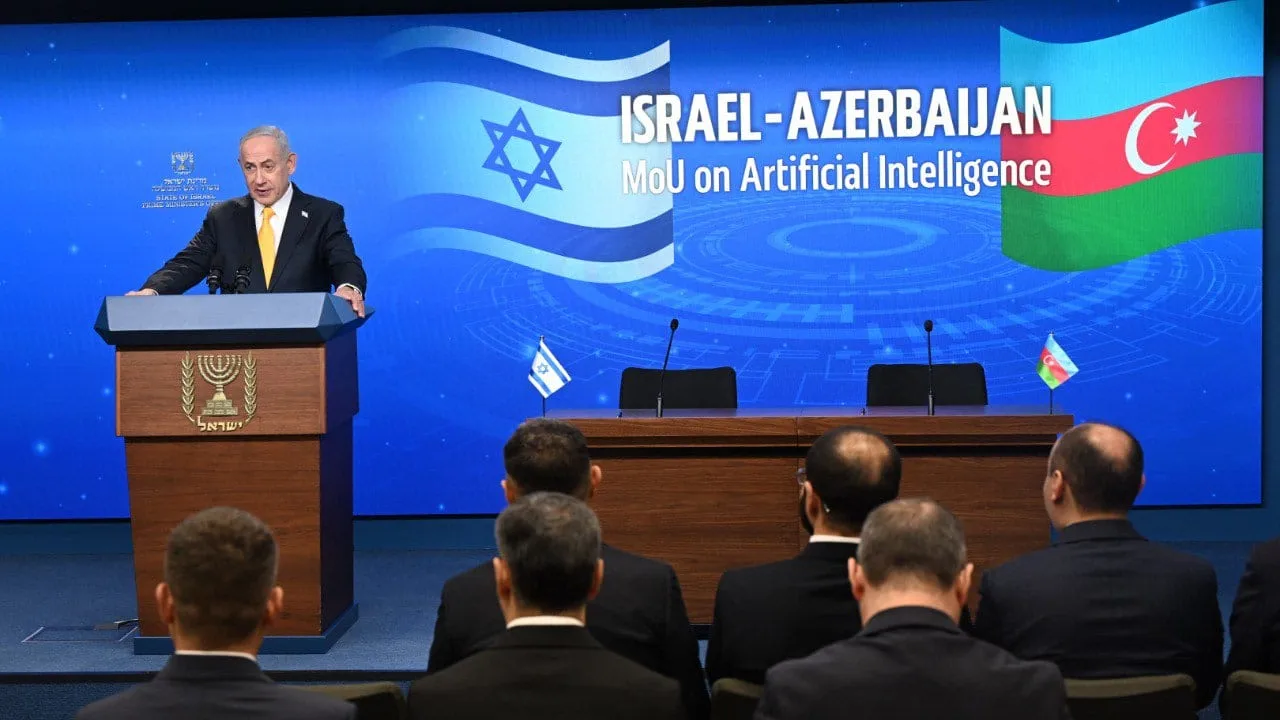
The broader Israel-Azerbaijan relationship goes well beyond crude oil. Shahbazov described Israel as one of Azerbaijan’s most important strategic partners, while stressing that Baku rejects the idea that cooperation with Israel means hostility toward Iran.
“Azerbaijan pursues quite a pragmatic multivector diplomacy, because the country has long sought to maintain productive relations with competing powers simultaneously, rather than joining geopolitical blocs,” Shahbazov said. “Baku consistently argues that cooperation with Israel does not mean hostility towards Iran or Turkey or another Muslim country, because it’s mostly energy and security cooperation,” he added.
Israel views Azerbaijan as a rare Muslim-majority partner with close political, economic, and security ties to the Jewish state, Shahbazov said. Azerbaijan’s border with Iran and its location between the Middle East, the Caucasus, and the Caspian Basin make it strategically valuable to Israel.
Roberts said Israel and Turkey were two key external actors that contributed to Azerbaijan’s military success in Nagorno-Karabakh.
“Turkey, which taught them how to use, operate, and manufacture drones for them. Nagorno-Karabakh was an early use of drones in warfare. And Israel, because it taught some of the elite Azerbaijani troops,” Roberts said.
Shahbazov was even more direct about the defense relationship. “We do not refute those allegations that we have a very, very deep security partnership with Israel,” he said. “This includes intelligence sharing, this includes military technical, defense industry, procurement, weapons supply, even experience exchange with military officers,” he added.
For Israel, Azerbaijan is not a direct gas supplier, but it is a significant oil partner and an increasingly important energy and security counterpart. Shahbazov said Azerbaijan remains Israel’s second main oil supplier and has continued deliveries despite the war.
“Azerbaijan contributes to Israel’s energy security through oil exports,” he said. “Azerbaijan is the second main oil supplier of Israel, even despite the war since 2003. Azerbaijan still systematically and consistently supplies Israel with oil with no interference or with any interruptions,” he added.
Baku walks a fine line between its relationship with Israel and its ties to Iran
Roberts framed the oil relationship in commercial rather than strategic terms. Once Azerbaijani crude reaches Ceyhan in Turkey, he said, it enters the open market, and Israel is one of the nearest customers.
The Israeli connection is also what makes the Iranian dimension so sensitive. Azerbaijan shares a border with Iran and has significant ethnic, historical, and cultural overlap with the Azerbaijani population in Iran. Roberts said Baku has been careful not to make territorial claims or provoke Tehran.
“Azerbaijan is very careful not to make claims over Iranian territory,” he said. “It tried to have good trade relations. It tried to work with the Iranian government over issues like the Caspian. It tried to improve road and rail links with Iran. In no way does Azerbaijan want to upset Iran.”
Both experts said Iran-linked security threats have made Azerbaijan’s position more difficult. In March 2026, Azerbaijan said it had foiled Iran-linked plots against the Baku-Tbilisi-Ceyhan oil pipeline, the Israeli Embassy, an Ashkenazi synagogue, and a Mountain Jewish community leader. A day earlier, Azerbaijan accused Iran of launching four drones at Nakhchivan, injuring four civilians and damaging airport infrastructure; Tehran denied responsibility.
Shahbazov said Azerbaijan also faces the challenge of Iranian sympathizers and possible sleeper cells inside the country.
“It’s quite a complicated question, because there is no specific guideline on how the government will be handling this sleeper cells or Iranian sympathizers issue,” he said. “Since Azerbaijan is a Shia-majority Muslim country, and we have quite a number of Iranian sympathizers, who are not exactly members of Iranian cells, but personally they do sympathize for the regime,” he added.
He also warned that the war had not destroyed the Iranian regime but had strengthened the Islamic Revolutionary Guard Corps.
“IRGC became more powerful and more authoritarian than it was before the war,” Shahbazov said. “So I expect that the IRGC will take control over the country in all spheres, including civilian, diplomatic, and military spheres. So IRGC will be quite a serious problem, even a greater problem than it was one or two years ago,” he added.
Roberts also saw Iran as a revolutionary actor willing to use calibrated escalation across the region.
“It would appear that Iran has a governmental structure that really is quite genuinely revolutionary,” he said. “That fervor is still there.”
Azerbaijan maintains a strong border security capacity, receiving support from both the US and Israel
Iranian attacks beyond its borders can serve a deterrent function, Roberts said, but sustained escalation against Azerbaijan would carry risks for Tehran because Azerbaijan has recently won a war and has capable armed forces of its own.
Shahbazov pointed to Azerbaijan’s border security capacity, noting that it has received support from the United States and Israel. “Azerbaijan is one of those regional states that has a quite effective border security service.”
He said infiltration attempts from the Iranian side continue, but mostly involve smuggling. “There are still some attempts of infiltration from the Iranian side, but mostly those are smugglers, drug smugglers, or the people who are carrying some guns,” he said. “None of them successfully managed to infiltrate into Azerbaijan.”
The dispute over alleged Israeli activity is only one piece of a larger Azerbaijani strategy: staying useful to competing powers without becoming captive to any of them. Baku’s value has grown because it can talk to Israel, Turkey, the European Union, the US, Russia, and Iran, even as many of those actors are increasingly at odds with one another.
That diplomatic flexibility is also visible in Azerbaijan’s approach to Moscow. Roberts said Baku’s policy toward Russia is based on caution, distance, and realism.
“The point about their relationship with Russia is keeping Russia at a distance, being polite, not being unnecessarily inimical, but no full trust in Russia,” Roberts told The Media Line. “Azerbaijan will not go to try to deliberately upset Russia, but it will do things in its own interest that Russia may not be happy with,” he added.
Energy has made that caution more valuable. After Russia invaded Ukraine in 2022, Europe accelerated its search for alternatives to Russian gas. Azerbaijan had already been supplying Europe through the Southern Gas Corridor, a 3,500-kilometer route carrying gas from the Shah Deniz field through the South Caucasus Pipeline, the Trans-Anatolian Natural Gas Pipeline across Turkey, and the Trans-Adriatic Pipeline through Greece, Albania, and the Adriatic Sea to Italy.
The European Commission says Azerbaijani gas supplies to the EU through the corridor increased by more than 40% between 2021 and 2024. It also says the State Oil Company of the Republic of Azerbaijan supplied gas to 14 countries in 2025, while Reuters reported that Azerbaijan began gas deliveries to Germany and Austria in January 2026.
Shahbazov described the war in Ukraine as the turning point that heightened Azerbaijan’s value in European calculations.
“Russia’s invasion of Ukraine elevated Azerbaijan’s importance in European energy security calculations,” Shahbazov told The Media Line. “Because before 2022, Azerbaijan was already supplying gas to Europe through the Southern Gas Corridor. But after the war, the EU began actively seeking reliable non-Russian suppliers as a part of isolating Russia from and trying to diminish its role in the global energy market,” he added.
While Azerbaijan is playing a larger role in supplying energy to Europe, it cannot fully replace Russian volume
Still, both experts warned against overstating Azerbaijan’s capacity. Shahbazov said Azerbaijani gas can help Europe diversify but cannot fully replace Russian volumes.
“But still, Azerbaijani gas cannot fully replace Russian gas, because it’s technically impossible, given also the size of gas reserves that Russia has,” he said. “Russia simultaneously supplies Asia and the European markets, which Azerbaijan cannot do, of course. But Azerbaijan can be quite an important contributor in terms of global uncertainty,” he added.
Roberts said Azerbaijan has already done much of what it can without major new upstream investment. Additional European exports would require pipeline upgrades, added compression capacity, and long-term commercial certainty for companies such as BP.
The same geography that makes Azerbaijan useful as an energy supplier also strengthens its role as a corridor state. Turkey is central to that position. The partnership is strategic, military, cultural, and infrastructural, and it gives Azerbaijan energy access to Europe through the Trans-Anatolian Natural Gas Pipeline. In June 2026, Turkey’s energy minister said Ankara and Baku were looking beyond oil and gas toward electricity transmission and green energy corridors with Georgia, Bulgaria, and southeastern European states.
Azerbaijan’s links to Turkey, Israel, Europe, Russia, and Iran have made ambiguity a strategic tool. Shahbazov described this as a deliberate “multivector” foreign policy, while Roberts argued that Azerbaijan is unlikely to abandon that approach.
“I would be absolutely astonished if Azerbaijan at any point showed all its cards and took a definite side,” Roberts said. “It enjoys very good commercial relations with the West, with Europe, and with the United States. Look at the development of its oil and its gas and the markets it serves. It is well aware of how important those commercial ties are,” he added.
Beyond energy, Azerbaijan is also positioning itself at the center of the Middle Corridor, which links China and Central Asia to Europe through the Caspian and the South Caucasus while bypassing Russia and Iran. Roberts said Azerbaijan is central to this geography.
“Azerbaijan is absolutely essential because it is the country between Iran and Russia that constitutes the gateway at the Caspian through to Europe,” he said.
A final peace treaty with Armenia, Roberts added, could open additional routes into Turkey and Europe while reducing dependence on the Black Sea during the Russia-Ukraine war.
Azerbaijan increasingly sees itself as a connectivity state linking multiple regions.
Shahbazov framed Azerbaijan’s future in even broader terms, saying its importance is no longer tied only to hydrocarbons. “Azerbaijan increasingly sees itself as a connectivity state linking multiple regions.”
He described the country as becoming “the hub of both energy and transportation at the same time,” combining geography with political flexibility.
“What makes Azerbaijan particularly significant is that it combines geography with political flexibility, so it’s not simply an energy exporter,” Shahbazov said. “It’s becoming a regional platform for diplomacy, for strategic cooperation.”
That stability is becoming a strategic asset. Azerbaijan sits near the Iran-Israel front, north of the Persian Gulf crisis, west of Central Asia, south of Russia, and east of Turkey. It has emerged from its own war with Armenia stronger, while neighboring Georgia and Armenia face political uncertainty, and the Black Sea remains affected by the Russia-Ukraine war.
Roberts warned against assuming there is a single coherent regional plan behind these shifts. “I would be very careful about using words like a ‘bigger plan or picture.’ I think an enormous amount of what happens in the Middle East is unplanned. It’s accidental, it’s coincidental, it’s mistaken, and it’s not planned.”
That uncertainty may be precisely why Azerbaijan’s position matters. It is not large enough to replace Russia in Europe’s energy market or powerful enough to dictate the outcome of the Iran-Israel confrontation. But it is geographically placed at the intersection of several crises and politically agile enough to talk to actors that are increasingly unable or unwilling to talk to one another.
For Europe, Azerbaijan is a tool for diversification. For Israel, it is a rare Muslim-majority security and energy partner. For Turkey, it is a strategic brother-state and corridor partner. For the US, it is a useful Caspian actor at Iran’s northern edge. For Russia, it is a neighbor that must be managed but no longer fully constrained. For Iran, it is both a sensitive border state and a potential source of suspicion.
Baku’s challenge is that the same geography that gives it influence also exposes it. Its future role will depend on whether it can continue to convert proximity to conflict into diplomatic and economic leverage without being pulled into the wars surrounding it.