In the past decade or so, farmers around the world have faced a string of crises that show no sign of abating. Most recently, the conflict in the Middle East triggered supply shocks in energy and fertiliser that directly impacted farmers’ ability to grow crops and raise livestock. On the climate front, the onset of a strong El Niño promises to disrupt weather patterns and threaten yields in several regions. The UN’s Food and Agriculture Organisation (FAO) has warned that a severe global food crisis could take hold within six months.
Many of us in the global development community are proactively working on strategies to support smallholder farmers – who are among the populations most vulnerable to crises – to strengthen their resilience to shocks and thereby escape repeated cycles of poverty and hunger. But success will require holistic approaches that also put women smallholder farmers at the centre.
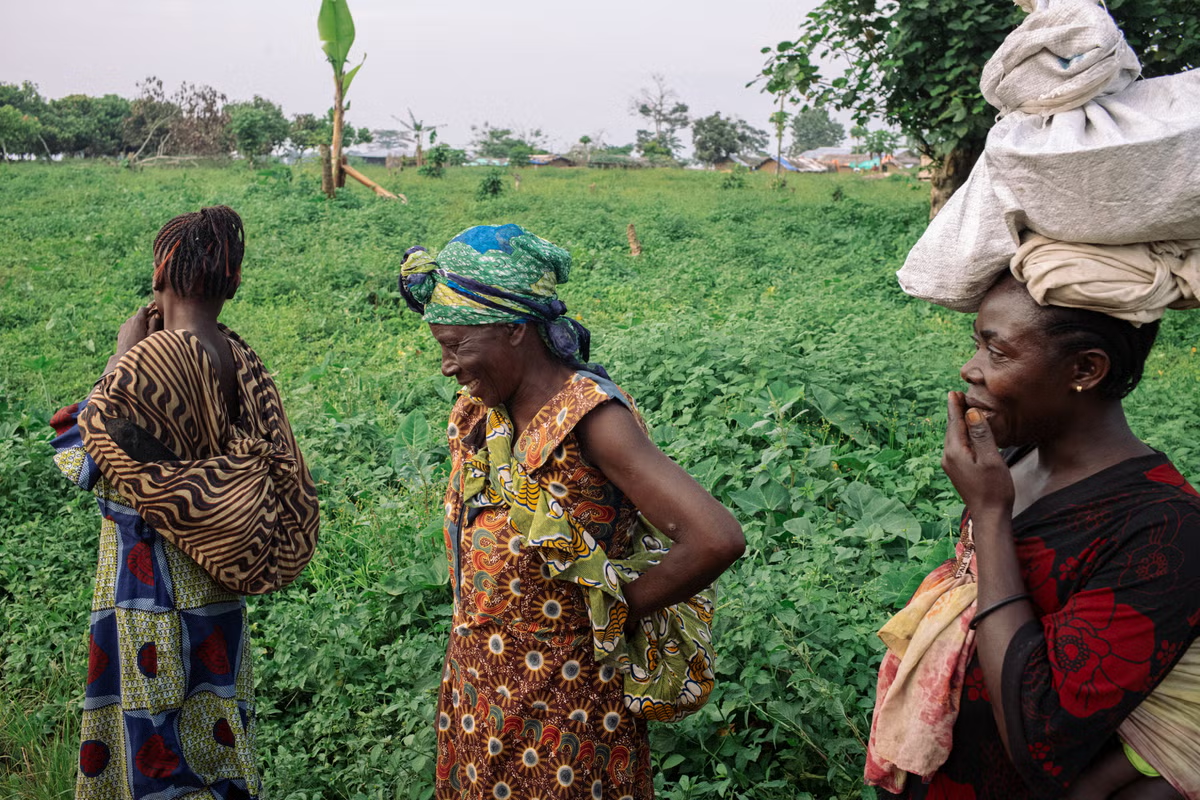
In lower-income countries, women are responsible for producing as much as 80 per cent of food, despite shouldering unequal caregiving and other duties. These women are also systematically excluded from full participation in formal agricultural markets, land ownership, access to finance and other important building blocks of productive farming.
The costs of women’s exclusion are enormous. At the macro level, it has been estimated that closing the gender gap in farm productivity and wages could raise global gross domestic product by as much as $1 trillion and reduce food insecurity for some 45 million people around the world.
Addressing women farmers’ multiple challenges requires more than just isolated interventions – indeed, there are no silver bullets. Integrated approaches, which combine social, technological, market and environmental solutions tailored to local contexts and priorities, are significantly more effective.
To deliver these solutions, cross-sector collaboration is essential. The most effective approaches bring together local and global partners to draw from a broad range of expertise and experience, and help women farmers address the various challenges they face. This is why Heifer International works with governments, businesses, organisations like the CGIAR – the world’s largest global agricultural innovation network – as well as the UN’s Food and Agriculture Organization (FAO) and the Mastercard Foundation to support women farmers as they strengthen their livelihoods, adapt to climate change and build lasting resilience.
There are more than 1.2 million women participating in Heifer’s programmes in 19 countries across Africa, the Americas and Asia, representing two-thirds of all participants. We have seen that the real impact of investing in women farmers is already visible in communities around the world.
For example, in southern Ecuador, women coffee farmers are applying soil restoration practices that help their farms withstand rising temperatures, erratic rainfall and crop disease. Coffee farmer Marilú Rivera says these changes have actually increased production on her farm by an estimated 20 per cent, with healthier trees producing more beans. The Ecuadoran women farmers involved in this work also include Josselyn Vega, who was recently recognised by the World Food Prize Foundation as a Top Agri-Food Pioneer for her work with the women-led Association of Agroecological Producers of Cotopaxi, Ecuador.
In Rwanda, innovations like Azolla, a fast-growing aquatic plant used as livestock feed, are helping women farmers cut feed costs by nearly a third, while enriching soils. And goat-farming cooperatives in Nepal, representing 300,000 smallholder farmers — mainly women — have planted cultivated fodder for animals to feed on, rather than grazing on communal lands, on 16,000 hectares to reverse deforestation and soil erosion.
These are just a few examples of how investing in, equipping and empowering women can have significant ripple effects for productivity, food security and climate and environmental resilience. In an era defined by recurring crises, investing in women farmers is not simply a matter of inclusion. It is one of the most effective ways to strengthen food security, accelerate climate resilience and build a more sustainable future for everyone.
This year, designated by the UN as the International Year of the Woman Farmer, should not only be a time to celebrate women farmers’ contributions. It should also be a time of broader reckoning with what the world loses when women farmers are left behind.
Surita Sandosham is the president and CEO of Heifer International, which aims to end hunger and poverty by supporting smallholder farmers and their communities
This article has been produced as part of The Independent’s Rethinking Global Aid project