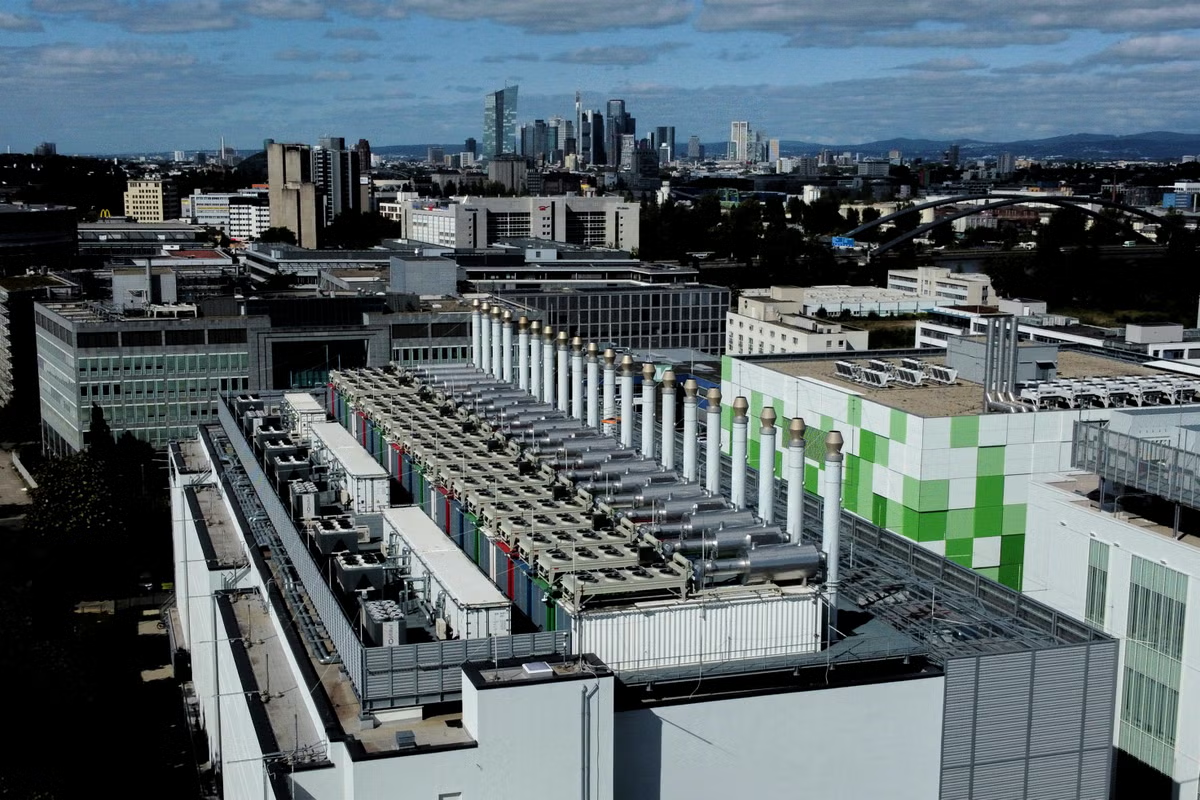
Forty mayors from cities across the globe have united to sign a new pact aimed at shaping the sustainable development and operation of urban data centres.
The initiative, unveiled by C40 Cities – an alliance of nearly 100 cities committed to tackling climate change – during London Climate Action Week, outlines a vision for ensuring these crucial digital hubs do not compromise natural resources, energy prices, or climate targets.
While many new data centres are increasingly located in rural areas due to cheaper land, metropolitan areas are also experiencing significant pressure. Experts from C40 note that approximately 1,700 data centres currently exist within their network of cities, with development projected to surge by over 40 per cent in 50 of these urban centres.
The pact arose from concerns voiced by the mayors of Phoenix and Melbourne, Australia, regarding the substantial electricity and water consumption of data centres, alongside their competition with housing developers for available land.
Cassie Sutherland, a managing director at C40, highlighted the universality of these challenges, stating: “We found out that the challenges in every region around the world were very similar. Our approach was to say OK, how do we now use a global mayoral voice to come together with the conditions under which they will accept data centres.”
Data centres are often strategically built in cities to provide instantaneous response times for firms utilising artificial intelligence, and to be close to major companies’ business operations. These facilities tend to form clusters, creating ecosystems in metropolitan areas that can outweigh factors like land costs, though a recent trend has seen some shift to rural locations, according to Andrew Batson, global head of data centre research at JLL.
However, growing political and local opposition has emerged due to fears of blackouts, escalating electricity bills, and the centres’ considerable water demands. In response, some states are now suspending tax breaks or contemplating moratoriums on new data centre construction.
About half of participating mayors are from the U.S. That includes Seattle and the California cities of Palo Alto and Riverside. In the Southwest, Phoenix and Albuquerque, New Mexico, joined. On the East Coast, Beverly, Massachusetts, signed, as did Lincoln, Nebraska; Chicago and Cleveland in the Midwest and Miami in the South.
European cities in Greece, Spain, Italy, Germany, the United Kingdom and Norway joined, as did Montreal in Canada. The pact includes African cities in Ivory Coast, Sierra Leone, South Africa and Kenya, as well as Asia-Pacific cities in India and Australia, and Lebanon in the Middle East.
Sutherland said their vision needs to be translated into action, with each city using it as a framework for their own regulations or guidelines. Mayors are limited in what they can do unilaterally, so they’ll need buy-in from other government officials, utilities and the private sector.
The pact lists several standards for data center developments. Urban data centers should be built on abandoned or underutilized land in an area that minimizes negative impacts on noise, heat and air pollution. Developments should be fueled by renewable energy and battery storage, and data centers should reduce water use and emissions, as well as capture waste heat.
And, the mayors want data centers that create jobs, buy local goods and services, pay for their own infrastructure upgrades and listen to community feedback.
The Phoenix metropolitan area has pending permit requests that would double the electricity demand if all of these data centers were built. Developers are drawn there for its reliable power and predictable weather.
Phoenix Mayor Kate Gallego said she’s concerned that investments in data centers right now are worsening climate change and not meeting the needs of communities. Mayors are forming a unified front to help improve data centers everywhere — that will keep developers from simply looking for communities unable to advocate for their own benefits, she added.
“We understand the importance of this innovation, it’s creating great jobs in our community,” Gallego said. “We just want to make sure that we get it right for our local residents and for the health of our planet.”
As of Tuesday, none of Southeast Asia’s cities endorsed the pact. Several said they couldn’t because of national policies or other complications, but the conversations are ongoing, C40 said.
The region accounts for a quarter of global energy demand growth, partially driven by more than 2,000 data centers in Indonesia, Malaysia, Singapore, Thailand, Vietnam and the Philippines, according to the think tank Ember.
The annual energy demand from these data centers will more than double in the next five years, the International Energy Agency said. This is most evident in Malaysia, which has drawn investments and interest from tech giants like Microsoft, Google and Nvidia.
If Melbourne follows through on all its plans, data centers will annually consume up to 20 billion liters (5.3 billion gallons) worth of water, or about 4% of the drinking water supply, according to the city’s Lord Mayor Nicholas Reece.
The water supply is already strained by the growing population, longer dry periods and more extreme heat driven by climate change.
Melbourne played a key role in the pact. Reece said stricter environmental regulations there likely won’t threaten future plans. Ultimately, he said, data centers are going to go where there’s enough power and land, and where they’re close to the markets and companies using artificial intelligence.
“We don’t want to see a race to the bottom between cities where governments, desperate for investment, are chasing data centers on any terms possible,” he said. “We want to see a better framework in place so that the investment rush in data centers can be a win-win — a win for investors and also a win for local communities.”