As the United States prepares to celebrate the 250th anniversary of its independence on July 4, 2026, one of the country’s biggest modern success stories is increasingly tied to immigration, particularly highly skilled professionals working in technology. Among them, Indians stand out by far. Today, nearly three out of every four H-1B visas approved by the US go to Indian nationals, making them the backbone of America’s technology workforce and some of Silicon Valley’s biggest companies.
The H-1B visa, introduced under the Immigration Act of 1990, allows US employers to hire highly skilled foreign professionals in specialised fields such as software engineering, artificial intelligence, cloud computing and cybersecurity. While the programme has long been central to America’s innovation economy, it has also remained one of the country’s most debated immigration pathways, praised for filling talent shortages but criticised over its impact on domestic jobs and wages.

As America marks 250 years of nationhood, here’s why the H-1B visa remains so important, why Indians dominate the programme, and what it means for the future of the US technology industry.
What exactly is the H-1B visa?
The H-1B is a non-immigrant work visa that allows US employers to hire foreign professionals in speciality occupations requiring highly specialised knowledge and at least a bachelor’s degree or equivalent work experience. It was created under the Immigration Act of 1990 and is administered by the US Citizenship and Immigration Services (USCIS).
The visa is generally issued for an initial period of three years and can be extended to six years. Workers whose employers sponsor them for permanent residency may remain in the US beyond this period while their Green Card applications are being processed.The
US Congress has capped new H-1B visas at 65,000 annually. An additional 20,000 visas are reserved for applicants who have earned a master’s degree or higher from a US university. Since applications routinely exceed these limits, USCIS conducts an annual lottery to determine which eligible applicants can proceed.
Why do Indians dominate the programme?
Indians account for the overwhelming majority of H-1B recipients. According to a 2025 Pew Research Center analysis based on USCIS data, nearly 73 per cent of approved H-1B petitions in fiscal year 2023 were for people born in India. China ranked a distant second with around 12 per cent, while all other countries accounted for relatively small shares.
Story continues below this ad
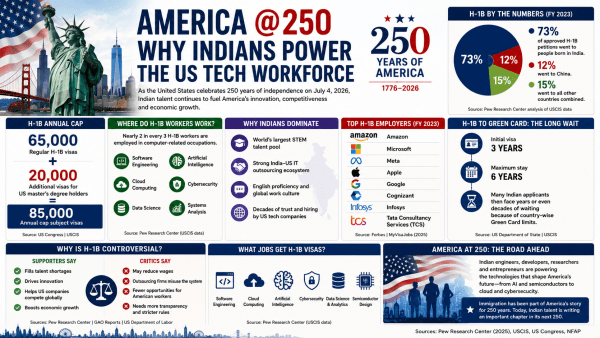 Indian engineers have become central to America’s innovation story—powering AI, cloud computing, cybersecurity and the technologies shaping the country’s next 250 years. (AI-generated image)
Several factors explain India’s dominance
First, India produces one of the world’s largest pools of STEM (science, technology, engineering and mathematics) graduates. Every year, thousands of engineers, computer scientists and technology professionals enter the workforce, creating a vast talent pool for global employers.
Second, India’s IT services industry has built deep ties with the US technology sector over the past three decades. Companies such as Infosys, Tata Consultancy Services (TCS), Wipro and Cognizant have long relied on the H-1B programme to deploy skilled professionals to serve American clients.
Third, English-language proficiency and familiarity with global business practices have made Indian professionals particularly attractive for multinational companies operating across borders.
Why is the visa so important for America’s tech industry?
The H-1B programme is closely linked to technology-related jobs. According to Pew Research Center’s analysis of USCIS data, computer-related occupations accounted for nearly two-thirds of all approved H-1B workers in 2023. These include software development, artificial intelligence, cloud computing, cybersecurity, systems analysis, network administration and data engineering.
Story continues below this ad
Major US technology companies have long argued that the programme helps them fill specialised positions where domestic talent is in short supply. The rapid growth of artificial intelligence, semiconductor development and cloud infrastructure has only increased demand for highly skilled engineers and researchers.
Does an H-1B visa lead to a Green Card?
Technically, no.
The H-1B is a temporary work visa. However, many recipients eventually use it as a pathway to permanent residency.
US employers can sponsor H-1B workers for employment-based Green Cards, allowing them to become lawful permanent residents. Indian nationals, however, often face some of the longest waiting periods because US immigration law imposes per-country limits on employment-based Green Cards.
Story continues below this ad
According to the US Department of State and USCIS, applicants from India in some employment-based categories face waiting periods stretching several years and, in certain cases, decades because of the backlog.
Why is the programme controversial?
The H-1B programme has remained politically contentious for years.
Supporters argue it helps American companies recruit specialised talent that is unavailable domestically. Technology companies say access to global talent is essential for maintaining innovation and competitiveness. Research by organisations such as the National Foundation for American Policy (NFAP) has also linked skilled immigration to entrepreneurship, innovation and economic growth.
Critics, however, argue that some employers use the programme to replace American workers with lower-paid foreign employees. Concerns over wage suppression and labour market impacts have featured prominently in reports by the US Government Accountability Office (GAO) and congressional hearings.
Story continues below this ad
To reduce misuse, employers must comply with wage requirements set by the US Department of Labor and meet eligibility criteria established by USCIS. Successive administrations have proposed reforms aimed at increasing transparency and ensuring visas are awarded to genuinely high-skilled workers.
America at 250: Why Indian talent matters
As the United States celebrates its 250th Independence Day this year, the H-1B programme highlights how immigration has become a defining part of the country’s modern economic story.
Indian engineers, software developers, researchers and entrepreneurs today help power some of America’s biggest technology companies—from Silicon Valley giants to fast-growing startups. Their work spans artificial intelligence, cloud computing, semiconductors, fintech and cybersecurity, sectors expected to drive the next phase of US economic growth.
For many economists and industry leaders, America’s ability to attract global talent has remained one of its greatest competitive advantages. Indian professionals have become central to that story, underscoring how skilled immigration continues to shape the country’s innovation ecosystem 250 years after its founding.