
Washington recently announced another round of sanctions, one more list of names added to the expanding ledger of people and companies accused of sustaining one of the world’s bloodiest wars in Sudan. But buried inside the announcement was an unexpected Indian connection.
An explosives manufacturer based in Maharashtra’s Nagpur, a company that describes itself as an ethical supplier to mines, quarries and infrastructure projects, suddenly found itself named alongside Sudanese military-linked companies, Egyptian suppliers and international recruitment networks accused of prolonging a civil war that has devastated an entire nation.
Advertisement – Scroll to continue
The allegation from the US is that explosives manufactured by SBL Energy Limited had entered Sudan through a company tied to the country’s military establishment before ultimately being used in bombs deployed by the Sudanese Armed Forces.
Exclusive | A Massacre In Waiting, And A World That Chooses Silence
When NDTV contacted SBL Energy for a clarification, the company rejected the accusation and insisted that it had exported only industrial explosives for legitimate civilian purposes under licences granted by Government of India
The US Allegations
On Friday, the US Treasury Department announced sanctions against eight individuals and entities accused of fuelling Sudan’s civil war by supplying weapons, explosives and foreign fighters to both sides of the conflict.
Among those sanctioned was Alok Choudhari, who, according to his publicly accessible social media account, is a man from Chhattisgarh’s Raipur and the chief executive officer (CEO) of SBL Energy Limited, a manufacturer of industrial explosives which describes itself as being based in Nagpur. The company itself was also sanctioned.
NDTV Exclusive | A Catastrophe Captured By Satellites, Ignored By The World
According to the US Treasury Department’s Office of Foreign Assets Control (OFAC), SBL supplied explosives and explosives-related material to Target Multiactivities Company Ltd. (TMAC), a Sudan-based company that Washington claims is controlled by Sudan’s Defence Industries System (DIS) through another military-linked conglomerate called Giad Industrial Group.
The US Treasury Department alleged that senior DIS officer Tariq Hussain Muhammad Madani served as TMAC’s managing director and oversaw imports of explosives from Egyptian companies as well as SBL Energy Limited in India.
Those explosives, the US Treasury Department claimed, were subsequently used in bombs deployed by the Sudanese Armed Forces (SAF).
Washington alleged that SBL, led by Choudhari, had supplied TMAC with more than 200 shipments of explosives and explosives-related material since 2024.
The US has placed SBL in a “network” that it claimed enables the bloodshed in the ongoing civil war in Sudan.
NDTV Exclusive | ‘Innocents Killed, Girls Raped’ – Inside Sudan’s Crisis
“These networks supply weapons, explosives, and foreign fighters to both the Sudanese Armed Forces and the Rapid Support Forces. Their support has prolonged a conflict that has created the world’s worst humanitarian crisis and provided space for terrorist groups to operate,” Tommy Pigott, spokesperson for the US State Department, claimed while announcing the measures.
The sanctions did not focus solely on the Indian company.
Washington also blacklisted TMAC and its managing director, Tariq Hussain Muhammad Madani, along with Sudanese and Egyptian entities accused of supporting the Sudanese military.
It designated Ports Engineering Company Ltd., a state-owned Sudanese civil engineering firm established in Port Sudan, alleging that it had imported military uniforms, footwear, ammunition belts and weapons cases after the conflict began in April 2023.
The sanctions also targeted individuals connected to a Panama-based company allegedly involved in recruiting former Colombian military personnel to fight alongside Sudan’s Rapid Support Forces (RSF), which is the principal player against the Sudanese army in the ongoing civil war.
SBL Denies All Accusations
When NDTV contacted SBL for a statement, the company described itself as “one of India’s leading manufacturers of industrial explosives for mining and civil construction” and said it wished to “unequivocally clarify” its position.
“SBL Energy Limited is a legitimate enterprise licensed by the Government of India, producing and exporting industrial explosives strictly for civil mining, quarries, and civil construction purposes,” the company said.
It added that it “does not produce or supply any defence or military products.”
The company said it currently exports industrial-grade products to more than 18 countries while complying with Indian regulations as well as the laws of importing nations.
Exclusive | World’s Newest Country Is Without Medicine. And It’s Getting Worse
“Regarding the exports to Sudan, the importing entity referred to under the sanction as Target Multi activities co Ltd (TMAC) provided comprehensive end-use certificates vetted and verified by both the Sudan Government and the Indian Embassy based in Sudan. The end-use certificate explicitly stated that the products are intended solely for civil construction and mining purposes. Upon the submission of these vetted certificates, official export licenses were issued by PESO (Petroleum and Explosives Safety Organisation), the regulatory body of the Government of India,” SBL told NDTV in a statement.
The company also challenged one of the central claims made by the US Treasury Department. Rather than the more than 200 shipments alleged by Washington, SBL said it had shipped “approximately 10 consignments” of mining explosives to Sudan since 2022.
“Since 2022, the company has shipped approximately 10 consignments of mining explosive products to Sudan. All of these were strictly for civil construction and mining, far below the 200 shipments alleged in the official US Treasury statement,” the company said.
SBL said it would formally approach the US Treasury Department with documentary evidence to contest the allegations.
What Does SBL Do
According to information published on its website, SBL Energy Limited was incorporated in 2002 to manufacture industrial explosives and accessories. Its manufacturing facility occupies 225 acres near Nagpur.
The company says its production units were established in technical collaboration with the Central Mining Research Institute (CMRI), a Government of India institution operating under the Council of Scientific and Industrial Research (CSIR).
SBL describes its business as being built around industrial and commercial explosives used in mining, quarrying, tunnelling, road construction and infrastructure projects.
“Since our inception, SBL Energy has totally focused on building an ethical work environment and delivering excellence in the field of industrial/mining explosives manufacturing,” the company says.
According to figures published by the company, its approved annual manufacturing capacity includes 50,000 metric tonnes of cartridge explosives, 21,699 metric tonnes of bulk explosives, 45 million detonators, 55 million metres of detonating fuse and 400 metric tonnes of PETN or pentaerythritol tetranitrate which is a military-grade high explosive used by many countries including India and the US.
Its product catalogue advertises packaged explosives, cap-sensitive and non-cap-sensitive emulsion explosives, slurry explosives and small-diameter emulsion explosives.
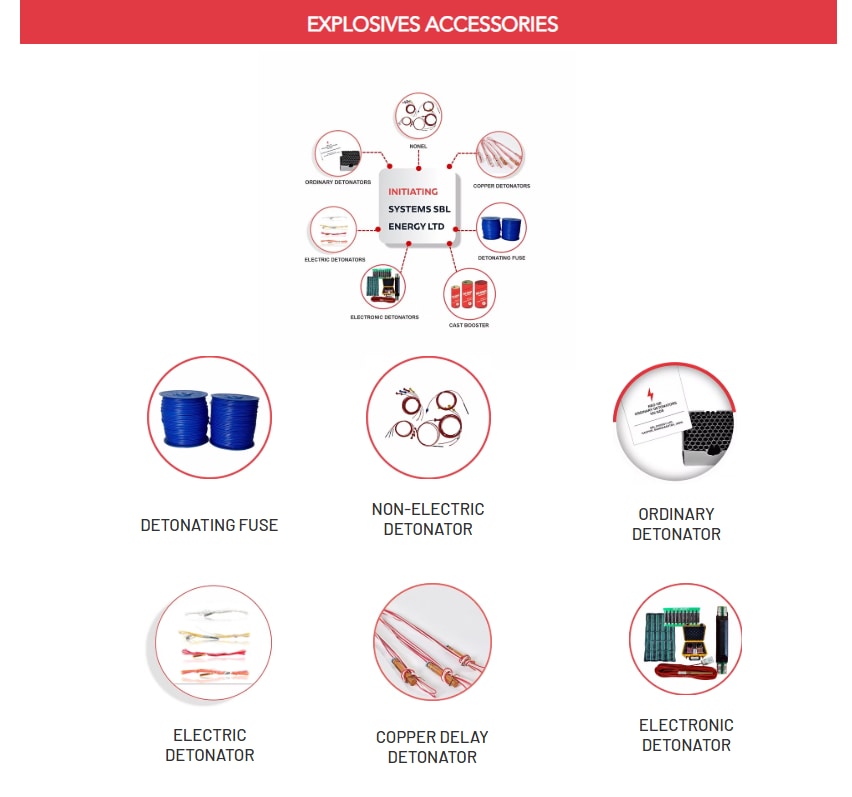
Those are the same categories of industrial products that the company says are intended for civilian infrastructure and mining industries.
Sudan Civil War Explained
Sudan has been engulfed in civil war since April 2023 after a power struggle between the Sudanese Armed Forces and the paramilitary group RSF erupted into open conflict.
The fighting followed years of political instability after the 2019 overthrow of long-time president Omar al-Bashir. A transitional military-civilian government was itself removed in another coup in 2021.
The two military leaders behind that coup — General Abdel Fattah al-Burhan, head of the Sudanese Armed Forces, and his deputy, General Mohamed Hamdan Dagalo, widely known as Hemedti — later turned against one another.
The immediate dispute centred on plans to integrate the approximately 1,00,000-member RSF into the national army and on who would command the unified force.
Those disagreements quickly escalated into nationwide warfare.
The army controls much of the country’s north and east while the RSF has established dominance across large parts of Darfur and neighbouring Kordofan.
Khartoum, after changing hands, was left with burned government buildings, destroyed hospitals and damaged infrastructure.
The fighting in Sudan continues, unabated.