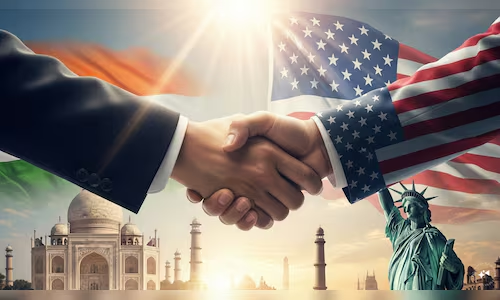
Their concerns come after Commerce Minister Piyush Goyal said India and the US could finalise an interim trade pact by mid-July, with another round of negotiations expected when a US delegation returns to India. Goyal also said the proposed agreement would provide preferential access for Indian exports to the American market.
The optimism from the government follows the latest round of trade talks between the two countries, which both sides described as constructive and pragmatic. Discussions covered trade in goods, non-tariff barriers, customs procedures and economic security, with both countries reiterating their commitment to a mutually beneficial agreement.
However, experts speaking to CNBC-TV18 said the biggest challenge for India may not be securing an interim pact, but ensuring that Indian exporters are protected from future US tariff actions.
Former Ambassador to the WTO Anjali Prasad questioned whether the framework being discussed would genuinely provide preferential market access to India.
“If the interim draft or the deal is anything to go by, then I really don’t know how we will get preferential access,” she said.
Prasad argued that publicly available details of the negotiating framework suggest India could be required to significantly lower tariffs and non-tariff barriers, while the US may continue to maintain duties on Indian products.
She also warned against rushing into an agreement simply to avoid higher tariffs.
“Often, no deal is better than a bad deal,” Prasad said, adding that the final assessment would depend on the fine print of the agreement, which has not yet been made public.
The concerns stem largely from the uncertainty surrounding proposed US actions under Section 301 of the US Trade Act. Washington has launched investigations into alleged unfair trade practices by several countries, including India. The proposed measures could result in an additional 12.5% levy on Indian exports.
While New Delhi has said it raised its concerns over the Section 301 proceedings during the recent negotiations, experts note that the investigations are still underway and their eventual outcome remains unclear.
Robinder Sachdev, Founder and President of IMAGINDIA Institute, said this uncertainty makes it difficult to assess the true value of any interim agreement.
“I find the whole negotiation process between India and the US on trade extremely puzzling,” Sachdev told CNBC-TV18.
According to Sachdev, the Trump administration has multiple legal avenues available to impose new trade restrictions even if an interim agreement is reached. He noted that investigations under Sections 232 and 301 are continuing and could potentially result in additional tariffs or trade measures in the future.
“So how can we be negotiating right now? What exactly are we negotiating?” he asked.
Prasad echoed those concerns, arguing that India could still face fresh actions under US domestic trade laws even after an interim deal is concluded.
She pointed to India’s previous experience with Special 301 investigations in the 1990s and said there remains uncertainty over what future US investigations could focus on, including intellectual property rights and other trade-related issues.
Despite those concerns, exporters are looking for greater certainty as negotiations enter a crucial phase.
Ajay Sahai, Director General and CEO of FIEO, said businesses are struggling to plan contracts beyond July because they do not know what tariff regime will apply after July 24, a date widely seen as a key deadline in the ongoing trade discussions.
“We would also like some certainty in place because, at this point in time, exporters are not in a position to negotiate what will happen to contracts that will come into force after July 24,” Sahai said.
He added that an interim agreement could at least provide some clarity for businesses, even if it does not eliminate all tariff-related concerns.
At the same time, Sahai stressed that any deal must serve India’s broader economic interests.
“I would like to have a deal that meets the national interest. If it meets the national interest, I personally feel it is a good deal,” he said.
Also Read | India-US trade talks: Former diplomats say better no deal than a bad deal amid Section 301 tariff threats
For now, both governments continue to project confidence. The US delegation led by chief negotiator Brendan Lynch concluded four days of discussions in India this week, while US State Department spokesperson Tommy Pigott said a bilateral trade agreement remains a priority for the Trump administration.
Yet as negotiations move towards a possible July conclusion, experts say the real test will be whether the agreement provides lasting protection against future tariff risks, or merely postpones a new round of trade disputes.