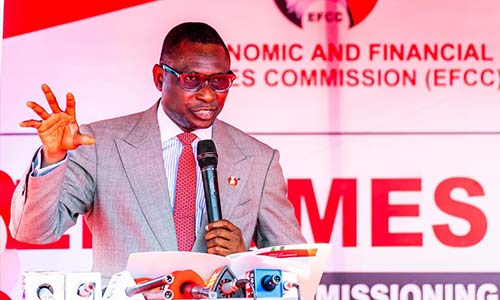
Chairman of the Economic and Financial Crimes Commission, EFCC, Ola Olukoyede, has warned that vote-buying and other forms of financial inducement pose serious threats to credible elections and democratic governance in Nigeria.
Olukoyede said the growing monetisation of the electoral process undermines the quality of leadership, weakens public trust in democratic institutions and compromises accountability in public office.
He spoke on Wednesday at the inaugural High-Level Guest Speakers’ Series organised by the Centre for Peace and Strategic Studies at the University of Ilorin.
The EFCC Chairman delivered a lecture titled “Mobilising Critical Stakeholders for Setting the Agenda for Peaceful and Credible 2027 Elections in Nigeria.”
According to him, politicians who gain power through vote-buying and financial inducement are often more concerned with recovering campaign expenses than delivering good governance to the people.
He said vote-buying, vote-selling and other forms of electoral corruption compromise the political recruitment process and allow persons with questionable motives to emerge as leaders.
Olukoyede noted that the EFCC had, in previous elections, made arrests and secured prosecutions and convictions involving politicians, electoral officials and voters linked to vote-buying schemes.
He said the commission would intensify enforcement efforts ahead of the 2027 general elections.
The EFCC boss also disclosed that electoral corruption was becoming increasingly sophisticated, with perpetrators now relying on covert networks, coded communications and off-site arrangements to influence voters away from polling units and official electoral processes.
He stressed that curbing electoral corruption would require stronger collaboration among political parties, security agencies, the media, civil society organisations and other electoral stakeholders.
Olukoyede urged political actors to embrace issue-based campaigns and reject divisive rhetoric capable of triggering violence before, during and after elections.
He also called on journalists to expose vote-buying networks and other forms of electoral malpractice, saying the media has a major role to play in protecting electoral integrity.
The EFCC Chairman further challenged security agencies to remain neutral, professional and coordinated throughout the electoral cycle.
According to him, effective and impartial security arrangements would enhance public confidence in the electoral process.
Earlier, the Director of the Centre for Peace and Strategic Studies, G. A. Animasawun, said the lecture series was designed to identify practical solutions to threats facing Nigeria’s democratic process ahead of the 2027 elections.
In his remarks, the Vice-Chancellor of the University of Ilorin, Wahab Olasupo Egbewole, described electoral corruption as a major national security concern.
He called for stronger institutional partnerships to safeguard electoral integrity and ensure peaceful and credible elections in 2027.