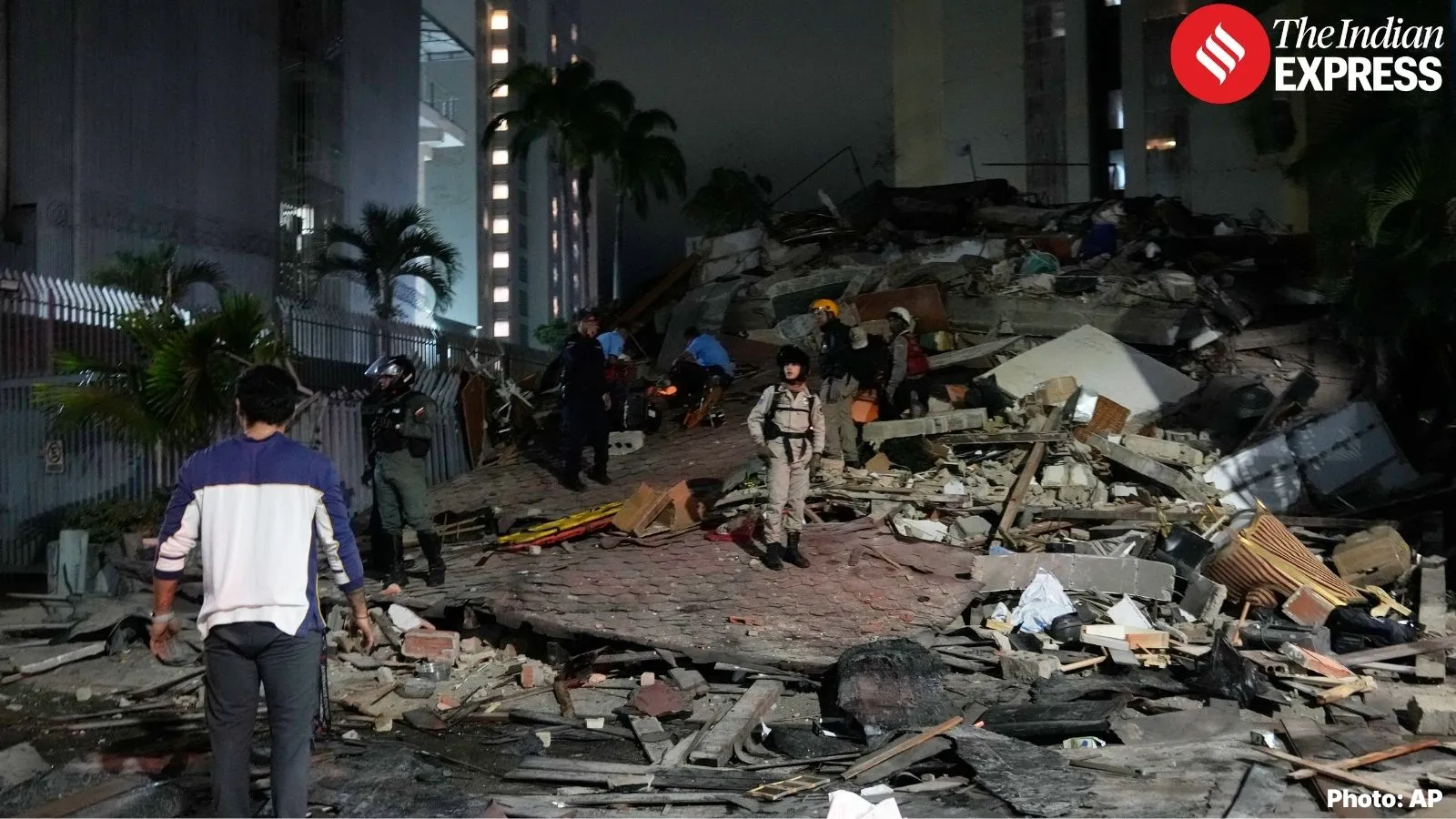
Venezuela is grappling with its deadliest earthquake disaster in decades after twin powerful earthquakes struck within seconds of each other, flattening buildings around Caracas, killing at least 164 people and leaving hundreds trapped beneath rubble. A quake of magnitude 7.2 hit around 160 km (100 miles) west of Caracas, followed by an even stronger quake less than a minute later, the largest to hit the country in more than a century, news agency Reuters reported, citing the US Geological Survey.
Delcy Rodríguez, acting President of the country, declared a state of emergency, and warned that the toll was expected to rise intensely once rescuers reached La Guaira, which is the hardest-hit state situated near the capital, which she described as the “disaster zone,” AP reported.
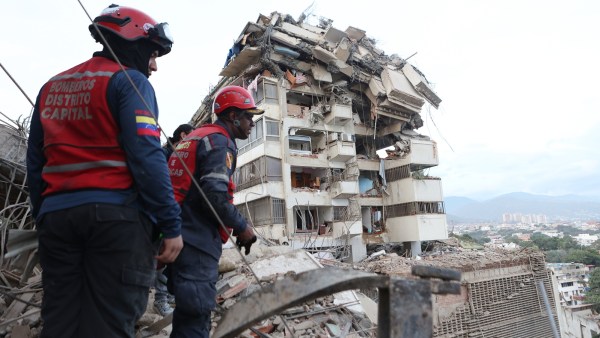 Rescue workers search through the rubble after an earthquake in La Guaira, Venezuela, Thursday, June 25, 2026. (AP Photo/Pedro Mattey)
The rescue team worked throughout the night, pulling survivors from rubble. International aid offers filled in from the United States, Latin America, Europe, and beyond, with thousands yet unaccounted for.
1. Twin quakes of historic magnitude rattle the region
According to AP, the first earthquake, measured initially, had struck at a magnitude of 7.1. It was later revised to 7.2 by the USGS, struck in west of Morón, Venezuela’s Caribbean coast, around 168 km (104 miles) from Caracas, at a depth of 22 km. After less than a minute, an even greater quake of 7.5 magnitude with a depth of 10 km struck about 16 km southwest of Morón.
The USGS stated that the pairing of this scale is unusual and difficult to model. Paul Earle, a seismologist, said that it is hard to unravel the effects “when the earthquakes are this close together” in time. The tremors were felt as far away as Brazil’s Amazon region, roughly 1,700 km from Caracas, prompting building evacuations in cities like Manaus, Belém, and Macapá, as well as in parts of Colombia. A tsunami warning was issued but swiftly cancelled once the danger had passed.
2. Death toll climbs as La Guaira emerges as ground zero
President Rodríguez confirmed a minimum of 164 deaths and more than 900 injured during a broadcast address and cautioned that the figures excluded La Guaira state, which is home to Caracas’s main airport, where “dozens of buildings have collapsed” and rescue operations were underway.
The USGS’s predictive modelling distinctively estimated that the final death toll could run into thousands, with a considerable probability of exceeding 10,000, underlining the scale of destruction which officials feared was still being uncovered.
Story continues below this ad
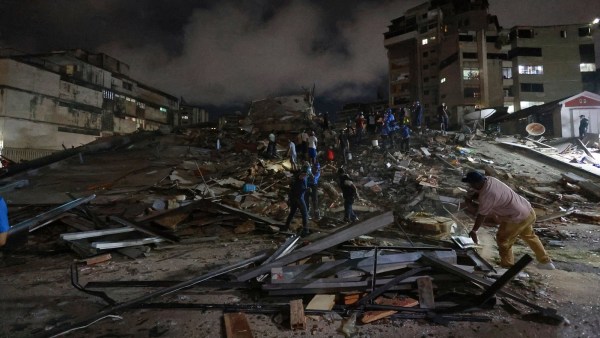 Rescue workers search through the rubble after an earthquake in Caracas, Venezuela, Wednesday, June 24, 2026. (AP Photo/Javier Campos)
In Falcón state, the governor noted 32 people were hospitalised, and 15 were still trapped in the disaster’s initial hours. A crowdsourced tracker as shared by the opposition figures listed over 6,600 people as unaccounted by early Thursday.
3. Scenes of chaos as Caracas buildings collapse and residents flee
Witnesses reported mayhem as the land shook for the second time, even before a minute had passed. Residents told about jugs falling inside refrigerators, distressed families climbing over rubble, and the entire neighbourhoods rushing into the streets. One resident compared the situation to “a horror movie.” An 80-year-old pensioner mentioned that the earthquake felt worse than the lethal Caracas quake of 1967.
Television broadcasts showed 3 children being pulled alive who were covered in dust from rubble in La Guaira. A hospital in Tucacas reportedly sustained damage. Caracas’s Simón Bolívar International Airport was shut down after it sustained through the damage, alongside interruptions in the capital’s subway and natural-gas services.
Parts of the capital also had a power shutdown and lost cellphone signal, deepening angst for over 7.7 million Venezuelans who had emigrated amidst the country’s prolonged crisis. They were unable to reach their family back home.
Story continues below this ad
4. International aid mobilises rapidly
Rescue aide arrived from around the hemisphere and beyond, including the United States, Brazil, Mexico, Chile, Ecuador, El Salvador, Bolivia, Argentina, Panama, Uruguay, Qatar, and Spain. Marco Rubio, the US Secretary of State, said that Washington was “immediately deploying search and rescue teams, medical resources, and humanitarian assistance”.
US President Donald Trump called the earthquake toll “devastating” and requested for support. Rodríguez said rescue teams from Qatar, Mexico, and El Salvador were expected to arrive within a day, even as some governments offering help like El Salvador under President Nayib Bukele, have in the past been at odds with Caracas. Opposition leader María Corina Machado, in exile, also sent messages of solidarity to all Venezuelans.
5. A seismically vulnerable nation bracing for aftershocks
Venezuela lies along the boundary of the Caribbean and South American tectonic plates, a seismically active zone that has historically generated huge earthquakes, including one in 1812 killing about 30,000 people in Mérida and Caracas. While earthquakes are more frequent along the Pacific “Ring of Fire” and are responsible for roughly 90% of global earthquakes.
Experts stated that Caracas’s location in a deep sedimentary basin tends to heighten seismic waves, magnifying the damage from this week’s twin quakes. School classes were cancelled for the whole week. Some school buildings were adapted as shelters and donation centres, as the aftershocks continued into Thursday morning.
Story continues below this ad
The officials requested residents to be cautious outdoors. According to Reuters, so far, Venezuela’s critical oil infrastructure, including facilities close to Lake Maracaibo and the El Palito refinery near the quakes’ epicentre, has not reported huge damage. An extended power shutdown could affect crude output in the coming days.
(With inputs from agencies)
(The article was curated by Seekriti Saha, who is an Intern with The Indian Express)