3 min readJun 5, 2026 07:17 PM IST
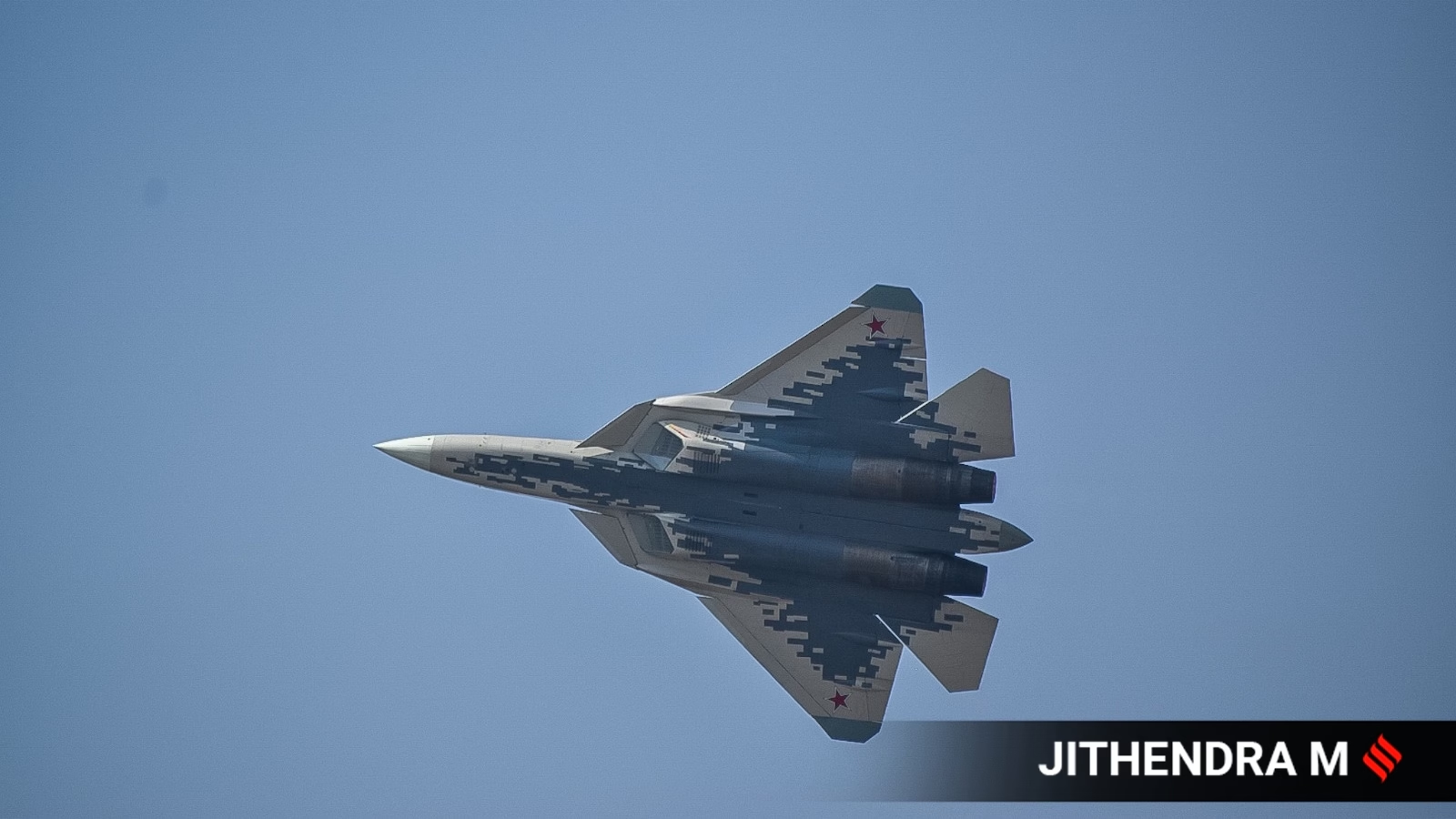
Russian President Vladimir Putin on Thursday offered India joint production of the Su-57 — Russia’s most advanced fifth-generation stealth fighter jet — and said Moscow was willing to cooperate with “no restrictions whatsoever”.
The proposal comes as India weighs options to bridge a growing fighter aircraft gap before its indigenous Advanced Multirole Combat Aircraft (AMCA) enters service, likely after 2035.
“As for the Su-57, we offered our friends from India to jointly develop this machine, a fifth-generation aircraft. I think it’s the best to date. But our Indian friends said, ‘Well, let’s see,” Putin quoted as saying by news agency PTI.
He added, “In principle, this could have been our (Russia-India) product. We made it independently. And we are ready to work with India. To work and develop. There will be no restrictions whatsoever.”
The Su-57 is Russia’s fifth-generation stealth fighter designed to rival advanced US aircraft such as the F-35.
Where India stands
The PTI report claimed that New Delhi has not yet shut the door on the Russian offer, indicating that state-run Hindustan Aeronautics Limited (HAL) is in contact with the Sukhoi Design Bureau for possible collaboration. The government is also considering procuring at least two squadrons – around 36 aircraft – of the Su-57, subject to technical specifications being met.
India’s own fifth-generation fighter, the Advanced Multirole Combat Aircraft (AMCA), is unlikely to enter Indian Air Force service before 2035, leaving a capability gap that the Su-57 deal could potentially fill.
Story continues below this ad
India and Russia had earlier pursued a joint Fifth Generation Fighter Aircraft (FGFA) programme for years before New Delhi withdrew in 2021 over concerns about cost, technology sharing and performance.
Su-57 vs AMCA: The fighter jet question facing India
5th Generation
Generation
5th Generation
In service with Russia
Status
Under development
Available now
Availability
Post-2035 earliest
Yes — proven in service
Stealth
Planned — by design
Twin-engine
Engines
Twin-engine
Russian-origin
Origin
Fully Indian-made
~36 aircraft mooted
India Plan
Core IAF programme
💡
The question India faces: wait over a decade for its own AMCA while the fighter gap widens — or accept Russia’s Su-57 offer as a bridge. Both are fifth-gen. Only one exists today.
S-400 and air defence cooperation
Putin also expanded the discussion to broader defence cooperation, particularly air defence systems, which dovetails with India’s development of the indigenous “Sudarshan Chakra” integrated air defence network — in which Russian-origin S-400 missile systems are set to play a central role.
“The same goes for the air defence system. Russia is ready to work with India on air defence systems and related hardware.” – Vladimir Putin, Russian President
India signed a $5 billion deal with Russia for five S-400 units in October 2018, defying US warnings of sanctions under CAATSA. The systems proved their operational value during Operation Sindoor. The fifth squadron is still awaited. In March this year, India cleared the purchase of a fresh batch of five more S-400 systems, which would take the total to ten
Story continues below this ad
Russia has been India’s primary defence supplier for decades. But supply chain disruptions caused by the war in Ukraine have pushed New Delhi to aggressively diversify its procurement strategy – a shift that has added urgency to Moscow’s outreach. According to Stockholm International Peace Research Institute (SIPRI), India was the world’s second largest arms importer between 2021 and 2025, with Russia accounting for the largest share of those imports.
Stay updated with the latest – Click here to follow us on Instagram