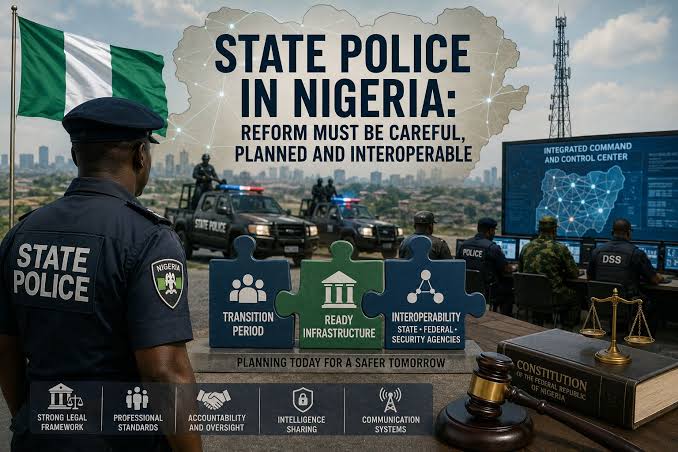
By Oluwole Solanke, PhD, FCIB
Nigeria is once again standing at a crossroads of national consequence. From the blood-soaked communities of the North-West ravaged by banditry, to the insurgency-battered territories of the North-East; from the simmering farmer-herder battlegrounds of the Middle Belt, to the kidnapping corridors of the South and the organised crime networks festering in major urban centres, the Nigerian state is confronting a security crisis of alarming proportions. The question that now stirs vigorous debate in legislative chambers, academic circles, market squares, and living rooms across the country is whether the creation of State Police represents a genuine solution to this crisis or an invitation to a new set of dangers.
The Tinubu administration has signalled a firm commitment to pursuing state-level policing, arguing that the complexity and localised nature of modern security threats demand a structural overhaul of Nigeria’s policing model. Yet, as with all consequential governance decisions, the devil lies not merely in the legislation but in the details, and in the character of those who would implement it.
This essay examines the arguments for and against State Police in Nigeria, weighs the evidence with clear eyes, and proposes the conditions under which such a reform could serve the Nigerian people rather than imperil them.
The Anatomy of Failure: Why the Current System Is Broken
To appreciate the urgency of this debate, one must first reckon honestly with the failures of the existing centralised police structure.
Nigeria operates a unified police force, the Nigeria Police Force (NPF), under the exclusive control of the Federal Government. The Inspector-General of Police commands the entire apparatus from Abuja, and state commissioners of police operate within a federal chain of command that renders governors largely powerless to direct policing operations within their own territories. This arrangement was designed to forestall the fragmentation of security authority and to preserve national cohesion. In theory, it was sound. In practice, it has proven woefully inadequate.
A single command structure policing over 220 million citizens across 36 states and the FCT, each with distinct topographies, cultures, crime patterns, and languages, is structurally incapable of being effective everywhere. The ratio of police officers to citizens in Nigeria remains one of the lowest in Africa, let alone when measured against United Nations recommended standards. Slow bureaucratic decision-making chains mean that responses to local crises are often delayed, sometimes fatally so. Intelligence gathering suffers because federal police officers rotated frequently across states rarely develop the intimate local knowledge necessary for effective crime prevention.
The Roman orator and statesman Marcus Tullius Cicero declared that the safety of the people shall be the highest law. By that standard, Nigeria’s current policing architecture has been found gravely wanting.
The Case for State Police: Why Advocates Are Persuasive
1. Local Problems Demand Local Solutions
The most compelling argument for State Police is also the most intuitive: crime is local. The bandit who terrorises a farming community in Zamfara operates with knowledge of local terrain, local networks, and local grievances that a police officer transferred from Lagos or Enugu is unlikely to possess. State and local governments, by contrast, are embedded within these realities. Officers recruited from within a community bring irreplaceable social intelligence, they know the language, the geography, the key personalities, and the patterns of deviance that outsiders must spend years learning, if they ever do.
Policing works best when it is rooted in the communities it serves. This is not merely a platitude, it reflects the operational wisdom of security architecture in virtually every functioning federal democracy in the world. The United States, Canada, Germany, Australia, and India all maintain multi-layered policing systems precisely because they recognise that security is most effectively delivered closest to where it is needed.
2. Speed of Response and Operational Autonomy
In a security emergency, time is the most critical variable. The present system requires that many operational decisions pass through federal channels before state-level responses can be mounted. This bureaucratic lag has cost lives. When bandits overrun a community or kidnappers seize victims on a highway, the window of effective intervention is narrow.
With State Police, governors would be empowered to deploy resources immediately and decisively. Security operations could be coordinated with state intelligence networks without the friction of federal approval chains. Speed of response alone could represent the difference between life and death for thousands of Nigerians caught in the crossfire of escalating violence.
3. Complementing, Not Replacing, Federal Policing
A frequently misunderstood aspect of the State Police proposal is that it is not a call to abolish the Nigeria Police Force. Rather, it envisions a complementary, multi-layered architecture, federal police handling transnational and nationally sensitive security matters, while state police address local crime and community safety.
This architecture is not experimental. It is the standard in advanced democracies. Barack Obama, reflecting on the American experience, once observed that effective policing is built on trust between law enforcement and the communities they serve. Trust is a local currency. It is built face to face, neighbourhood by neighbourhood, generation by generation, and it cannot be manufactured from Abuja.
4. Reducing the Burden on an Overstretched Federal Force