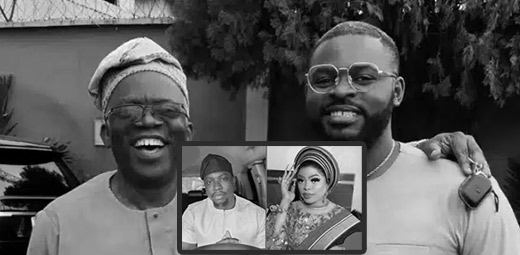
An Independent Investigative Panel set up by the Federal Government to investigate allegations surrounding the detention of crossdresser, Okuneye Idris Olanrewaju, popularly known as Bobrisky, has revealed that he allegedly enjoyed extraordinary privileges while serving his jail term in Lagos.
The panel said Bobrisky was kept in a specially furnished cell, allegedly used mobile phones in custody and was given privileges far beyond what is permissible under Nigerian correctional law.
The report also recommended further investigation into allegations of bribery involving officials of the Economic and Financial Crimes Commission and the Nigerian Correctional Service. It further recommended the prosecution of social media activist, Martins Vincent Otse, popularly known as VeryDarkMan, over alleged libel, incitement and data privacy violations.
Bobrisky was sentenced to six months’ imprisonment on April 12, 2024, for abuse of the naira and was released on August 5, 2024, after completing the jail term.
The controversy began weeks after his release when VeryDarkMan shared an audio recording alleged to be a conversation involving Bobrisky and another person. In the recording, Bobrisky allegedly claimed that he paid ₦15 million to EFCC officials to drop money laundering charges against him.
He was also alleged to have claimed that he bribed officials of the Nigerian Correctional Service to allow him serve his prison term in a private apartment rather than inside a custodial centre.
The allegations generated public outrage and prompted the Minister of Interior, Olubunmi Tunji-Ojo, to set up an investigative panel on September 30. The panel was chaired by the Permanent Secretary of the Ministry of Interior, Magdalena Ajani.
In its report, recently submitted to the minister, the panel found that Bobrisky received several special privileges during his incarceration at both the Medium Security Custodial Centre and the Maximum Security Custodial Centre, Kirikiri, Lagos.
At the Medium Security Custodial Centre, the panel said Bobrisky was housed in a special single cell fitted with a personal toilet and bathroom, floor carpet, television, fridge, humidifier and attractive electric bulbs.
The report also stated that he was placed on self-feeding, with his brother and sister-in-law authorised to bring him meals.
According to the panel, Bobrisky was also allowed to receive family members and friends as frequently as he wanted and in any number he desired.
The report stated that similar privileges continued after he was moved to the Maximum Security Custodial Centre.
At the Maximum Security facility, the panel said Bobrisky’s cell was decorated with wallpaper and furnished with a big bed, carpet, humidifier and television in an adjoining decorated room.
The panel also found that a fellow inmate was assigned to attend to Bobrisky’s personal needs. The inmate was said to have previously been attached to the Chief Warder’s office.
The report further stated that Bobrisky received visitors as frequently as he wanted and in whatever number he chose, with such visits allegedly conducted inside the office of the officer-in-charge of the facility, a privilege not available to ordinary inmates.
The panel also found that Bobrisky was transported from the Medium Security Custodial Centre to the Maximum Security Custodial Centre in the operational vehicle of the then Controller of Lagos State Command, accompanied by the State Controller.
One of the panel’s major findings was the discovery of a soundproofed door on Bobrisky’s private cell, identified as Room A12, at the Maximum Security Custodial Centre.
The panel said the door was different from every other door on the same floor and called for further investigation into why it was padded.
“There is the need to thoroughly investigate why the door was padded to understand what noise or sound was being shielded from the others,” the panel stated.
It added that it would be important to determine whether the soundproofing was connected to the alleged use of mobile phones or any other activity.
The panel said it believed Bobrisky used mobile phones inside custody, despite the prohibition of such devices within custodial centres.
It recommended that the Department of State Services be requested to investigate whether Bobrisky, directly or through proxies, bribed EFCC or NCoS officials. It said if the allegation is substantiated, he should be charged under relevant anti-corruption laws.
The panel also recommended that the Nigerian Correctional Service file defamation suits against Bobrisky under Sections 373 to 375 of the Criminal Code Act over what it described as false claims about bypassing the prison system and damaging the reputation of the institution.
On VeryDarkMan, the panel recommended that he be charged with libel under Sections 373 to 375 of the Criminal Code for allegedly disseminating unverified claims that defamed government officials and agencies.
It also recommended that he be charged with incitement under the Cybercrimes Act for allegedly spreading false information capable of eroding public trust in public institutions.
The panel further asked the DSS to investigate whether VeryDarkMan unlawfully intercepted Bobrisky’s phone conversations. It said if proven, he may face charges under Section 37 of the Cybercrimes Act for illegal communication interception.
The report has added a new dimension to the controversy surrounding Bobrisky’s imprisonment, raising questions about unequal treatment in custodial centres, alleged corruption within law enforcement institutions and the legality of publishing private conversations in the public space.