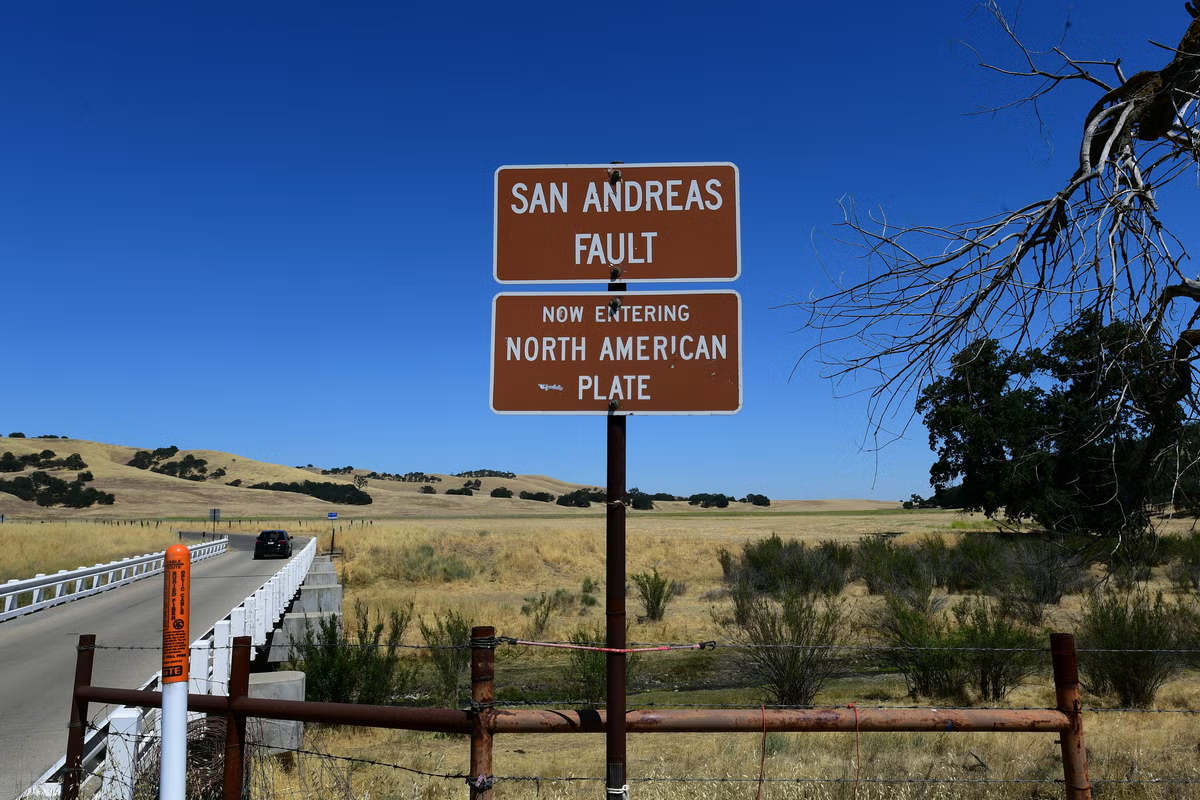
California’s blockbuster San Andreas Fault has reached its highest stress level in 1,000 years, University of Hawai’i researchers warn.
The 750-mile fault line has not produced a major earthquake in more than 160 years, when the 7.9-magnitude Fort Tejon earthquake ruptured 225 miles. The intertwined San Jacinto Fault, which is more active than San Andreas, is in a similar position, the researchers noted in a study published last week. It hasn’t seen a big quake since Christmas Day 1899.
The region’s inactivity has led to pressure building underground and the system is now “in a critically loaded state,” Liliane Burkhard, a research affiliate in the Hawaiʻi Institute of Geophysics and Planetology, explained in a statement.
“Our results show that stress levels on multiple fault segments are now at or above the highest values seen in the past millennium and that the region may be capable of a large through-going rupture involving both fault systems,” she said.
This is yet another sign that the next big one is coming for Californians; it’s just a matter of when.
Researchers also found the wildfire-riddled Cajon Pass, a mountain pass located between the San Gabriel and San Bernardino mountains, also plays a role in these earthquakes, the researchers said.
“We also found that Cajon Pass may act as an ‘earthquake gate’: sometimes blocking large ruptures from crossing between the faults, and sometimes allowing them to pass through and involve both systems in a single event,” said Burkhard.
It’s unclear why, but the consequences of allowing the quakes through could be dire.
The pass could lead to a simultaneous rupture of both faults, threatening cities with millions of residents, including Los Angeles, San Bernardino, Riverside and the Coachella Valley.
The researchers simulated the outcome of this stress using physics-based computer modeling.
They relied on 1,000 years of earthquake data, including tree-ring records and age-dating of displaced sediments in the area.
Based on these simulations alone, the researchers can’t predict when the next big one will occur — and earthquake prediction is not yet possible.
Still, they say their findings are important for emergency preparation efforts that could help save lives.
Scientists didn’t have this tech when the San Andreas Fault triggered the 1989 6.9-magnitude Loma Prieta earthquake in the San Francisco Bay Area, killing 63 people and leaving over thousands without homes.
That quake was not what the scientists considered to be a major rupture, striking at a 7.0 magnitude or higher.
There’s still a 50 percent chance or higher for one or more 7.0-magnitude quakes in the region in coming decades, California says.
“What we can say is that the system is critically stressed, and that physics-based models like this one give us a clearer picture of the range of scenarios we should be prepared for. That information matters for hazard assessments, infrastructure planning and emergency preparedness,” Burkhard said.
More details here...