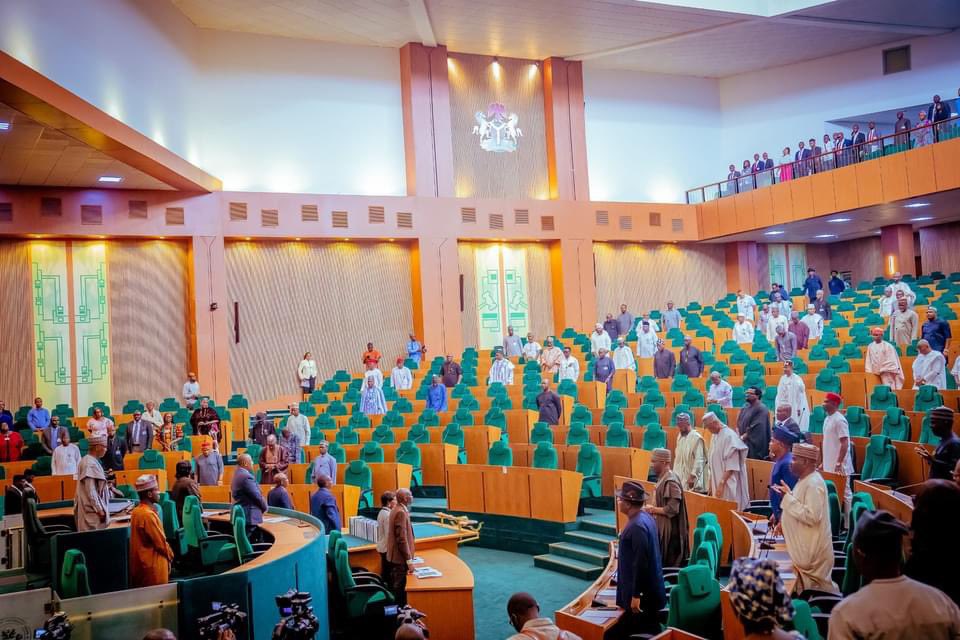
At the end of the voting process, 289 members supported the motion for state police, while four voted against it, effectively clearing the proposal for further legislative progression within the constitutional amendment process.
The House of Representatives has passed for further legislative action a bill seeking the establishment of state police, following a decisive voice vote during Thursday’s plenary.
The proposal, considered under HB 617, is part of the ongoing Constitution alteration process aimed at restructuring Nigeria’s security architecture in response to rising insecurity across the country, including terrorism, banditry, kidnapping and other violent crimes.
The session, presided over by Speaker Abbas Tajudeen, commenced with over 290 lawmakers in attendance.
The House Leader, Julius Ihonvbere, thereafter (APC, Edo), moved a motion for the House to suspend its rules to enable consideration of a motion on the rescission of an earlier decision relating to the presentation of reports by the Committee on Constitution Review.
The motion, seconded by the Minority Leader, Fred Agbedi (PDP, Bayelsa), was adopted.
The House later proceeded to the specific item on security reform.
Mr Tajudeen explained that the House would prioritise only the security-related amendment at this stage, describing it as urgent and necessary.
He said the decision was also influenced by the need to avoid further delay, noting that members would proceed on a two-week end-of-year recess afterwards to enable proper review of remaining bills upon resumption.
Midway into proceedings, the speaker announced that the electronic voting system was not functional, compelling lawmakers to adopt a manual voice vote.
The Deputy Speaker of the House, Benjamin Kalu, who doubles as the chairman of the Constitution Review Committee, in his presentation, described the bill as a response to Nigeria’s worsening security challenges.
He said the proposed reform was designed to decentralise policing and improve response time to security incidents by allowing states to establish their own police structures.
He argued that a centralised policing system, with command structures concentrated in Abuja, had slowed response times to emergencies. According to him, state police would enable officers who are familiar with local languages, geography and communities to respond more effectively to threats.
He urged lawmakers to treat the bill as a legacy reform that would strengthen national security beyond military intervention, stressing that it reflected a broad national consensus.
The speaker later ruled that the House would not consider the bill clause by clause but by its long title. He then read out the title, after which a manual count was conducted.
At the end of the voting process, 289 members supported the motion while four voted against it, effectively clearing the proposal for further legislative progression within the constitutional amendment process.
Following the consideration, the House passed the bill, marking a major step in the constitutional amendment process on state policing.
It, thereafter, adjourned sittings until 7 July to allow members to proceed on their end-of-legislative-year break and return to their constituencies.
The adjournment, according to Mr Tajudeen, is also to give lawmakers time to study the constitution amendment bills scheduled for consideration upon resumption.
With the House’s approval secured, the bill now moves to the Senate for concurrence. If approved by the upper chamber, it will be transmitted to the 36 state Houses of Assembly, where it must be endorsed by at least two-thirds of the states of the federation.
After securing state-level approval, the amendment will then be forwarded to the president for assent before it can become law.
One of the major provisions of the bill seeks to amend Section 214 of the 1999 Constitution to formally provide for the establishment of both the Federal Police and State Police. Under the proposal, the National Assembly will be responsible for defining the structure, organisation, administration and powers of the Federal Police, as well as setting the legal framework and minimum standards for the establishment and operation of state police services.
The bill further provides that no state police force shall commence operations unless it is established by a law passed by the relevant State House of Assembly and certified as meeting national minimum standards to be set by an Act of the National Assembly.
It also stipulates that until a state police structure becomes operational, the Federal Police will continue to exercise policing powers and responsibilities within such states.
To safeguard the autonomy of state police formations and prevent undue interference, the bill restricts federal intervention in state security affairs. The Federal Police may only intervene in cases of a total breakdown of law and order, upon request by a state governor, or where a state police force is unable to function due to administrative, financial or operational constraints.
The amendment also introduces changes to the appointment and command structure of the police.
Under the proposed amendment to Section 215, the Inspector-General of Police would be appointed by the President on the advice of the Nigeria Police Council from among serving officers of the Federal Police, subject to confirmation by the National Assembly.
Similarly, a State Commissioner of Police would be appointed by a state governor on the advice of the Nigeria Police Council from among serving officers of the State Police, subject to confirmation by the respective State House of Assembly.
The bill also empowers governors to issue lawful directives to State Commissioners of Police on matters relating to public safety and maintenance of law and order. However, where a commissioner considers such directives unlawful or inconsistent with established policing standards, the matter shall be referred to the Nigeria Police Council, whose decision shall be final.
Finally, the proposal amends Section 84 of the Constitution by replacing references to the “National Police Council and the Federal Police Service Commission” with the “Nigeria Police Council and the Police Service Commission.”