The deal has brought immediate relief to global markets, particularly oil, with crude prices falling as investors bet the risk of a wider regional conflict has receded. Leaders across the world have also welcomed the agreement as a step towards restoring stability in West Asia.
For India, it led to a marked upgrade in growth outlook for FY27; Citigroup revised India’s real GDP growth from the previous forecast of 6.6% to 6.9%
The Memorandum of Understanding, however, is only the beginning.
Several of the most contentious issues remain unresolved and are now set to move to the negotiating table. Here’s what the agreement achieved, what it didn’t, and what comes next:
Does the peace deal effectively end the war?
Not completely.
While the agreement is more than a ceasefire that will reopen the Strait of Hormuz, the most difficult issues have been deferred to future talks.
US and Iranian negotiators are due to meet in Switzerland on Friday, June 19 to begin discussions on implementing the agreement.
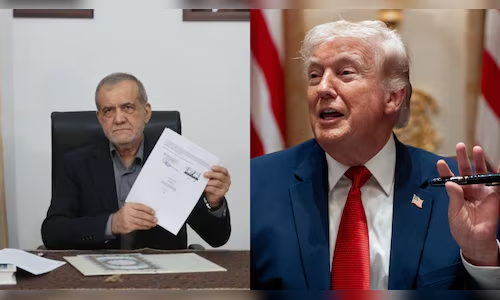
After the deal signing, the US floated an explicit threat of renewed military action. Both President Donald Trump and US Defence Secretary Pete Hegseth have warned that Washington is prepared to strike Iran again if Tehran violates the agreement.
So the Switzerland talks will be closely watched as the first real test of whether the war is truly ending or merely entering a pause.
Did Trump achieve the objectives he set out to achieve?
Not entirely.
The Trump administration entered the war seeking to prevent dangers to US interests and allies, mainly by stripping Iran of its nuclear ambitions.
However, the central dispute over Iran’s nuclear programme remains unresolved. The agreement postpones decisions on Tehran’s stockpile of near-bomb-grade uranium, one of the key issues from the beginning. Whether Trump ultimately achieves his most important strategic objective will depend on what emerges from the talks over the next 60 days.
What has the war changed in West Asia?
Analysts expect the war’s impact to outlast the fighting itself.
According to Philip H Gordon of Brookings, Iran emerges from the war with greater leverage over the Strait of Hormuz.
It has also raised questions about US influence in the region, with Gulf states likely to diversify their security partnerships rather than relying exclusively on Washington.
The war exposed divisions within the Gulf Cooperation Council and could complicate efforts to build a common regional security architecture.
It may also make Israel’s integration with Arab neighbours more difficult, potentially undermining one of the major goals of US regional policy in recent years.
Can the US and Iran turn this into a permanent peace agreement?
That remains uncertain.
Many analysts are sceptical that Washington and Tehran can reach a comprehensive settlement within the 60-day timeline outlined in the MoU.
As mentioned above, the interim agreement postponed the toughest issues. If negotiators can bridge those differences, the deal could evolve into a broader peace framework. If not, tensions could quickly return despite the current halt in fighting.
What did the US achieve militarily?
Despite the costs of the war, Washington can point to several battlefield successes, according to Brookings experts Caitlin Talmadge and Mara Karlin.
The US degraded Iran’s conventional military capabilities, damaged parts of its nuclear programme and managed to project military power into the region to a certain extent.
“The United States’ integrated air and missile defense regional architecture, developed over nearly 20 years, has also performed well, albeit at a high cost. No one can say that Iran has outright prevented the United States from projecting power into the region,” Talmadge and Karlin wrote.
However, it also exposed new vulnerabilities.
They note that while the US remained capable of operating in the region, it could no longer do so with the same freedom it enjoyed earlier in the region.
How did Iran change the way it fights the US?
One of the biggest lessons from the war is how Iran adapted its strategy.
Talmadge and Karlin argue that Tehran “went to school on the US way of war” and learned to target the foundations of American power projection rather than confronting US forces head-on.
Iran used missiles and drones to strike air bases, fuel depots, command facilities, airports, radars, and communications infrastructure across the region, disrupting military operations and forcing personnel relocations.
The campaign challenged a long-standing assumption that US bases in the West Asia enjoyed relative sanctuary from attack.
Iran’s Supreme Leader Ayatollah Mojtaba Khamenei did warn during the war that the region would no longer serve as “shields for American bases”. That message that appeared to shape Tehran’s military strategy throughout the war, experts note.