4 min readJun 9, 2026 05:22 PM IST
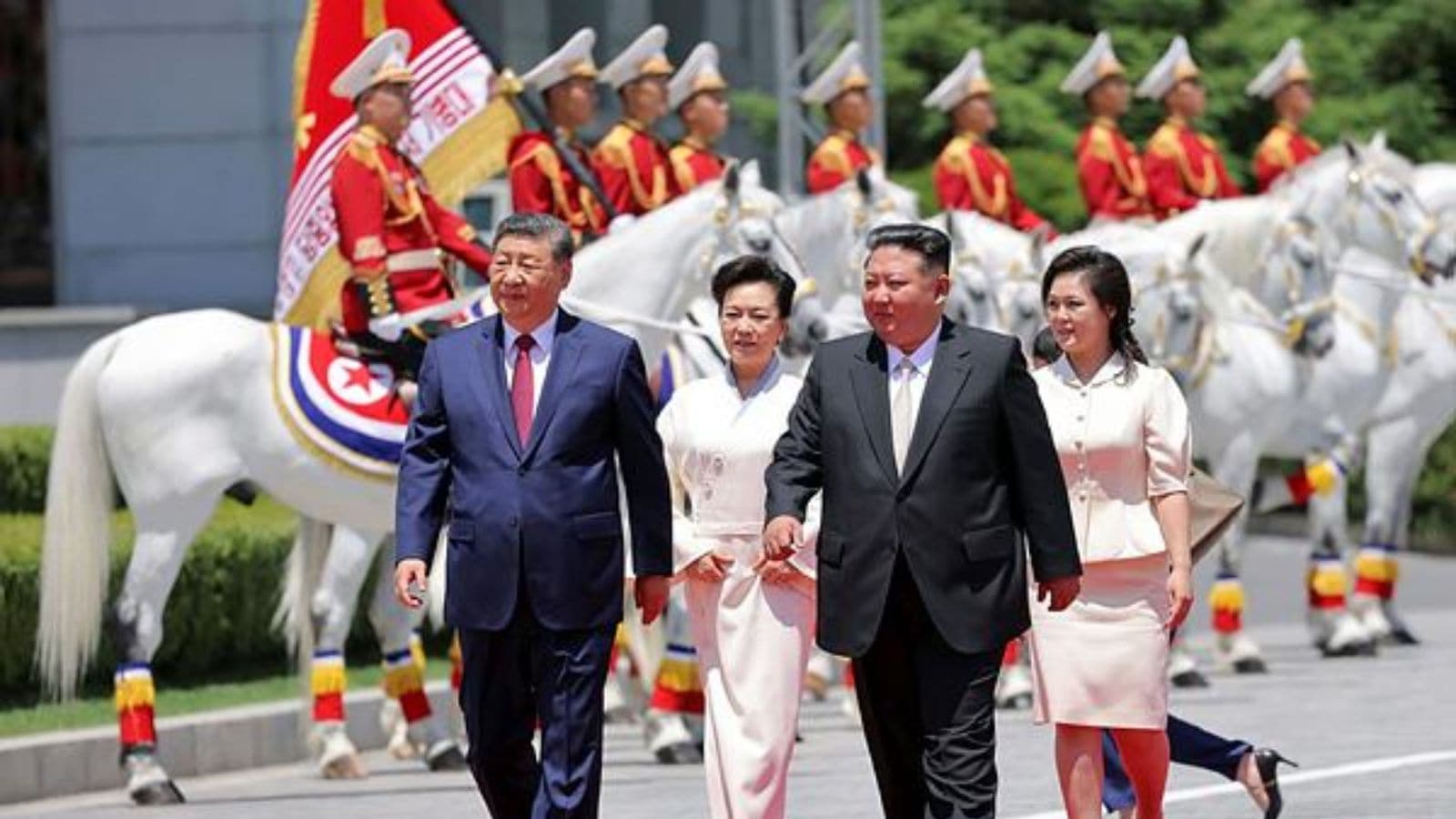
Chinese President Xi Jinping met North Korean leader Kim Jong Un in Pyongyang on Tuesday for the first time in seven years, with both sides agreeing to deepen cooperation – but making no mention of North Korea’s nuclear weapons programme.
What was agreed
North Korea’s official KCNA news agency said the two leaders agreed to expand cooperation across politics, economy, and culture, marking what it called a new chapter in bilateral ties. Xi told Kim he aimed to drive progress in relations, and both sides agreed to pursue closer strategic communication through high-level official visits.
Kim, in turn, told Xi that North Korea would fully support the “One China principle” – Beijing’s position that both sides of the Taiwan Strait belong to one country. China views democratically governed Taiwan as its own territory and has never ruled out the use of force to bring it under its control. Taipei rejects those claims.
Friendship Tower and a planted tree
On Tuesday, Xi visited the Sino-Korean Friendship Tower in Pyongyang, which commemorates Chinese soldiers killed in the Korean War. The two leaders also jointly planted a fir tree at a key political training school for dedicated members – a gesture China’s state news agency Xinhua described as symbolising “ever-renewing friendship.”
Xi and First Lady Peng Liyuan attended a performance of Chinese and North Korean songs, accompanied by Kim and his wife Ri Sol Ju, along with senior officials. Kim also hosted a banquet for Xi’s delegation, at which Xi expressed his desire to “share friendship” with Kim.
Xi said Chinese-North Korean relations had reached a “new historical starting point” at the event marking the 65th anniversary of the two countries’ friendship treaty.
Same summit, different messaging
Despite the display of goodwill, analysts noted that the two countries’ official summaries of the summit reflected different priorities.
Story continues below this ad
While Xinhua detailed proposals on high-level exchanges, trade, agriculture, and the restoration of transport links, KCNA framed the summit more broadly as a meeting between equal partners.
“North Korea removed elements that could make it look like a subordinate, dependent, or beneficiary party, and rewrote the relationship as one between equals,” said Hong Min, a senior research fellow at the Korea Institute for National Unification. “It amplified signals of solidarity, such as anti-US and Taiwan-related messages, while erasing signals of dependence or subordination,” according to Reuters.
Lim Eul-chul, a professor at South Korea’s Kyungnam University, said Pyongyang stressed regime dignity and the neighbours’ “special relationship.” At the same time, Beijing emphasised practical state-to-state ties and its vision for international order.
Nuclear question left unaddressed
North Korean state media made no mention of the country’s nuclear weapons programme or of relations with the United States in its account of the talks – a notable absence given the broader regional context.
Story continues below this ad
“The absence of such mentions suggests Beijing would like the visit cast in terms of the ties between the two countries,” said Ja Ian Chong, a political science professor at the National University of Singapore.
During his first term, US President Donald Trump met Kim three times in an unprecedented diplomatic effort that ultimately broke down over American demands that North Korea abandon its nuclear programme. Trump has since said he would be willing to restart talks.
“While it is highly likely that the leaders of China and North Korea would confer before Kim might meet Trump again, it is doubtful that Xi will serve as a catalyst for US-North Korea talks,” said Leif-Eric Easley, professor of international studies at Ewha Womans University in Seoul.
China is North Korea’s largest trade partner. Analysts had said ahead of the visit that Xi’s trip was likely to focus on trade and tourism. Xi was set to return to China on Tuesday afternoon.
(Inputs from Reuters)
Stay updated with the latest – Click here to follow us on Instagram