Tehran:
Barely two weeks after the United States and Iran signed a memorandum of understanding (MoU) to halt months of war in the Middle East, peace in the region is again hanging by a thread. Both sides have accused the other of violating the terms of the agreement to justify the weekend exchange of fire over the control of the Strait of Hormuz.
The interim MoU, signed by US President Donald Trump and Iranian President Masoud Pezeshkian on June 17, was intended to create space for negotiations on broader issues between Washington and Tehran, including sanctions relief and Iran’s nuclear programme.
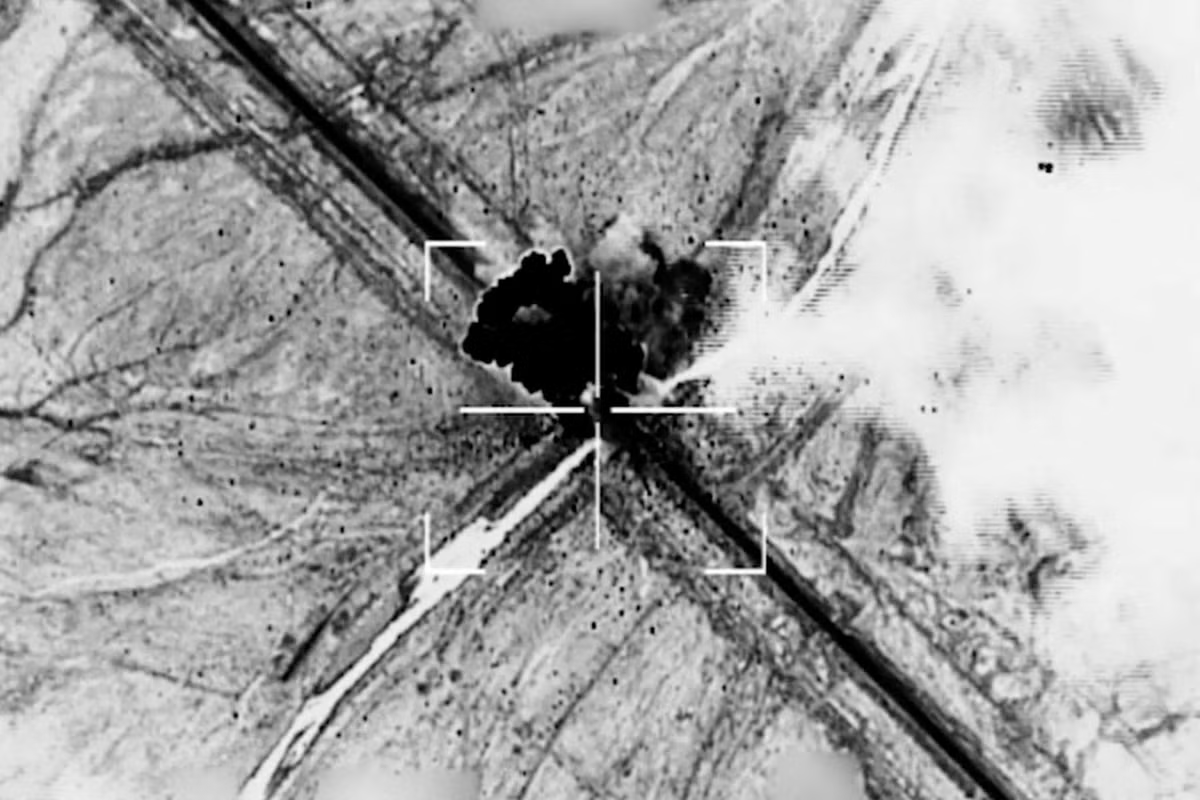
But both nations began a cycle of tit-for-tat strikes on Friday when a ship was hit by a projectile while trying to transit the Strait of Hormuz. The US military attacked Iran in response, although Tehran never claimed the attack. Since then, both sides have been blaming the other for violating Article 5 of the MoU, which calls for safe passage for commercial ships through the Strait of Hormuz.
What Is Article 5 Of The US-Iran MoU?
The fifth point of the US-Iran deal called for an agreement between the two sides over the reopening of the vital waterway and the immediate recommencement of commercial traffic. Shipping traffic through Hormuz, through which nearly 20 per cent of global oil supply passes in peacetime, has been disrupted since Tehran announced the blockade of the waterway shortly after the US-Iran war began on February 28.
Article 5 said, “Iran will make arrangements using its best efforts for the safe passage of commercial vessels with no charge for 60 days only from the Persian Gulf to the Sea of Oman and vice versa.”
It also called for the removal of “technical and military obstacles” and Iranian mines within 30 days.
The article further said that “Iran will conduct dialogue with the Sultanate of Oman to define the future administration and maritime services in the Strait of Hormuz in discussion with other Persian Gulf littoral states in line with the applicable international law and the sovereign rights of coastal states of the Strait of Hormuz.”
Why Two Sides Are Fighting Again
While both Tehran and Washington fundamentally support reopening the Strait of Hormuz, experts pointed out that the two sides interpret the terms of the MoU differently and disagree over how vessels should move through the waterway during the interim period and who should supervise those movements.
The strait has long been considered an international waterway despite its location in Iran and Oman’s territorial waters. But since the war started, Tehran has also used its chokehold on the narrow passage as geostrategic leverage.
Now, Washington is attempting to create alternative routes closer to the Omani side of the waterway. The US considers this southern route a safer option while maritime security conditions in the region remain unstable. The US wants navigation to go back to pre-war international shipping practices, allowing vessels to transit without being subjected to unilateral operational control by either party.
Iran, however, maintains that the MoU recognises its authority over operations within the Strait of Hormuz during the ongoing clearance process and insists that commercial traffic use the northern shipping corridor situated within Iranian territorial waters rather than shifting toward routes near Oman.
“The Strait of Hormuz remains under the total oversight and management of Iran through the 30 coming days, and after all obstacles are removed, the total capacity of the waterway will be restored. This is what we are working on,” Iranian Foreign Minister Abbas Araghchi said.
“This responsibility rests on the Islamic Republic of Iran. There is no other party or state in this respect. This is totally clear under the memorandum of understanding, and any intervention or any unilateral action will result in exacerbating the situation and also delay the reopening of the strait.”
What Experts Say
Talking to Al Jazeera, Hassan Ahmadian, an associate professor at the University of Tehran, claimed that Washington was going back on the deal it signed on June 15.
“The United States wants different arrangements in place as opposed to the MoU that it itself signed. What we see is the United States trying to find its way out of this memorandum of understanding while obliging Iran to its end of the terms,” he said.
He claimed that Washington has done the same in Lebanon by brokering a new framework agreement between Israel and the Lebanese government.
Wolfgang Pusztai, a Vienna-based defence analyst, however, claimed that it is Iran that insists on control of the Strait of Hormuz while the US and Arab states insist on the freedom of shipping through the waterway
“In order to underline its point of view, Iran has now twice attacked ships, and it doesn’t really come as a surprise that the US retaliated,” Pusztai told Al Jazeera.