Lanre Olagunju
On a rainy day somewhere in Nigeria, a photograph began circulating on social media.
In it, several police officers sat in the open back of a pick-up van. Rain poured heavily. Their uniforms were soaked. Their rifles were exposed to the elements. There were no visible raincoats. No protective cover. No comfort.
The image generated the usual reactions. Some expressed respect; a few mocked it. Others criticised the police
But hidden within that photograph was a deeper question.
What does it say about a nation when those entrusted with protecting lives are themselves exposed to such conditions?
And perhaps more importantly, what does it say about us when our first instinct is ridicule rather than reflection?
There is a Yoruba proverb that captures this contradiction perfectly:
“Alaaru t’on jẹ búrẹ́dì, ṣe awo orí ẹ l’ón jẹ́ ti kò mọ̀.”
Roughly translated, it means: “The labourer eating bread is actually chewing his own scalp, yet he does not realise it.”
The proverb speaks to people who fail to recognise that the things they mock, diminish or take for granted are often the very things sustaining them.
The relationship between Nigerians and the police increasingly resembles that proverb.
We criticise them. We ridicule them. We circulate their failures. We celebrate their embarrassment. Yet, when armed robbers strike, kidnappers invade communities, terrorists attack villages, or criminals threaten lives, it is still the police we call.
This is not an argument against criticism.
The police deserve scrutiny. Officers who abuse their powers deserve sanctions. Corruption must be confronted. Professionalism must remain non-negotiable, and impunity must end.
But two truths can exist at the same time.
The Nigeria Police Force is far from perfect.
And many Nigerian police officers are performing what can only be described as operational miracles.
Consider the realities.
Across vast parts of the country, officers are expected to confront terrorists, bandits, kidnappers and organised criminal networks that increasingly possess sophisticated weapons, communications systems and battlefield experience.
Yet many police personnel continue to operate with inadequate logistics, ageing equipment, insufficient welfare support and training models that were designed for a different era.
The security threats confronting Nigeria today are not the same threats the police were originally structured to combat.
Modern terrorists operating in parts of the North-West and North-East have received training from transnational extremist networks linked to groups such as ISIS and ISWAP. These are not merely disorganised criminals hiding in forests. Many possess military-style capabilities, tactical knowledge and access to advanced weaponry.
Yet in many cases, police officers are expected to confront these realities using training frameworks developed for conventional policing rather than modern asymmetric warfare.
Our police officers were never trained to become bush-combat hunters.
Many joined the force to investigate crimes, maintain public order and protect communities.
Today, some find themselves pursuing heavily armed insurgents across forests, mountains and remote terrain under conditions for which few police institutions around the world were originally designed.
And still they go.
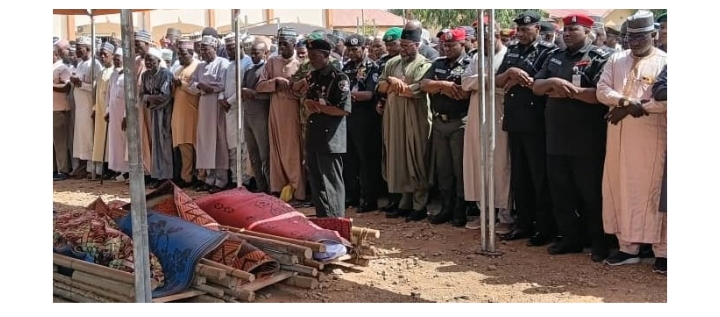
On 8 May this year, 17 police officers were killed when terrorists attacked the Nigerian Army Special Forces School in Buni Yadi, Yobe State.
The officers were undergoing specialised counter-terrorism training.
They did not die while extorting motorists at checkpoints.
They did not die while sitting behind office desks.
They died preparing to protect a country most of them would never become wealthy serving.
Just weeks later, three Explosive Ordnance Disposal officers lost their lives in Zamfara after their armoured vehicle struck an improvised explosive device during patrol operations.
Twenty officers.
Twenty families changed forever.
Twenty homes where wives, children, parents and siblings must now learn to live with absence.
Today, as the world marks International Widows’ Day, it is difficult not to think about those families.
Behind every fallen officer is a widow.
Behind every casualty notification is a child whose future has suddenly become more uncertain.
Behind every headline is a family making sacrifices most Nigerians will never fully see.
And tomorrow, despite these losses, thousands of their colleagues will put on the same uniforms and return to duty.
This is why the national conversation about policing requires greater maturity.
We must continue demanding accountability.
But we must also learn to appreciate sacrifice.
We must continue calling for reform.

But we must also support those carrying out the difficult work of keeping society safe.
A skilled furniture maker is judged by the quality of the furniture he produces. But even the most talented craftsman can only do so much with poor tools and inadequate raw materials.
Nigeria’s police officers are often expected to produce first-class results with conditions that would frustrate many professionals in other sectors.
The remarkable thing is not that they sometimes fall short.
The remarkable thing is how much they achieve despite those limitations.
The police are not separate from Nigerian society.
They are products of it.
They are our brothers, sisters, neighbours, children and friends.
Their failures reflect our national shortcomings.
But their courage reflects our national strengths too.
When they are shamed, a part of us is shamed.
When they are strengthened, all of us become safer.
That is why supporting the police should not be viewed as charity.
It is an investment in our collective security.
Because ultimately, the police we celebrate, neglect or ridicule today will determine the kind of society we live in tomorrow.
And perhaps the real lesson from that old Yoruba proverb is this:
The load on the labourer’s head may not look impressive from a distance.
But without it, there may be no bread at all.
Olagunju wrote in from Abuja.