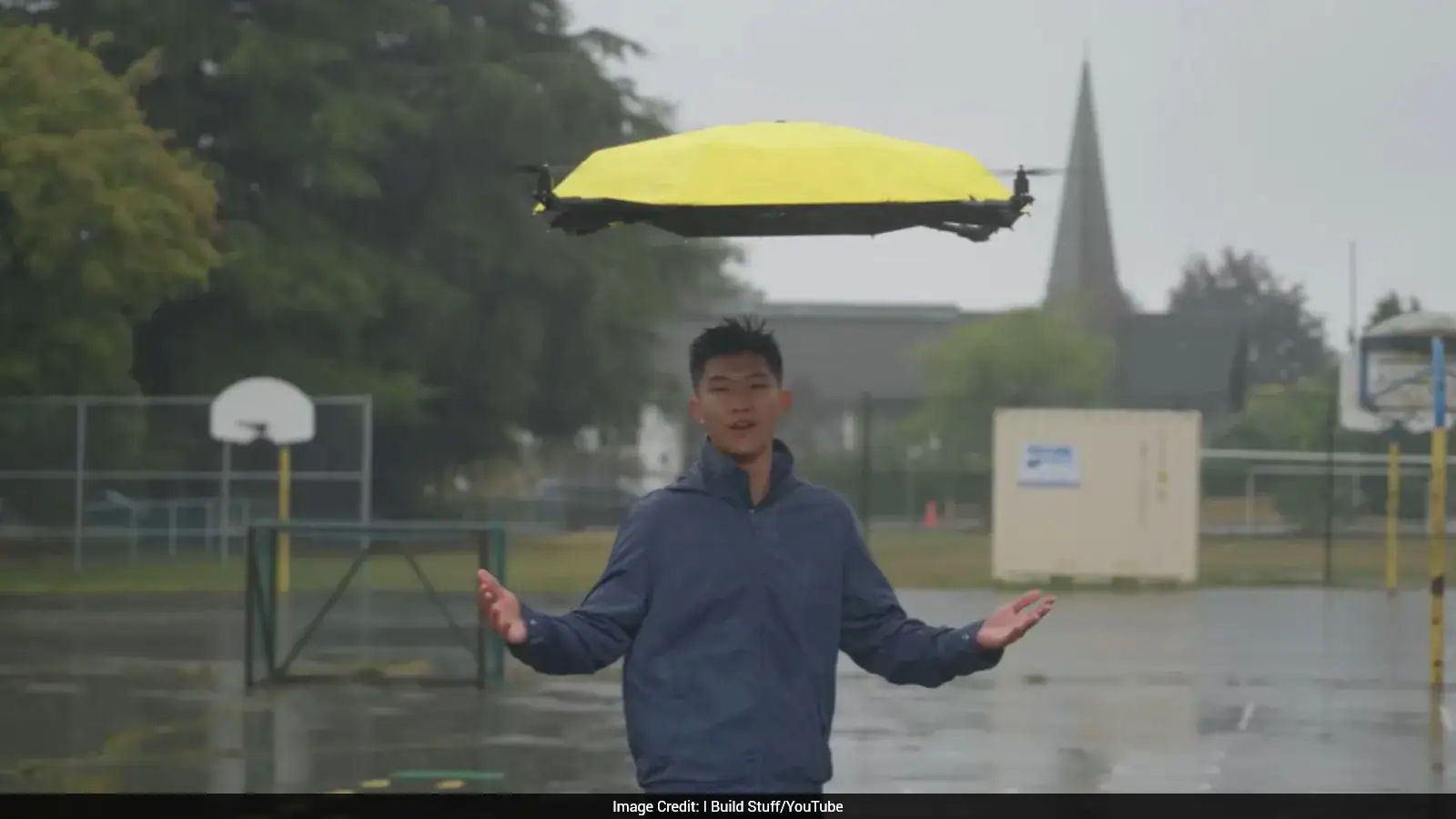
A video of a flying umbrella that appears to follow its user automatically is going viral again across social media platforms. Built by Canadian engineer John Tse, the device has drawn widespread attention for its unusual design and hands-free functionality. According to claims made in the video, the device is designed to shield users from both rain and sunlight without requiring them to hold an umbrella. Tse shared the video on his YouTube channel, I Build Stuff, where he showcased how the flying umbrella automatically follows a person while staying overhead.
The autonomous umbrella is an updated version of a remote-controlled model and is designed to keep users dry and cool as they move.
Although it looks like an ordinary yellow umbrella, the device is actually a drone built into a familiar design. Four propellers are mounted around the umbrella using a custom internal frame, providing lift and control similar to a quadcopter drone, reported Daily Bloom.
Watch Video Here:
According to Tse, one of the biggest design challenges was mounting the propellers. The umbrella’s centre rod was the only strong structural part, but attaching all the hardware there would have made it bulky and difficult to carry.
To solve this, he designed folding arms that hold each propeller. These arms fold inward when the umbrella is not in use and lock securely into place when opened. The locking mechanism uses hinges, rubber bands, and specially designed plates to minimise shaking and keep the structure stable during flight.
How It Tracks The User
The most significant feature of the project is its ability to hover and automatically follow a person. Instead of focusing only on flight, Tse wanted the umbrella to track its user without manual control.
He first built a smaller test drone to experiment safely before moving to the larger umbrella. The tracking system went through several versions using regular cameras, GPS, and eventually a time-of-flight depth camera.
The depth camera works by sending out light and measuring how it reflects back to create a three-dimensional depth image. This allows it to detect a person’s position even in low-light conditions.
A Raspberry Pi processes this depth data, identifies the user’s head position, and sends instructions to the controller, which continuously adjusts the umbrella’s position to keep it centred above the person.
Most of the umbrella’s structural components were produced using 3D printing and durable carbon-fibre nylon. The 3D-printed parts include precise hinges, locking mechanisms, and a central hub that connects the flying system to the umbrella. Inside the umbrella are the electronics that power the system, including a professional flight controller that keeps it balanced in the air and an embedded GPS that helps it maintain position outdoors.