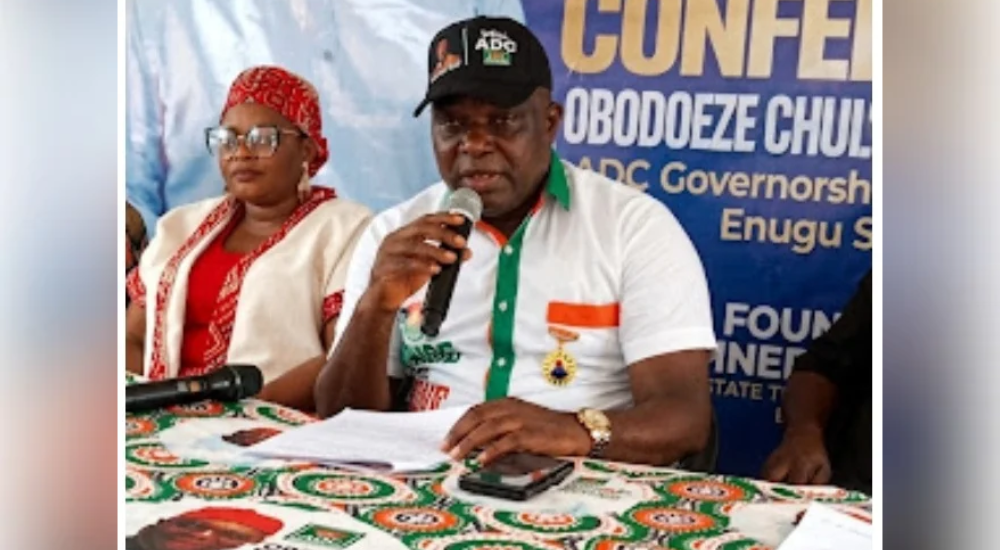
Ocho stated this when he addressed a press briefing where he unveiled his seven pillars agenda for the people of the state if elected. He said his administration would address all the agro-challenges to maximally harness the sector in the interest of the people.
In his words, “We have land and hardworking people. We have traders, artisans, farmers, teachers and young people full of energy. Our farmers produce but they lose a large part of what they produce after harvest because there are no processing, and storage facilities as well as guaranteed market. Our youths graduate, but there are no jobs. Our artisans and small business owners face rising cost of doing business, market levies and tickets while their incomes are not rising at the same rate.”
He said agriculture, which should be the state’s greatest wealth creator, had remained largely individual and unorganised, adding that “the farmer works alone; he buys inputs alone; he sells alone and loses alone.”
The economist said if elected, farming across the state would become a business and not business. He said he would establish an agricultural institute in Uzo-Uwani LGA for research. He also said he would introduce an agro-cooperative model where farmers would be registered in cooperatives and provided seedlings, fertilisers, grants and loans.
Quoting him, “Government will buy excess farm produce. If a farmer produces 500 tonnes and sells 200 tonnes, the government will store the remaining 300 tonnes through our food rank. No more post harvest losses. No more wasted labour. We will build the value chain. We will build an agro-marketing board, storage board and processing board; create agro-processing clusters so cassava, yam, rice and vegetables become finished products and jobs here in Enugu.”
He also pledged to revive the state coal sector through private investments and promote industrial parks and manufacturing.
Ocho also addressed how his administration would address insecurity bedevilling some rural communities in the state. Quoting him, “Ndi Enugu are being kidnapped in numbers, and ransoms are being paid; sometimes the victims are killed while the government sometimes visits bereaved families to commiserate with them. Condolences are not security; sympathy is not protection. Communities in Uzo-Uwani, Aninri, Udenu, Awgu, Igbo-Etiti and other border areas have faced repeated security challenges. Farmers are afraid to enter their farms. Villages are deserted at night. Travellers are anxious on Ugwuogo Road and other highways.”
He commended the establishment of a Command and Control Centre and CCTV cameras by the state government in fighting insecurity, noting however that “the devices do not cover rural areas”.
According to him, “Security has become largely top down. Cameras in the capital, but weak response on the ground; surveillance in urban centres, but villages and communities area abandoned. There is poor network coverage in rural communities where a distress call cannot even go through.”
He said his administration, if elected, would build an integrated security control centre with HD CCTV at flashpoints. “We will establish neighbourhood watch, community response teams and forest guards in all the 17 LGAs. Security must start from the community. We will create a security welfare and insurancey scheme life assurance, disability compensation, medical support for operatives and their families.”
He pledged to partner with telecom operators to expand network coverage to underserved communities “so that when a farmer is in distress, his call will go through. Under my administration, no farmer will be a prisoner on his own land.”