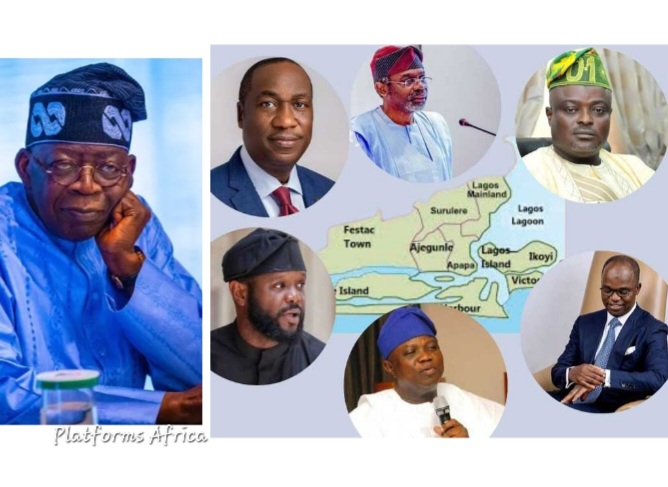
From Alausa to Marina, from the five Ibile Divisions to the 57 LGs and LCDAs, down to wards and grassroots structures thunders the familiar but profound question of Who wears the crown. Here are the names, profiles and chances of the contenders, but most importantly, the list and pedigrees of men and women who may pre-decide their fates, and by extension, the exact answer to the question on the lips of 25 million residents
Lagos is not merely governed—it is engineered and meticulously organised. A megacity of over 25 million people, the economic heartbeat of Nigeria, and arguably the most strategic sub- national political ecosystem in Africa.
As 2027 approaches, a familiar but profound question echoes across corridors of influence—from Alausa to Marina, from the five Ibile Divisions to the 57 LGs and LCDAs, down to wards and grassroots structures: Who wears the crown?
Yet Lagos does not answer loudly. It whispers. “Elections may be public, but power in Lagos is negotiated in private and through caucuses—long before ballots are cast.”
Before the consolidation of today’s political order, Lagos politics was shaped by structured caucuses that defined leadership selection. At the elite level stood the Primrose Group, a discreet but powerful screening body that assessed aspirants in the early 90s and late 1990s. It played a critical role in screening Bola Ahmed Tinubu for the Senate against political heavyweight Odu Onikosi, in what many described as a David-versus-Goliath contest. Tinubu emerged victorious.
Primrose also screened the 1998 governorship aspirants:
Bola Ahmed Tinubu
Wahab Dosunmu
Funsho Williams
The Primrose circle included:
Prince Tajudeen Olusi
Bushura Alebiosu
Mofutau Olatunji Hamzat
Alhaji Kola Oseni
Dapo Sarumi
Oyinlomo Danmole (the youngest member).
Notably, Mofutau Olatunji Hamzat, father of Kadri Obafemi Hamzat, chaired the screening process that produced Tinubu as the 1998 AD governorship candidate.
University of Abuja graduates 17,200, honours Odili, others
Tinubu inaugurates 720-capacity school in Lagos
Lagos unveils 10-day burial rites for Akran of Badagry
APC to PDP: Your allegations against AbdulRazaq over Saraki baseless
UNIZIK appoints journalist, five others as Directors
Alongside Primrose emerged two other critical blocs: Mandate Group — the grassroots mobilisation engine and Justice Forum — the stabilising and conflict-resolution bloc.
Together, they formed a strategic architecture:
Primrose — elite validation
Mandate Group — mass mobilisation
Justice Forum — internal balance and cohesion
From this convergence, Tinubu emerged—not by accident, but by design. “He was not elected into power—he was processed into leadership.”
Over time, these blocs evolved into a more formal structure—the Governor’s Advisory Council (GAC). President Bola Ahmed Tinubu did not create the GAC; he strengthened, harmonised, and institutionalised these legacy blocs into a central decision-making body.
“GAC is the institutional memory of Lagos politics.”Politics
THE DOCTRINE OF SUCCESSION IN LAGOS
Lagos has developed a predictable pattern of leadership transition:
Babatunde Fashola — technocratic consolidation
Akinwunmi Ambode — performance with political rupture
Babajide Sanwo-Olu — consensus restoration.
Each transition reinforces a central doctrine: “The primary is the battlefield. The structure is the judge. Consensus is the verdict.” And more fundamentally: “The candidate will always come from within.”
Zonal Map and Tinubu’s Kwara Vote in 2027: Lessons from the Past, By Nuhu Yahaya
Deaths, Disappearances of 10 US Scientists Stir Concern, Trump Orders Probe
‘NOUN For NYSC,’ NUC To Get Open Varsity Graduates Participate in Youth Service
Doctors Bicker As Crisis Rocks Lagos NMA
Poison In Your Plate: Nigeria’s Chicken and Eggs Scientists Say You Should Worry About
‘Grievous Crime,’ NSCDC Uncovers Lagos Factory Selling Newborns For N1m
At the centre of Lagos political architecture sits the Governor’s Advisory Council (GAC)—a body that does far more than advice.
Chairman: Prince Tajudeen Olusi
Key Members Include:
Babatunde Fashola
Femi Gbajabiamila
Mudashiru Obasa
Adeyemi Ikuforiji
Senator Anthony Adefuye
Tokunbo Abiru,
Musiliu Obanikoro
Oluremi Tinubu
Sarah Sosan
Idiat Adebule
Femi Pedro
James Faleke
Adeseye Ogunlewe
Demola Seriki
Adejoke Adefulire
Kadri Obafemi Hamzat.
Other Influential Figures Within the Structure:
Henry Ajomale
Ganiyu Solomon
Rabiu Oluwa
Muraina Taiwo
Abdul-Wahab Ogundele
Sunmi Odesanya
Kaoli Olusanya.
In addition, almost all former governors, deputy governors, senators, and selected members of the House of Representatives and Primrose, Mandate Group and justice forum are embedded within or aligned to the GAC structure.
“At critical moments, the GAC does not merely advise—it decides.”
The political history of Lagos has consistently demonstrated one principle: discipline within the system is non-negotiable. The experience of Akinwunmi Ambode remains instructive.Politics
“Performance alone is not enough—alignment with the structure is critical.” In Lagos: “No individual is bigger than the system.”
The 2027 governorship race is no longer speculative—it is crystallising into a layered contest of insiders, technocrats, institutional loyalists, and strategic actors. Beneath the surface, resumes are being weighed as much as relationships; pedigree is being measured alongside perception.
Key Aspirants Include:
Kadri Obafemi Hamzat — Deputy Governor; perhaps the most deeply embedded institutional actor in the race. A technocrat with academic depth and governance continuity credentials. Notably headhunted from the United States banking sector by Bola Ahmed Tinubu, his return to public service reflects longstanding trust. His father, Mofutau Olatunji Hamzat, chaired the screening process that produced Tinubu in 1998—placing him at the intersection of legacy and continuity.
Femi Gbajabiamila — Chief of Staff to the President; former Speaker of the House of Representatives. A consummate legislator with vast national reach, elite networks, and deep understanding of federal power dynamics. Bridges Lagos structure with Abuja influence seamlessly.
Tokunbo Abiru — Senator; former Managing Director in the banking sector. Represents fiscal discipline, financial system credibility, and investor reassurance. A technocrat-politician hybrid with strong appeal to the private sector and global investors.
Tokunbo Wahab — Commissioner for Environment. A bold regulator and reformist voice, known for enforcing urban order and environmental compliance. Project decisiveness, discipline, and administrative courage.
Mudashiru Obasa — Long-serving Speaker of the Lagos State House of Assembly. A master of grassroots politics with deep control of legislative structures and ward-level mobilisation. Represents structure from the ground up.
Olajide Adediran (Jandor) — Media entrepreneur and political mobiliser. Built his base through grassroots engagement and alternative political messaging. Represents outsider energy attempting to penetrate a deeply structured system.Politics
Akinwunmi Ambode — Former governor; technocrat with a proven governance record. His tenure still resonates in infrastructure and public sector efficiency. Carries a redemption narrative, but must reconcile history with structure.
Mojisola Lasbat Meranda — Legislative figure and symbol of gender inclusion. Represents institutional evolution and the expanding role of women in Lagos power architecture.
Kayode Egbetokun (speculative) — Security chief; represents discipline, order, and enforcement capability. A potential “stability candidate” in uncertain times.
Samuel Ajose (speculative) — Former Head of Service; experienced bureaucratic strategist with deep knowledge of Lagos governance machinery. Represents administrative continuity and institutional memory.
Tayo Ayinde (speculative) — Long-serving Chief of Staff in Lagos; a quiet but powerful insider with proximity to executive decision-making and operational governance.
“Some are building alliances. Others are building acceptance. A few are building inevitability.”
Beyond ambition, the Lagos APC operates a strict, unwritten checklist for candidate selection:
Proven Loyalty to the Party
A party defector stands little chance
Product of the System
The candidate must come from within
Alignment with the Lagos Master Plan
Continuity over disruption
Investor Confidence
Lagos cannot risk economic instability
Political Discipline and Temperament
Arrogance and lawlessness disqualifies.
Ibile Balance and Broad Acceptability
Zonal sensitivity remains critical
Ability to Work with the Structure
Collaboration over confrontation.
Presidential Trust Factor
National confidence is key—but not absolute.
Electoral Value and Grassroots Reach
Structure must meet the street.
Importantly, this will not be a solo decision.
A former, widely respected governor and former minister is expected to play a critical role as the eyes and ears of the President in determining the most suitable candidate.
A reliable source revealed that the President held a private meeting with this former governor and minister in Lagos during the Easter break—signalling early alignment consultations ahead of 2027.
Quiet political movements are already unfolding beneath the surface. There are strong rumours that:Politics
One top aspirant is in talks with the ADC to fly their flag
Another is exploring alignment with the Accord Party
“Those who sense resistance within the structure begin to shop for alternatives.”
‘Preeminently Qualified;’ Omupo People Seek First Class Status For Olomu
Ripples Beyond Movements: Ate’lè Fest; A Spotlight On Dance, Culture, Community Impact
‘Not Bible, Not Qur’an;’ Juju Is Source Of My Success – Saheed Osupa
‘Do This, Don’t Do That;’ Nigeria Warns Citizens In S’Africa Over Igbo King Protest
Concensus: Inside The APC Meeting That Ratified Hamzat, Yayi, Alli
Beyond party alignments, another layer of activity is emerging.
It is widely whispered in political circles that: Some bank accounts of PR operatives, journalists, and lobbyists have begun to quietly interface with key GAC members. Certain aspirants are already patronising columnists to shape favourable narratives.
Billions of naira have allegedly been earmarked for lobbying, influence, and perception management.
A reliable source suggests that the real contest has already begun—not on the ballot, but in boardrooms, private residences, and media corridors and newsrooms.

Yet history cautions: “Breaking away from the Lagos APC structure rarely guarantees victory.”
Five decisive variables will ultimately determine the outcome:
GAC consensus
Presidential trust (shared, not unilateral)
Party loyalty
Economic confidence
Public acceptability.
Notably, the private sector remains a critical stakeholder. Lagos, as Africa’s commercial nerve centre, cannot afford political uncertainty that threatens capital flow. Investors—local and international—are watching closely.
The international community is equally attentive. Lagos is no ordinary state—it is a golden economic enclave, a city of compounding value and strategic global interest.
The Presidency too cannot be indifferent—notwithstanding that Lagos is its political base. Stability in Lagos is stability in the broader national equation.Politics
Lagos does not gamble with leadership. It engineers and groomed it. No emergency leader in Lagos.
From Primrose…
To Mandate…
To Justice Forum…
To GAC…
The philosophy remains unchanged: “Power in Lagos is not taken. It is processed.”
As 2027 approaches, one truth stands firm: The crown will not go to the loudest. It will not go to the most desperate. It will not go to ambition alone. It will go to the most acceptable aspirant.
And in Lagos: “Acceptability is not declared. It is decided by all the variables and joint gatekeepers before the general public casts their votes.”
Politics, in the end, remains a temple of many tendencies: The good, the bad, the pretenders, and the presumed righteous.
All contending for one crown. May the best man win.
. Prince Adeyemi Shonibare, an integrated marketing consultant, writes from Lagos
NOP NIGERIA