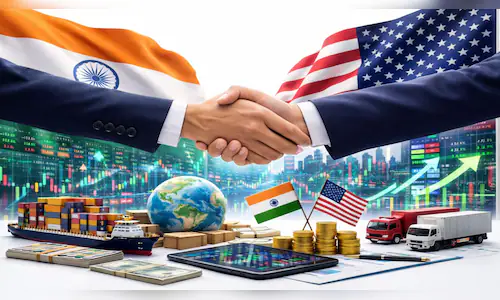
The Donald Trump administration has already begun refunding tariffs after the court deemed the earlier regime illegal, following a March order by the US Court of International Trade to return over $160 billion to importers. Indian exporters are expected to claim as much as $12 billion, with more than 300,000 traders likely to file for refunds, even as the claims portal briefly crashed amid a surge in applications. The development comes alongside ongoing India-US trade talks.
Shankar said the earlier understanding between India and the US had been based on differentiated tariffs, which gave India a marginal advantage over other developing economies. “Now that those tariffs have been struck down by the Supreme Court, there is a different situation where everybody has a 10% universal tariff,” she noted, adding that accepting the old framework would leave India at a “relative disadvantage of quite significant proportions”.
She said Indian negotiators are making the case in Washington that there is little justification for action under Section 301 of US trade law. “There is really not a case for trade investigations against India… there really isn’t any excess capacity that India has built specifically for exports,” she said, underlining that Indian exports do not materially threaten US domestic production.
Former WTO ambassador Jayant Dasgupta pointed to parallel US investigations into forced labour and excess manufacturing capacity as key pressure points in the negotiations. He said these probes, which cover sectors such as engineering goods, textiles and leather, could complicate India’s position.
“The chances of us getting slapped with tariffs, if we do not sign the agreement that the US has been asking us to sign, are quite high,” Dasgupta said, adding that several countries are facing similar scrutiny. Around 16 countries have been flagged for excess capacity and nearly 60 for forced labour concerns, he noted.
Dasgupta argued that these actions are being used strategically by Washington. “The US is basically using these two actions as a means of pressuring countries to come and sign trade agreements,” he said, referring to the broader push for new trade deals following the collapse of the earlier tariff framework.
He added that India is seeking a fresh starting point in negotiations, with an emphasis on reciprocity. “We want to start on a new footing and have a deal that is mutually beneficial, balanced and equitable,” he said, echoing recent remarks by Commerce Minister Piyush Goyal.
On sectoral concerns, Dasgupta downplayed the impact of recent US tariffs on pharmaceutical imports, including the 100% duty on certain branded drugs. He said Indian exports are largely insulated as they are dominated by generics. Only a small number of companies exporting patented medicines are likely to be affected.
Also Read | India-US trade deal first tranche almost finalised; focus on preferential access: Goyal
Shankar also flagged uncertainty around India’s imports of Russian oil, another issue raised by Washington. She noted that temporary waivers linked to the West Asia crisis have enabled continued imports, but the outlook remains unclear. “We do not know what will happen,” she said, pointing to signals from US Treasury officials that the waiver may not be extended.
She added that disruptions in the Strait of Hormuz and broader geopolitical tensions could keep the waiver in place to avoid a spike in global energy prices. At the same time, she said India could explore sourcing from Russian suppliers not directly under US sanctions, though with caution as the situation evolves.
With tariff refunds underway and trade negotiations intensifying, both diplomats suggested that the post-ruling reset has created a more complex but also more negotiable landscape for India, where outcomes will hinge on how effectively New Delhi leverages the shifting policy environment.