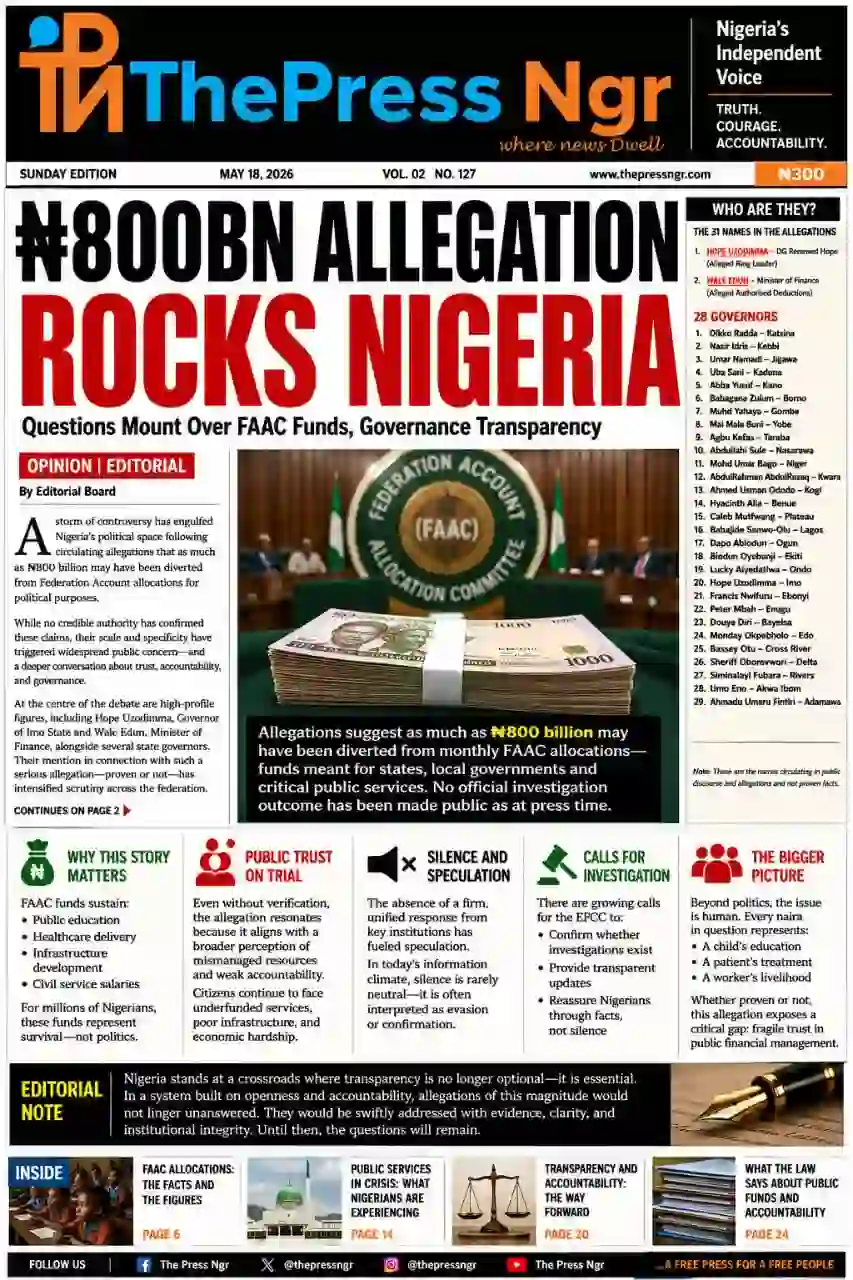
In recent days, a deeply troubling allegation has circulated within Nigeria’s political and media space claims that a group of governors, alongside key federal figures, may have collectively diverted as much as ₦800 billion from Federation Account allocations for political purposes.
Let’s be clear: these claims remain unproven and unverified by credible authorities. No court ruling, official audit, or confirmed investigation has established them as fact. Yet, the mere scale and specificity of the allegation demand serious reflection.
At the center of the conversation are prominent political figures, including Hope Uzodimma and Wale Edun, as well as several state governors across the federation. Their inclusion in such a narrative, whether accurate or not, speaks to a deeper issue: a growing crisis of trust between citizens and those in power.
Why This Allegation Resonates So Strongly
The reason many Nigerians are paying attention is not necessarily because the claim has been proven, but because it feels plausible within an existing pattern of governance concerns.
The Federation Account Allocation Committee (FAAC) is not an abstract institution. It is the financial backbone of Nigeria’s federal system. Every naira distributed through FAAC is meant to fund:
Public schools
Healthcare systems
Infrastructure projects
Salaries for civil servants
When citizens hear that such funds may have been redirected rightly or wrongly, it strikes at the heart of daily struggles: unpaid wages, dilapidated roads, underfunded hospitals, and rising poverty.
The Real Issue: Accountability and Transparency
Even if this specific allegation turns out to be exaggerated or false, it exposes a fundamental problem: the opacity surrounding public finance management in Nigeria.
Why is it so easy for such a story to gain traction?
Many Nigerians do not have clear visibility into how FAAC funds are spent
State budgets are often poorly communicated or inconsistently implemented
There is limited real-time accountability for public officials
Silence and Public Perception
Another factor fueling the controversy is the perceived lack of strong, coordinated responses from key institutions. In the absence of clear, transparent communication, public silence is often interpreted as confirmation, whether fairly or not.
This is where leadership matters most not just in governance, but in public accountability and communication.
A Call for Institutional Response
Rather than dismissing such allegations outright or allowing them to fester in the rumour mill, this moment presents an opportunity for action:
The Economic and Financial Crimes Commission (EFCC) should clarify whether any investigation exists
Independent auditors and civil society groups should demand greater transparency in FAAC disbursement and usage
State governments should proactively publish detailed, accessible accounts of their spending
At the core of this debate are ordinary Nigerians:
Teachers waiting for salaries
Patients relying on underfunded hospitals
Young graduates facing unemployment
Whether or not this ₦800 billion allegation is ultimately substantiated, the anger it has generated reflects real hardship and real frustration.
Final Thought
Nigeria does not just need to prove or disprove this particular claim. It needs to address the deeper issue it reveals: a deficit of trust.
In a system where transparency is strong and accountability is visible, allegations like this would be quickly tested, verified, or dismissed with evidence.
Until then, stories like this, true or not, will continue to find fertile ground.